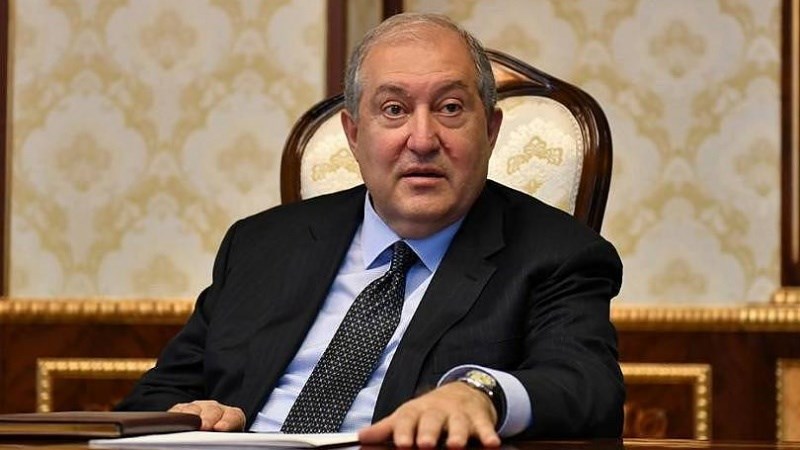
The President of the Republic of Armenia, Armen Sarkissian, has submitted his resignation.
The President issued a statement on the matter, in which he said, in part:
At the beginning of the 1990s, as a result of major geopolitical changes, our people were given the greatest opportunity to create their independent state. Our mission was not to replace one flag with another, but to build a country that, after centuries, would once again ensure the security, progress and prosperity of Armenians.
I emphasise: the fundamental meaning of the existence of an independent state is the ability to assume and bear responsibility, when we realise that we alone, as one unified body, are the makers of our own victories and the authors of our own defeats.
Inspired by such a historic opportunity, I, like many of my compatriots, devoted myself to that mission. For various reasons, the intensity of my participation changed at one stage or another, but I never ceased to believe in our ultimate nationwide success. And that was my main motive for agreeing to the offer to assume the office of President of Armenia.
In accepting that important decision, I was guided by the offer made to me, according to which the new presidential institution was to have the tools and opportunities to influence foreign and economic policy, investment policy, relations with the Diaspora, as well as to advance nationwide interests on the international stage and to shape a new scientific, educational and high-tech environment.
Some time later, the events of April-May 2018 took place…
A question may arise: why did I not resign at that moment? The answer is obvious: because of the responsibility I had taken upon myself in assuming the office of President of the Republic. I was obliged to do everything in my power to preclude the further deepening of internal division and possible clashes, which could have led to extremely negative consequences. I also sought to put at the service of building a strong and stable statehood the authority, connections and my international political and economic potential acquired through my many years of work.
Again, a question may arise as to why the President could not influence the political events that brought us to the present nationwide crisis. The reason is again obvious: the lack of appropriate tools — tools with which any state official is endowed exclusively by one document: the Constitution. The roots of some of our important problems are hidden in the very current Basic Law.
We have a paradoxical situation, when the President is forced to be the guarantor of statehood while in fact having no real tools. The Constitution also presupposes the supremacy of one institution over another, creates obstacles for well-known Diaspora specialists to participate in the governance of the state institutions of the historic Homeland, and so on.
We are a parliamentary republic in form, but not in substance. The meaning and purpose of my proposal was not to move from one form of governance to another (from parliamentary to semi-presidential or presidential), but to create a state system based on checks and balances. Without that, it is difficult to speak of significant achievements, since progress and success can be attained only under conditions of a predictable and harmonious system.
I am glad that a commission on constitutional changes has been established, for which I thank the government. I hope that, ultimately, the constitutional changes will take place, and that the next president and the presidential institution will be able to work in a more balanced and coordinated environment.
We live in a peculiar reality — a reality where the President cannot influence questions relating to war and peace.
A reality where he cannot apply a veto to laws that he considers inexpedient for the state and the people.
A reality where the President’s capabilities are perceived not as an advantage for the state, but are viewed by various political groups as a danger threatening them.
A reality where the President cannot use the predominant part of his potential in favour of resolving systemic internal and external political problems.
A reality where the world is in a zone of permanent turmoil, yet the President has no constitutional tool to help his country.
A reality where the head of state and sometimes also his family become targets of various political groupings. The latter are not so much interested in the achievements realised by the presidential institution in favour of the country, as in my past, various conspiracy theories and myths. That “concern” towards my person also goes beyond the bounds of morality, with the final result of directly and negatively affecting my health.
I have thought for a very long time and have decided, after working actively for nearly four years, to resign from the office of President of the Republic.
That decision is absolutely not emotional and stems from a certain logic.
The President does not have the necessary tools to influence the radical processes of internal and external policy during the present difficult times for the country and the nation.
At this difficult stage for our state, when nationwide unity is necessary, the presidential institution should not become a target of gossip and conspiracy theories, thereby diverting the attention of society from the most important issues.
Today, more than ever, meaningful, deeply considered, weighed and substantive actions are necessary. Otherwise, we — the Armenians of the whole world — will not attain the goal of our mission and will find ourselves on the margins of history.
We no longer have the right to err.
In conclusion, I wish to express special gratitude to our citizens and to our compatriots in the Diaspora for demonstrating steadfastness, endurance, patience and courage during these difficult times for the country.
Special thanks to the soldiers and officers of our valiant army, and my reverence to the families of the heroes who sacrificed their lives for our Homeland.
I am also grateful to all the staff of the Office of the President of the Republic and to my colleagues in state structures for our joint effective work.