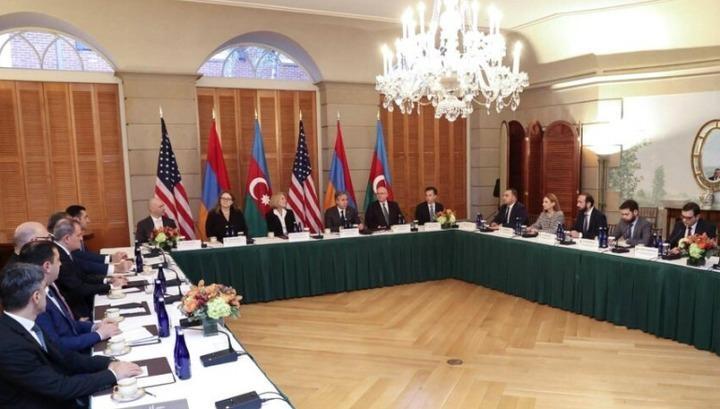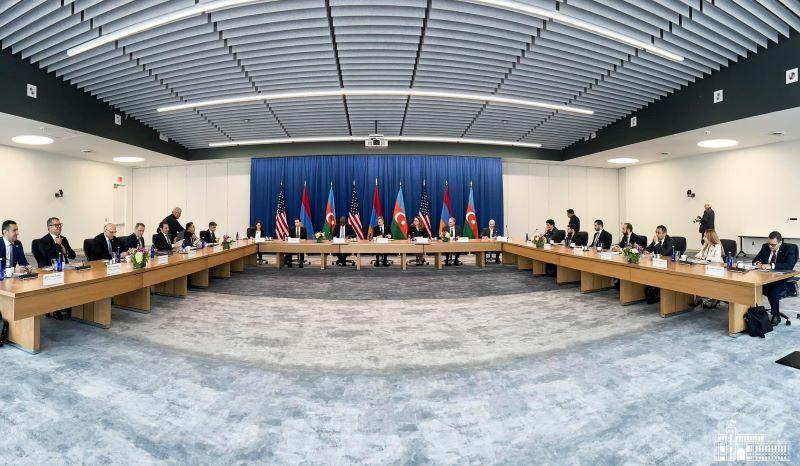
Negotiations between the foreign ministers of Armenia and Azerbaijan, mediated by the United States, have begun in Washington over a document titled “Agreement on the Normalization of Relations.” Senior U.S. diplomats provided details from the negotiations. This was reported by Voice of America.
The foreign ministers of Armenia and Azerbaijan will hold a series of successive meetings during this week, senior officials of the U.S. State Department said during a telephone briefing with journalists. The discussions between the parties, which began this morning, are proceeding constructively, said Louis Bono, senior adviser for Caucasus negotiations at the State Department.
According to senior diplomats, the United States is committed to contributing to a peaceful, democratic and prosperous future for the South Caucasus region, and direct dialogue is the only path to resolving problems and achieving lasting peace, which Washington is facilitating.
The negotiations are taking place at the George Shultz National Foreign Affairs Training Center, located near the capital, Washington. This morning, U.S. Secretary of State Antony Blinken had already hosted Foreign Ministers Mirzoyan and Bayramov, first in brief separate meetings and then in a trilateral discussion format.
The American side expressed disappointment over Moscow’s negative reaction to the negotiations. The most important thing is that the parties are able to communicate with each other, wherever that takes place — Washington, Brussels or Moscow, the senior diplomats noted, emphasizing that Washington’s goal is to provide a platform for achieving a lasting, balanced and dignified peace.
According to Bono, the Munich meeting made evident that the parties are committed to the peace process, which Bono describes as very complex and comprehensive. The document under discussion bears the name “Agreement on the Normalization of Relations.” Bono stated that the United States seeks for the parties to normalize their relations, be able to live together, strengthen economic ties and even their collective security in the region. This is a complex and comprehensive process, within the framework of which all issues are discussed, he said.
According to the State Department representative, one of the issues discussed between the parties in the negotiations over the comprehensive agreement is the treatment of ethnic minorities in both countries, which touches upon the rights and security of ethnic minorities.
Speaking about the Lachin corridor, the American side reaffirmed that Washington has very clearly pointed out over the past several months the importance of ensuring free commercial and humanitarian movement through the Lachin corridor, and remains engaged in those discussions, expecting that movement through the corridor will soon be restored.
U.S. Deputy Assistant Secretary Erica Olson also expressed hope that the parties will hold “direct and candid” discussions during this week to reach a resolution of the issue. We are committed to supporting that process and are honored to host this important dialogue here, which may continue, the Deputy Assistant Secretary emphasized, underscoring the ongoing nature of the negotiations.