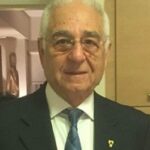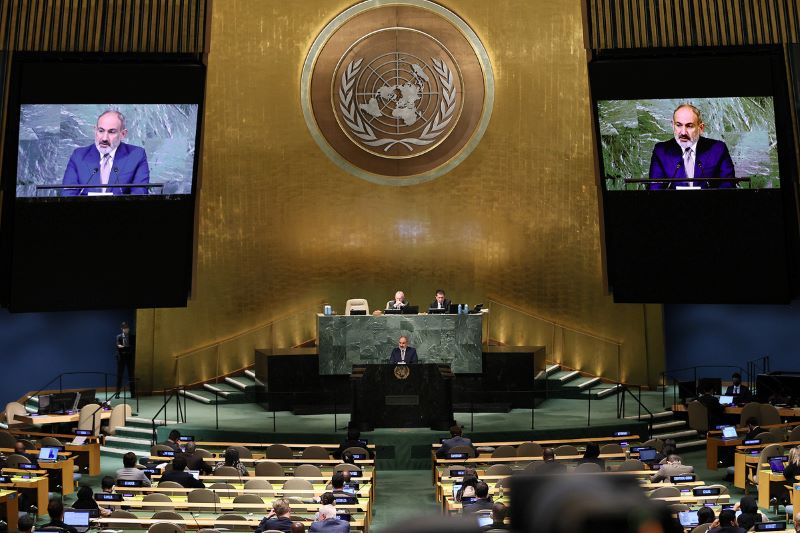
Within the framework of his working visit to New York, Prime Minister Nikol Pashinyan delivered a speech at the 77th session of the UN General Assembly at the UN headquarters.
The press service of the Government of the Republic of Armenia presents the full text of the Armenian Prime Minister’s speech.
“Mr. President,
Excellencies,
Ladies and gentlemen,
It is an honour for me to return to the General Assembly, although I would have wished to be here with a more positive message, given all the challenges and difficulties the world has gone through over the past few years.
But my speech will focus on Azerbaijan’s latest unprovoked aggression against the sovereign territory of the Republic of Armenia and its overall impact on the stability of the South Caucasus.
On September 13, Azerbaijan launched an unprovoked and unjustified military attack against Armenia. Using heavy artillery, multiple launch rocket systems and combat drones, the Azerbaijani armed forces shelled 36 residential areas and communities deep in the sovereign territory of Armenia, including Goris, Jermuk, Vardenis, Kapan and Geghamasar. This was not a border clash; it was a direct, undeniable attack on Armenia’s sovereignty and territorial integrity, which was condemned and addressed during and beyond the recent sessions of the UN Security Council.
The Azerbaijani attack deliberately targeted the civilian population and vital civilian infrastructure. Jermuk is one of Armenia’s main health resort and tourist destinations, and now, as a result of the Azerbaijani attack, all hotels, health resorts and recreation centres in Jermuk are closed. All residents of this town have been displaced. The total number of temporarily displaced persons from Armenia’s Gegharkunik, Vayots Dzor and Syunik provinces exceeds 7,600 people, mainly women and elderly, including 1,437 children and 99 persons with disabilities.
Around 192 houses, 3 hotels, 2 schools and 1 medical facility have been partially or completely destroyed. Seven electrical infrastructures, 5 water infrastructures, 3 gas pipelines and 1 bridge have been damaged. Two ambulances and 4 private vehicles were shelled. The Kechut reservoir was targeted and shelled. Journalists and ambulances were also targeted during the attack.
As a result of the attack, the number of dead and missing currently exceeds 207, of whom 3 of the dead and 2 of the missing are civilians. 293 servicemen and 8 civilians have been wounded, and at least 20 servicemen have been taken prisoner. There is evidence of numerous cases of torture and mutilation of captured or already dead servicemen, extrajudicial killings, cruel treatment of Armenian prisoners of war, as well as degrading treatment of corpses. The bodies of Armenian female servicemen were mutilated with particular cruelty and then ‘proudly’ filmed by Azerbaijani servicemen. Videos of such horrific war crimes and crimes against humanity are being circulated and praised on Azerbaijani social networks by individual users.
Undoubtedly, such unspeakable atrocities are the direct result of a decades-long policy by the political leadership of sowing anti-Armenian hatred and enmity in Azerbaijani society.
Parallel to this attack, the official discourse and other sources of information suggest that Azerbaijan intends to seize other territories of Armenia, which must be prevented. I want to stress that the risk of a new attack by Azerbaijan remains very high, especially given that Azerbaijan violates the ceasefire every day, and the number of dead and wounded may change at any moment. Another cause of further escalation could be the inadequate response of regional security organisations to this situation, which has raised serious questions in Armenian society.
Ladies and gentlemen,
Despite the aforementioned facts, Azerbaijan is trying to present itself as a country striving for peace in our region, for peace with Armenia. Listening from the side to what Azerbaijan says, you might even be impressed by its commitment to peace efforts. And to create such an impression, Azerbaijan uses the themes of a peace treaty with Armenia, the delimitation of borders, and the agenda of opening regional communications.
Why do we not have tangible progress in these directions? The reason is very simple. Azerbaijan uses all those themes for territorial claims against Armenia. For example, one of the most important points of the peace treaty is the mutual recognition of territorial integrity between Armenia and Azerbaijan. We have already stated that we are ready to do so, but Azerbaijan has not done so so far. On the contrary, Azerbaijan publicly claims that the entire south and east of Armenia, even the capital Yerevan, is Azerbaijani land. On the other hand, Azerbaijan keeps tangible territories of Armenia under occupation, and, as I said, the risk of a new attack by Azerbaijan remains very high.
In this regard, I am addressing an official and public question to the President of Azerbaijan: can you show the map of Armenia that you recognize or are ready to recognize as the Republic of Armenia? Why am I asking this? Because it may turn out that, in the view of official Azerbaijan, only half or less of Armenia’s territory is the Republic of Armenia. If Azerbaijan recognizes the territorial integrity of Armenia, not theoretically but concretely — I mean the integrity of our internationally recognized territory of 29,800 square kilometres — it will mean that we can sign a peace treaty by mutually recognizing each other’s territorial integrity. Otherwise, we will have a fictitious peace treaty, and afterwards Azerbaijan will use the border delimitation process for new territorial claims and seizures.
As you know, in May a bilateral commission on border delimitation and border security was established, and two sessions of the commission have taken place. Before the establishment of the commission, last year Azerbaijan had seized more than 40 square kilometres of Armenia’s territory. Afterwards, one of Azerbaijan’s justifications was that Armenia, according to them, was refusing to establish a delimitation commission. We, of course, had not refused, but had only insisted that a border security mechanism be created simultaneously.
Eventually, at the request of our international partners, who insisted that the work of the border commission would in itself be a reliable factor for border security, we agreed to start the work. And now, when the commission on border delimitation and security has been formed and is working, Azerbaijan initiated a new phase of attack. And some of those international partners are silent. But how is Azerbaijan’s attack explained now? You know, if someone has an excess of aggressiveness, a reason will always be found. As it is said in the film, it is always possible to find a reason. For example, why was Prince Hamlet killed? Who killed him, how, when and why, it does not matter; the reality is that Azerbaijan is trying and will continue to use the delimitation process for territorial claims against Armenia.
Another such theme is the opening of regional transport communications. Azerbaijan is trying to present Armenia as a destructive party in this discussion. The reality is that Armenia is ready to open its roads for Azerbaijan within the framework of our national legislation. Moreover, a draft government decision was recently published, which envisages opening three checkpoints on the border with Azerbaijan for the implementation of Article 9 of the trilateral statement of November 9, 2020. According to that draft, Azerbaijani citizens and cargo carriers will have the right to use Armenia’s existing roads to travel from Azerbaijan to the Nakhichevan Autonomous Republic. The Armenian authorities had the political will to adopt that decision unilaterally. But Azerbaijani officials tell us that they do not need those routes. What do they want? They want a new route to be built. That is also acceptable for Armenia, however, according to Article 9 of the trilateral statement of November 9, 2020, a new route can be built with the consent of the parties. Armenia is ready to build such a route that will operate in accordance with the legislation of the Republic of Armenia and under sovereign control.
In that case, what is the meaning of the Azerbaijani claims? Azerbaijan is hinting that Armenia should provide an extraterritorial corridor, and that, according to them, stems from Article 9 of the trilateral statement of November 9, 2020. The trilateral statement is a public document, and Article 9 contains nothing about a corridor, extraterritoriality and so on. So what is Azerbaijan’s goal? To create a new crisis as a pretext for a new attack against Armenia and a new territorial claim.
We have exchanged packages of proposals with Azerbaijan on the theme of opening communications, and if Azerbaijan accepts that those routes should operate in accordance with national legislation, we can reach a decision on this matter very quickly.
By the way, the trilateral statements of November 9, 2020 and January 11, 2021 imply that not only Armenia should provide roads to Azerbaijan, but also Azerbaijan should provide roads to Armenia. And we have not received anything yet.
As for the corridor formulation, it is very important to note that the November 9 trilateral statement mentions only one corridor, and that is the Lachin corridor for Nagorno-Karabakh.
Ladies and gentlemen,
One of the decisive factors for regional stability is the comprehensive settlement of the Nagorno-Karabakh conflict, where the rights and security of the Armenians living in Nagorno-Karabakh will be addressed and guaranteed.
The latest attack takes place at a time when the humanitarian consequences of the 2020 war in Nagorno-Karabakh have not yet been resolved. The post-war reconstruction of Nagorno-Karabakh, the social problems of the displaced population, the repatriation of Armenian prisoners of war and the preservation of cultural and religious heritage continue to remain on the agenda of our government.
Nevertheless, the Armenians of Nagorno-Karabakh need the support of the international community. We call for supporting the safe and unimpeded access of UN humanitarian agencies to Nagorno-Karabakh, with the aim of assessing the humanitarian and human rights situation on the ground and ensuring the protection of cultural heritage. We believe that the Office of the UN High Commissioner for Refugees and an independent UNESCO fact-finding mission should have access to the Nagorno-Karabakh conflict zone.
Unfortunately, Azerbaijan is obstructing both missions by setting artificial, political preconditions, essentially blocking the access of an independent fact-finding mission to Nagorno-Karabakh.
It is also deplorable that Azerbaijan has suspended the process of repatriation of Armenian prisoners of war, subjecting them, among other actions, to artificial trials, in gross violation of international humanitarian law, its own commitments and contrary to the calls of the international community.
Mr. President,
Ladies and gentlemen,
Sustainable regional peace and stability is our goal. Last year, through democratic early elections, our people decisively supported the government’s peace agenda and reaffirmed Armenia’s commitment to proceed along the democratic path.
It is very important to note that the target of the Azerbaijani attacks is not only Armenia’s independence, sovereignty and territorial integrity, but also Armenia’s democracy. Contrary to the expectations of some forces, Armenia remained democratic after the devastating war of 2020, using the instrument of free, fair and democratic elections as a way out of the domestic political crisis. The international community unanimously acknowledged and highly appreciated this fact.
Armenian democracy is struggling in an atmosphere where Azerbaijan uses force every day to unilaterally impose its agendas, to put an end to Armenian statehood, independence and democracy.
But I am here to declare that we are determined to defend our democracy, independence, sovereignty and territorial integrity by all means. I want to emphasize that diplomatic solutions are an absolute priority for us, and the full engagement and support of the international community is extremely important. In this regard, I want to note that an international observation mission in the Armenia-Azerbaijan border areas will be an important factor for regional stability.
It is undeniable that, in the interests of regional stability and in accordance with the standards and principles of international law, the Azerbaijani armed forces must be withdrawn from the sovereign territory of the Republic of Armenia.
Ladies and gentlemen,
I want to stress once again: we are determined to establish peace in our region, but we need the full support of the international community, which will stand by the side of a sovereign and democratic country and people that is subjected to attack, in contradiction to the standards and principles of international law.
I believe in the potential for establishing long-term stability, security and peace, and Armenia is committed to continuing diplomatic efforts to that end.
Thank you for your attention.”