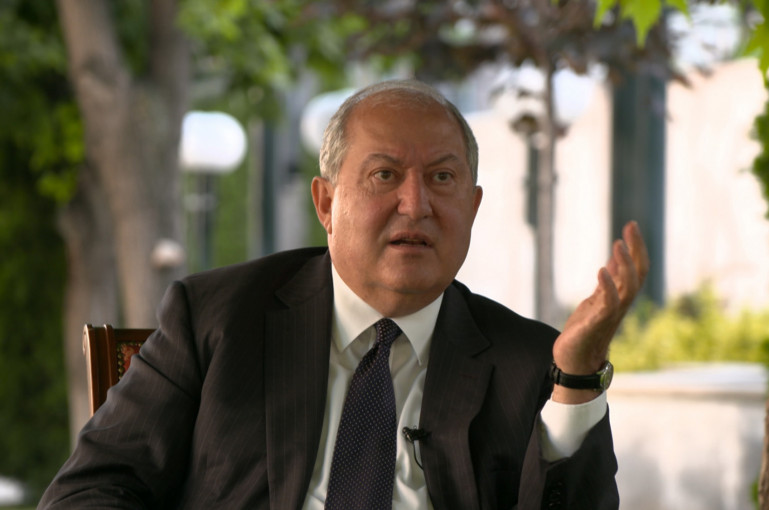
The renowned British newspaper The Times, on the occasion of April 24, the day of remembrance of the victims of the Armenian Genocide, presented under the heading Red Box the viewpoint of the 4th President of the Republic of Armenia, Armen Sarkissian.
Speaking about the lessons of the Armenian Genocide, Armen Sarkissian noted in particular: “We cannot credibly condemn the atrocities of the 21st century if we refuse to acknowledge the crimes of the 20th century that helped shape the world. The British government has the opportunity to correct a grave mistake and set an example to the world by recognising the Armenian Genocide and holding a commemoration ceremony every year, as the Armenian people do every April 24.
In an attempt to take Britain to the right side of history, last month an all-party parliamentary group, including former Conservative Party leader Sir Iain Duncan Smith and Labour MP Rupa Huq, expressed its support for a bill introduced by individual members to recognise the Armenian Genocide, which sought to “rectify a terrible historical injustice” by recognising the Armenian Genocide. Unfortunately, the bill, as often happens with private members’ bills, did not get beyond its first reading.
The Armenian Genocide is not only a moral but also a very pragmatic issue. Despite the burden of history, Armenia has begun negotiations with Turkey, attempting to normalise bilateral relations. But since Armenia’s ongoing negotiations with Turkey proceed without any preconditions related to the Genocide, they will most likely “stumble.” No process of normalising relations between the two sides can survive if it does not address the wound that haunts and torments Armenians throughout the world.
I support the normalisation of relations between Armenia and Turkey and wish to see stable relations between the two countries. However, such relations can only be built on the solid foundations of historical recognition and reconciliation. Temporary fixes achieved by avoiding history will not lead to lasting peace. They will simply conceal deepening grievances that will overflow with uncontrollable force in the future. For the establishment of peace and prosperity in the region and beyond its borders, the recognition of the Armenian Genocide is an indispensable path.
The 20th century is a collage of the darkest pages in human history, from the Holocaust and the Cambodian massacres to the Rwandan genocide. The horrors of genocide must never be left out of history. Memory is our best defence against their repetition in the 21st century.
This is one of the reasons why Joe Biden officially recognised the Armenian Genocide and the pain inflicted on the Armenian people. “We honour their history,” he said. “We acknowledge the history. We do this not to cast blame but to ensure that what happened is never repeated.”
As the first people to adopt Christianity as a state religion in 301 AD, Armenia possesses a rich cultural and artistic heritage, reinforced by faith in a strengthened future and the triumph of human goodness.
Our people are resilient, innovative, hardworking and creative. Our desire is to turn our country into a flourishing home for a global nation, a nation that strives to contribute to the common good of all its neighbours and the world.
But a just and flourishing future requires us to acknowledge our shared past. Britain can contribute to that process of healing.”