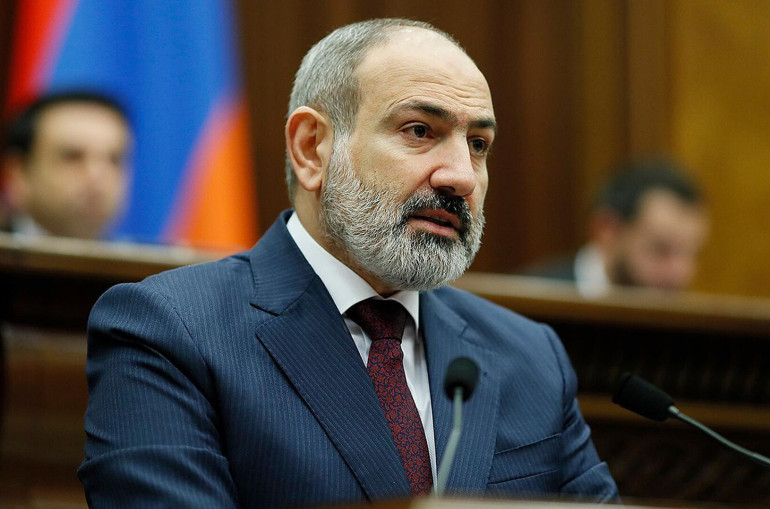
During the National Assembly-government question-and-answer session, Prime Minister Nikol Pashinyan addressed the decision of the EU Council to send EU observers to Armenia. He addressed the question of why Armenia decided to accept the EU mission but not the CSTO mission.
Prime Minister Pashinyan stressed that there are many misunderstandings on this topic, including within Armenia’s expert circles, because they ask how it came about that the CSTO observer mission did not arrive in Armenia, while the European observer mission is arriving.
“In the case of the CSTO, we have formulated the problem very clearly: since the CSTO has documents with very detailed descriptions, including the crisis response regulation, which was adopted back in 2010, where the actions are clearly written, at the same time, there is a clear understanding and concept of the CSTO’s zone of responsibility. We have asked the CSTO for one most important, principled thing: to specify the zone of responsibility of the Collective Security Treaty Organization in the Republic of Armenia. That is, to tell us their understanding of what the Republic of Armenia is. We have not received a clear answer to this question. On the other hand, why has the deployment of the European Union civilian mission become possible? Because as a result of the quadrilateral meeting in Prague, the European Union has clearly delineated, including with the participation and consent of Armenia and Azerbaijan, what the Republic of Armenia is. That is, they have said that in our understanding the map of the Republic of Armenia is this, or we have said it, they have taken note of it and confirmed it. They are coming to monitor and observe that territory,” the Prime Minister explained.
The Prime Minister stressed that without a conception of the territory, an observer mission would be strange, because it is not clear to them what they are to observe.
“The question arose from the situation when Azerbaijan seized territories of the Republic of Armenia. If any mission does not know what the Republic of Armenia is, what the territory of the Republic of Armenia is, how is it to observe whether the territory of the Republic of Armenia has been seized or not? This is the most important issue,” the Prime Minister said.
Pashinyan also stated that before the deployment of the European Union observer mission, Azerbaijan was explaining its aggressive actions against Armenia on Western platforms by saying that the Prime Minister of the Republic of Armenia was deploying more and more Russian troops on the Armenia-Azerbaijan border and was preparing for a joint Armenian-Russian attack against Azerbaijan, and that Azerbaijan, with its attacks, was simply trying to more or less balance the situation in order to manage its vulnerabilities.
“This process was continuing. Moreover, I have already said that in the West an attempt was being made to present Armenia as a participant in ‘Russia’s aggressive policy,’ and in Russia an attempt was being made to present it as a participant in a Western conspiracy. Since our Russian partners had representatives on the ground and our Western partners had already begun to look at us askance, saying that you are in fact preparing aggressive actions, because there are large concentrations of Russian and Armenian troops there, you are preparing to attack Azerbaijan, the poor Azerbaijanis are forced to want to seize heights, wishing to balance the situation. Realising that they are spending very large resources on this, we said: very well, come and observe whether all this corresponds to reality or not. The cornerstone provision is that there is, naturally, no geopolitical subtext in all this. There is a clear agenda, there is a clear issue that we are trying to resolve,” Pashinyan concluded.