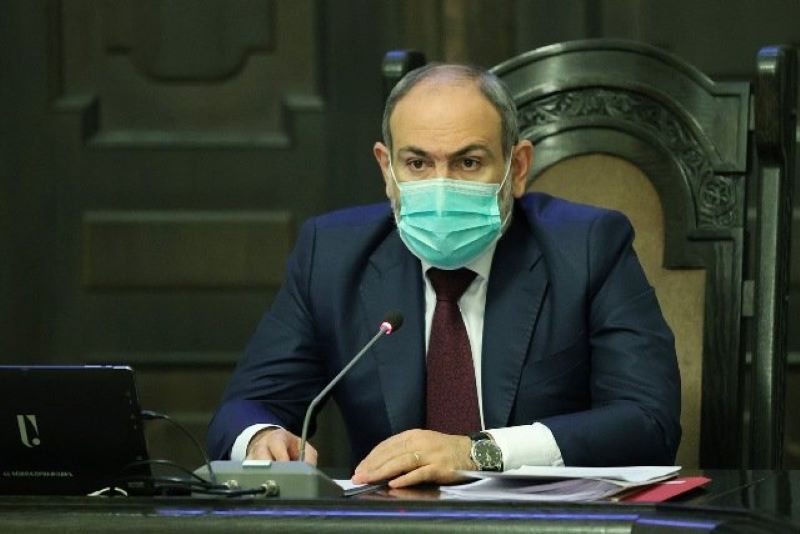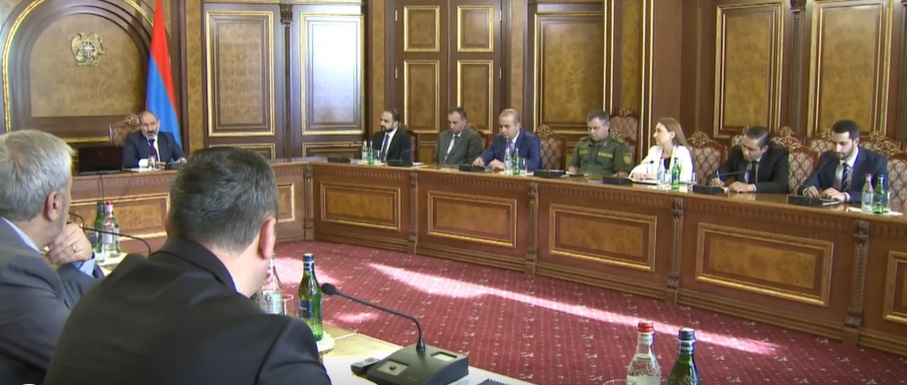
An extraordinary session of the Security Council was held under the leadership of Acting Prime Minister Nikol Pashinyan. In addition to Security Council members, the session was attended by Speaker of the National Assembly Ararat Mirzoyan, Acting Minister of Territorial Administration and Infrastructure Suren Papikyan, head of the National Assembly’s “My Step” faction Lilit Makunts, secretary of the “Prosperous Armenia” faction Arman Abovyan, head of the “Bright Armenia” faction Edmon Marukyan, Chairman of the Standing Committee on Defense and Security of the RA National Assembly Andranik Kocharyan, and Chairman of the Standing Committee on Foreign Relations of the National Assembly Ruben Rubinyan.
During the session, the situation created on the Armenian-Azerbaijani border was discussed, regarding the resolution of which Acting Prime Minister Nikol Pashinyan made a proposal. In his speech, the Acting Prime Minister, in particular, stated:
“Dear colleagues, I am returning from Gegharkunik Province, specifically from our border areas in the Kut village section. I have familiarized myself with the situation on the ground and want to share my impressions with you, but in addition to sharing impressions, I also want to make a proposal for resolving the situation.
The situation is tense, and the dynamics of that tension are escalating. That is, it is not only static tension, but it is continuously tightening and will most likely continue to tighten. Why? Because during the events of the last days, 15 days, the Azerbaijani soldiers who have penetrated our territory and our soldiers and units are in a state of mutual interpenetration. That is, in essence, they are not only face to face, but there is a mixed, mutually interpenetrated state.
And why will the situation become tense? Not only because various incidents have been recorded and that tension could ultimately explode the situation, but also because after today’s incident there is a possibility that our Armed Forces representatives will also try to take prisoners, then they will try to take a response step, and so on. And my assessment is that if the situation is not resolved, this provocation could inevitably turn into a clash, a large-scale clash.
Now I do not want to repeat the assessments that I have already publicly stated several times, but I want to propose a solution, a diplomatic peaceful resolution of the situation, which will lead to de-escalation.
You are aware that Azerbaijan explains and justifies its actions with certain maps it has, that our and their perceptions regarding the location and geography of the border line differ. We, of course, do not share that assessment and have our clear position on it. But since the situation has reached this explosive state, I am making an open proposal addressed to the international community. I am doing this before the Armenian public, and this proposal is also addressed to the government of Azerbaijan.
The proposal is as follows: we agree that very quickly the armed units of both sides, that is, the units of the Armed Forces, withdraw from the border in a mirror manner. That is, there is a perception regarding the border — 5 kilometers this side, that side, there is a difference of certain kilometers — one, two, three. Presumably we propose that the units of the armed forces generally return from those areas to their permanent deployment locations. In return, international observers — representing Russia or the OSCE Minsk Group co-chairmanship — would be deployed along the presumed border line.
The presence of observers in that region is necessary so that the parties are assured that the other side is fulfilling the agreement, that is, not bringing troops closer to the border line. Moreover, I want to emphasize that this concerns the Sotk-Khoznavar section; in this case, it is precisely in this section that border tension has arisen. After that, again under international auspices, work on the clarification of border points should take place. In this case, again, my understanding is that observers representing Russia or the OSCE Minsk Group should be involved, and this process should take place under the activities of Russia or the OSCE Minsk Group co-chairmanship.
This is the proposal, this is the plan I am proposing. If Azerbaijan truly has a problem with the clarification of border points, then it should have no reason to reject this plan. For our part, we are convinced, we are confident, that we can substantiate our position and viewpoint to all international observers. Perhaps they also have their share of confidence, but that is not the point; the point at this stage is to de-escalate the situation and achieve a diplomatic peaceful resolution.
And this can be considered, we can consider it an official proposal addressed to Russia, to the OSCE Minsk Group co-chair countries, and of course also to Azerbaijan. So, I hope that this proposal will be accepted.
To tell the truth, having familiarized myself with the situation on the ground, I have come to the conviction that this is precisely the shortest, most effective and sensible path to resolving the situation, because, I repeat, if we do not take this path, the situation will inevitably spiral out of control, and we cannot allow that. In addition to this proposal, of course, we will begin active consultations with our international partners. We have already spoken with the Minister of Foreign Affairs on this topic, and I hope that we will soon have the opportunity to move to the implementation of the proposal.”