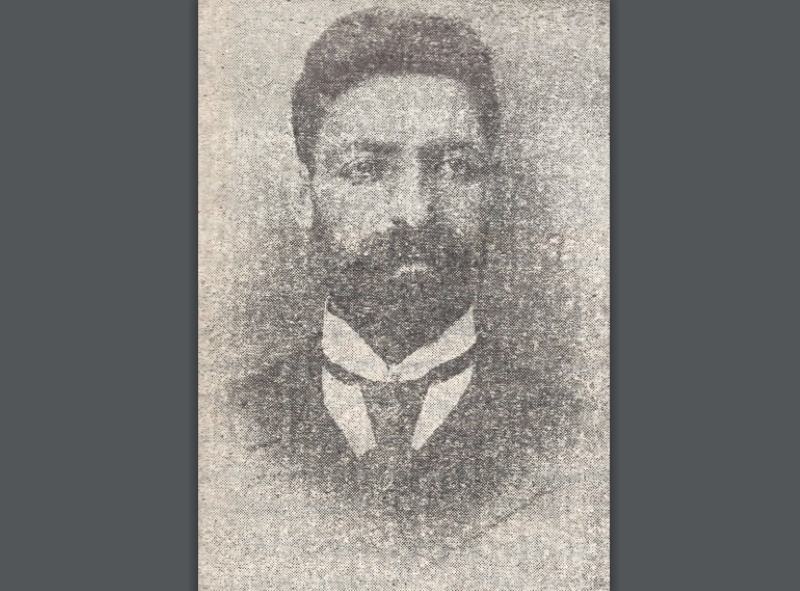
Karekin Pagueshjian (Manukyan)
(Van, 1867 – Los Angeles, 1937)
The benefactor was born in 1867 in the Ayghestan district of the city of Van, under the family roof of the renowned Manukyan family, which had moved from Bitlis (Paguesh) to Van.
After receiving his primary education at the local school, Karekin attended the Central School of Van, becoming one of the first students of Mkrtich Portugalian.
With his revolutionary temperament, he stood out by participating in the movements forming in Van.
In 1884, Mkrtich Portugalian initiated the formation of a society named the Cooperative Union for his first 12 graduates of the teachers’ college he had founded in Van, whose purpose was to bring textbooks and reading publications from Constantinople and France and distribute them to the Armenians of Van as intellectual supply.
After Portugalian was exiled from Van in the spring of 1885 and settled in Marseille, his published newspaper “Armenia” secretly entered Van.
Among his students gathered around the newspaper was Karekin Manukyan, and guided by the Armenian outlook found there, he became part of the founding body of the first Armenian political party in the autumn of 1885, which was named the “Armenakan Organization”.
The Organization first decided to reorganize the official national bodies of Van, reopen the Sunday schools, and educate the youth of Van as a priority concern.
One of the important decisions of the founding body of the Organization was to establish contact through Persia with important Armenian-populated colonies, especially considering Tiflis.
In particular, a structure named the Armenian Patriotic Union was planned to be undertaken in Azerbaijan, for which Manukyan assumed the duty of frequently traveling to Persia and gradually involving the elements gathered around the Union in the Armenakan ranks.
For the Organization, Manukyan had become such a trusted figure that he also secretly planned to transport weapons to Van, bringing them from regions adjacent to Persia.
With his imposing build and attractive appearance, Manukyan gradually began to attract attention, especially from the Turkish police.
For the Armenians of Van, he had become the savior of the wronged, repeatedly freeing Vanetsis from Turkish prisons.
In 1889, when Manukyan was returning from Persia with some of his comrades, they were surrounded by Kurdish marauders and, deceived, surrendered to the Turkish police.
In the prison of Van, Manukyan and his Armenakan comrades, making no confession, were subjected to the most atrocious tortures.
Karekin Manukyan was kept crucified upside down in prison for some time, but even that torture proved powerless, because the police could not learn the plan of the secret mission.
During this period, the famous political figure Garabed Natanyan had been appointed governor of Van, who was respected by all the minorities of Van; through his intercession, Manukyan and his comrades were freed from prison before the end of 1891.
Among the Armenians of Ayghestan, Manukyan was already known for his bravery and ardent patriotism.
By the decision of the executive body of the Armenakan Organization, Manukyan was entrusted with the duty of pursuing the secretly developing anti-Armenian activities of the Turks in the villages of the province of Vaspurakan.
At the beginning of 1896, Manukyan formed a mounted fedayee group consisting of 11 Armenakans, among whom were Krikor Shigaher and Armenak Yekaryan, as well as Manuk Vardanyan, known by the pseudonym Derbe.
The mounted fedayee group undertook the mission of leaving for Persia to transport ammunition to Van, where the three national parties were jointly preparing for Self-Defense.
On the return from Persia, disguised as Kurds, the mounted group was disarmed by Persian border troops; Shigaher and Yekaryan were imprisoned, while Manukyan managed to escape and, coming to Salmast, took refuge with Vanetsis known to him, unable to return to Van to participate in the Self-Defense of June 3.
In Salmast, he continued the work begun for the Armenian Patriotic Union; from the first days of the founding for the Armenakans, Azerbaijan had already been considered important.
In 1898, Manukyan went to the Caucasus, and in Tiflis developed close relations with one of the founders of the Federation, Kristapor Mikayelyan, as well as with Simon Vratsyan, for whom the information coming from Vaspurakan was vital.
Manukyan maintained contact with his brother in Van, staying informed of the condition of his relatives.
As a result of betrayal, he was also imprisoned in Tiflis, and in the same prison met his comrade-in-ideals, Panos Terlemezyan.
After being released, he remained in Tiflis for some time, engaging in teaching within the local established community.
In 1907, when the Armenakan Organization regained its vigor in Van under the leadership of founding member Krikor Achemyan, Manukyan was asked to return to Salmast and continue his career and propaganda work there.
In 1908, when the Constitutional Ramgavar Party was formed in Alexandria through the union of the Armenakans and the Reformists, Manukyan’s longtime comrade-in-ideals, Krikor Shigaher, also came to Salmast, and together, alongside their teaching careers, they planned to strengthen the Constitutional structure within Persia, proving useful to the Party circle of Van.
Manukyan had learned from his relatives in Van that the Armenakan youths he had taught had come as refugees and settled in the United States (Boston and Fresno).
In 1913, Manukyan finally came to settle in Boston, where he met one of the Armenakan recruits who had participated in the Self-Defense of Van, Shadakhtsi Murad, with whom they frequently met Vanetsi compatriots at the editorial office of the Azg-Bahak (National Guardian).
In September 1915, when the Armenian population of Vaspurakan was leaving its ancestral land and migrating to Vagharshapat and Yerevan, the Benefactor’s relatives had also joined those migrants.
The declaration of the Republic of Armenia in 1918 and the subsequent Sovietization of Armenia were turning points for Manukyan, because the revolutionary spirit sown in him to serve the Armenian people was fulfilled by having statehood.
At the beginning of the 1930s, the Benefactor decided to settle in California, where again Vanetsis had come to settle in Fresno, while he decided to live in the seaside town of Venice near Los Angeles.
He was frequently in contact with the Husyan and Der Mkrtichyan families, who had been his fellow Vanetsi compatriots.
The twilight of the life of this patriot with a revolutionary devoted past, under a foreign sky, would come in January 1937, due to attacks suffered by robbers on two separate occasions.
The funeral service took place at the Holy Cross Church in Los Angeles, where Vanetsis who had come from Fresno were present.
At the request of his relatives going to Armenia, his body was cremated and the ashes were transported to the Homeland.
Ara Aharonian