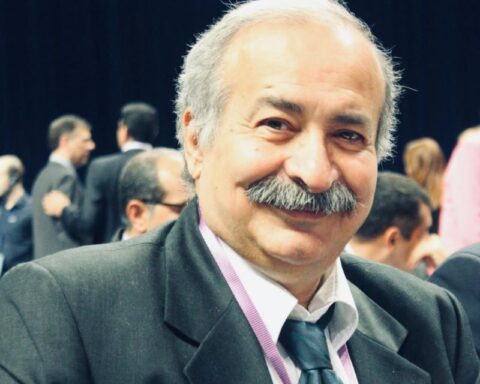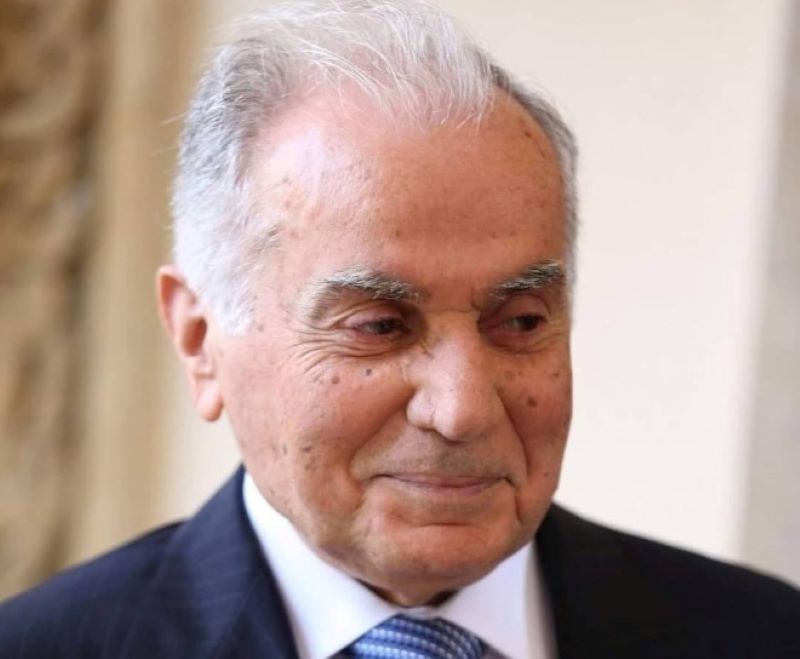
Aram (Aris) Sepetjian
(1934′ Alexandretta – 2020′ Beirut)
Aram was the youngest of the eight children of Armenak Sepetjian and Hovsanna Lepejian, of the well-known Sepetjian family of Chork Marzban. He was born in the coastal city of Alexandretta, Cilicia, in 1934, when that predominantly Armenian city was still under the benevolent rule of France.
In 1938, when France handed over the sanjak to Turkish rule, the Sepetjians, like others, came to settle in Beirut, where other relatives of Armenak from Chork Marzban had previously arrived.
In the growing Armenian atmosphere of Beirut’s then-small Armenian community, Aram attended the Armenian elementary school, and then continued his studies at the AGBU Hovagimian-Manoukian boys’ secondary school, where he showed a particular interest in Armenian literature, studying under Vahe Vahian.
Sepetjian’s first literary work appeared in 1951, in the Boston-published “Baykar” daily newspaper, as a short story titled “Forgive Me, Homeland.”
After completing his secondary education in 1954, he followed correspondence courses for two years, with the London Institute of Surveyors.
During this period, Aram, with his union interests, actively took part in the cultural programs of the AGBU, while his ideological leanings led him to join the ranks of the Armenian Democratic Liberal Party, becoming a member of the ADL Mkrtich Portugalian club.
In 1957, he was certified as a building surveyor from the Beirut Technical Institute, and with his professional expertise he frequently travelled to Lebanon’s neighbouring countries for construction projects.
Sepetjian’s literary collaboration began in 1956 with the “Shirak” literary and cultural monthly, of which he would become a permanent and sought-after contributor. Sepetjian also contributed to the literary pages of the party press, alongside the “Shirak” monthly, collaborating with the “Zartonk” daily.
In 1964, his first publication appeared: the short story “Lightless Nights,” under the title (Diary of Sadness and Love).
In 1967, Sepetjian became a member of the editorial board of the “Shirak” monthly.
Before the end of the year, he chose as his life partner Meline, the daughter of a well-known Musa Dagh family. They were blessed with three children, two boys and a daughter, and thanks to their upbringing, they grew up in a warm Armenian atmosphere.
In 1969, Sepetjian’s second volume of short stories was published, titled “Yearning for Life.”
During this period, he travelled to the United Arab Emirates for his profession, after which he became a member of the Architects & Surveyors Institute in London, and established his permanent office in 1973, within the newly opened T.M. Union center in Beirut’s Jemmayzeh district.
Within this newly opened center, the T.M. Union’s Beirut branch carried out vigorous activity, and Sepetjian for a time became a board member of the branch’s administration.
In 1978, his novella “The Burnt Offering” won the T.M. Union’s Haykashen Ouzounian literary prize, and the Arabic translation of the novella (Trans. by Nizar Khalili’s “Al Dhabiha”) was published in 2004.
After Lebanon’s civil war, the relatively revived Armenian-Lebanese community life, particularly in the Antelias area, had resumed with unionist fervour, and Sepetjian had become a board member of the AGBU’s Antelias executive committee.
It should be noted with importance that alongside his literary activity, in 1982 the veteran became a member of the ADL’s Lebanese Regional Board.
In 1984, he came to stay in Los Angeles for a period at his brother Andranik’s home. During his stay, he contributed book reviews to the “Nor Gyank” weekly, as well as to the “Nor Or” tri-weekly.
After returning to Beirut, his second novella was published in 1985, titled “…I am black but beautiful,” which again won the T.M. Union’s Ouzounian literary prize.
In 1986, he was invited to Armenia by the Armenian Writers’ Union to participate in the 9th congress of the Writers’ Union.
In 1991, he founded his own publishing house, “Sipan,” in Beirut. It should also be noted that his faithful friends of the Armenian letter and press always remained gathered around the publishing house he founded, because he had also been one of the three founders of the Lebanese-Armenian Writers’ Union.
The following year, in 1992, he became the responsible editor of the AGBU-Armenian General Union’s “Khosnag” monthly, a position he would carry out with meticulousness for the next 15 years.
In 1996, he became a member of the Armenian Writers’ Union, and in 1997 he was awarded the H. and A. Vartivarian press prize of the “Zartonk” daily.
In 2001, “Land and Sorrow,” Sepetjian’s collection, was published in Yerevan, which received wide acceptance among the homeland’s intelligentsia at the time.
The veteran’s journalistic articles signed over the decades were published as a collection titled “Timely Thoughts” in 2005, and the same year he was invited to become a member of the Armenian Journalists’ Union, as well as of the editorial board of the “GAMAR” literary periodical.
Athens-2006, the composition of the ADL Central Board at the conclusion of the ADL 14th General Delegates’ Meeting. Standing, first from the right: Aram Sepetjian.
In 2006, he participated in the ADL’s 14th General Delegates’ Meeting convened in Athens, and was elected secretary of the day’s Bureau, while the chairmanship of the same meeting was entrusted to the author of these lines. At the conclusion of the meeting, Sepetjian was appointed alternate member of the ADL Central Board.
In 2007, he was awarded the ADL’s double veteran plaque.
The veteran frequently established contact with Chork Marzban intellectuals residing in various diaspora communities, and through his efforts the publishing body of the “Chork Marzban” book series was brought to life, one of whose publications is Toros Toranian’s “Faces of Armenian Letters and Press of Chork Marzban.”
In 2009, his work of literary re-evaluations was published, titled “Poetry Through Crisis.”
In 2010, for his long-standing literary merits, he was awarded the St. Sahak-St. Mesrop medal and pontifical encyclical by His Holiness Karekin II, Catholicos of All Armenians.
The 80-year-old veteran tirelessly continued his literary and journalistic activity, and in 2014 his second collection was published, titled “Voices in the Silence,” as well as the literary re-evaluation “Literary Encounters,” while His Holiness Aram I, Catholicos of the Great House of Cilicia, honoured him with the St. Mesrop Mashtots medal and pontifical encyclical for his long-standing merits.
Even in his advanced age, the veteran remained a respected Lebanese-Armenian prose writer, and closely followed developments related to the Homeland and Artsakh, but an unfortunate fate made him an eternal traveller, making him, like others, a victim of the Corona pandemic on Oct. 30, 2020.
XXXXXXXXXXXXXXXXXXXXXXXXXXXXXXXXXXXXXXXXXXXXXXXXXXXXXXXXXXXXXXXXXXXXXX
The veteran’s eldest son Hrach is the director of the Armenian section of the AGBU’s Manoukian-Demirdjian School in Canoga Park, and for about 4 years also assumed the position of responsible editor of the “Nor Or” weekly.
Ara Aharonian