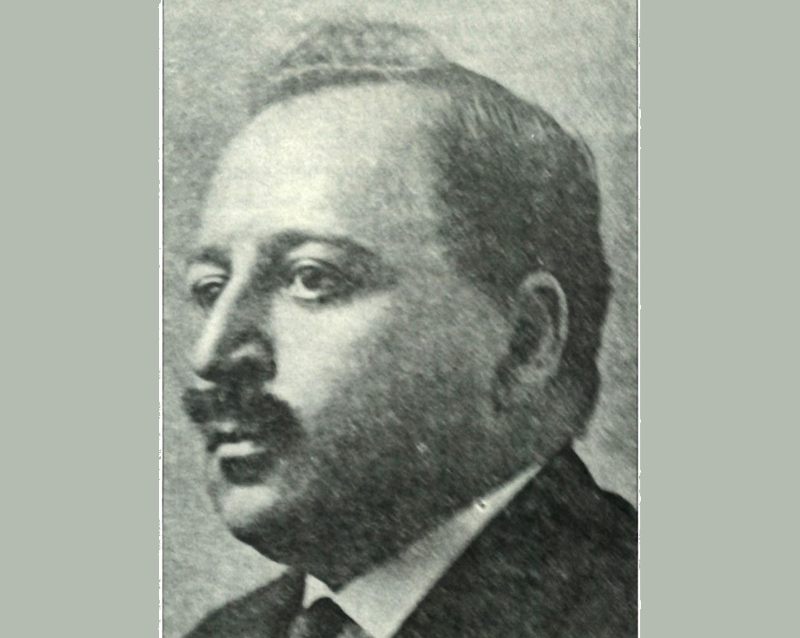
Yervant Messiayan
(1882: Sebastia – 1956: New York)
The distinguished figure was born in Sebastia in 1882; for his primary education he attended the school of Bardizag.
His parents sent the young man to Kharpert, where he attended Euphrates College, becoming acquainted with the English language.
Even in his youth, Yervant showed an interest in belles-lettres.
Before the turn of the century, he went to Constantinople to attend Robert College, from which he graduated in 1901. During his student years, the articles he signed earned him the appreciation of Constantinople’s intellectual circles of the time.
For about two years in Constantinople, he became a permanent contributor to well-known newspapers — “Massis,” “Piurakn” and “Puzantion” — while also contributing remotely to “Tsayn Hayrenyats,” published in Boston, which was the official organ of the Reformed (Veragazmial) party at the time, and he established frequent contact with his ideological companion Surend Parthévian, whom he had met in Constantinople.
Messiayan’s literary interest led him to depart for Paris in 1903, where he sought work specifically by translating French literary works and presenting them to the Western Armenian press, also publishing his first novella, titled “The Broker.”
In 1909, he returned to Constantinople and lectured at his alma mater, Robert College, becoming a lecturer in French literature.
In 1910, his novel devoted to Constantinople Armenian life, titled “Varvareh,” was published.
At the beginning of 1914, he came with his family to settle in Boston, United States, where he officially assumed the editorship of the Liberal organ “Bahak.”
Within a short time, Messiayan had already become a prominent party figure, working alongside Dr. Arshag Der Markosyan.
As editor, through the press, Messiayan introduced among Armenian Americans a taste for, and especially an interest in, French literature and culture through his literary works.
In 1917, when the Armenian National Union of the United States was formed under the presidency of Mihran Svazlian, and after Mihran Damadian’s arrival in Boston, Messiayan’s organizational contribution was great, particularly in the work of forming the Armenian American Legion initiated by the Armenian National Union.
Svazlian and Damadian, as Reformed (Veragazmial) members, were already acquainted with Messiayan’s activities from Constantinople.
When the Armenian American Legion was formed under the leadership of Captain Jim (Bedros) Changalian, Messiayan, through his organizational participation, sought out Armenian American volunteers from various regions of the United States.
At Svazlian’s suggestion, Messiayan was entrusted with the office of Secretary of the Armenian National Union, alongside his absorbing editorial position.
Over the course of five years, the Armenian National Union of America raised around one million dollars to reach those in need after the catastrophe of the Great Calamity (Medz Yeghern), for relief, reconstruction, and also allocated a certain sum for office expenses.
In October 1921, after the formation of the Armenian Democratic Liberal Party through the merger of the Ramgavar and Azadagan currents, “Bahak,” joining with “Azg,” became the “Azg-Bahak” official organ of the ADL’s American Regional Committee, which in 1922 was to be named “PAYKAR,” and A. Nazar became the responsible editor of the official organ.
Yervant Messiayan was entrusted with organizing the party’s regional committee, becoming a leading figure of the ADL’s American Regional Committee.
Alongside his editorial work, the distinguished figure also found time to translate Anatole France’s novels, and before the end of 1922, his extensive study “Anatole France, the Man and His Work” was published in Boston.
During this period, the ADL’s American Regional Committee found itself at a new organizational stage, thanks to the efforts of Messiayan, Hrach Yervant, and Dr. Arshag Der Markosyan.
Due to his public office, Messiayan frequently travelled to various newly established Armenian colonies in the United States to carry out organizational work, and during this period his second literary volume was published in 1929 — the study “Literary Schools in France.”
The distinguished figure brought his unconditional participation to major national programs in America, conducting necessary fundraising campaigns, the most notable of which was aid to the Armenian community of Alexandretta; during this period, a formed Armenian colony existed in coastal Alexandretta, where the AGBU’s Nubarian School served the community.
Messiayan’s literary studies frequently appeared in the “PAYKAR” literary quarterly, among which the portraits of “Under the Flag” were notable, as well as the play “Stronger than Love.”
In 1936, after A. Nazar’s departure from the editor’s post, Messiayan was invited again as editor, this time for the “PAYKAR” daily newspaper.
During his tenure as editor, the official organ’s Yearbook and quarterly enjoyed wide popularity among Armenian Americans.
In 1943, he left the editor’s post to assume another public office for Armenian Americans.
The Benevolent Union (AGBU), as an institution, had its regional office in New York, and became the AGBU of America, whose first president’s office was assumed by Messiayan’s longtime friend and ideological companion, Captain Jim Changalian, while Messiayan became the Executive Director of the American Regional Committee.
After him, the editor’s post of the “PAYKAR” daily was assumed by Hrach Yervant. Messiayan brought his literary contribution to the daily’s quarterly.
As executive director, he was entrusted with the one-million-dollar fundraising campaign for the Repatriation program, which was to be realized within a short time.
Within the Benevolent Union, he was also entrusted with the editor’s post, editing the Union’s official organ, “HOOSHARAR.”
In 1952, due to health reasons, he left his post and retired, but regularly brought his contribution to the Armenian American press.
Appreciating his many years of unconditional service to public, literary, and union programs, he was declared an Honorary Member of the Union by the Benevolent Union.
The distinguished figure’s health condition gradually worsened, and in 1956 he closed his eyes forever in New York.
Undoubtedly, Messiayan held his special place among the ranks of the Distinguished Figures of the Armenian American Press.
Ara Aharonian