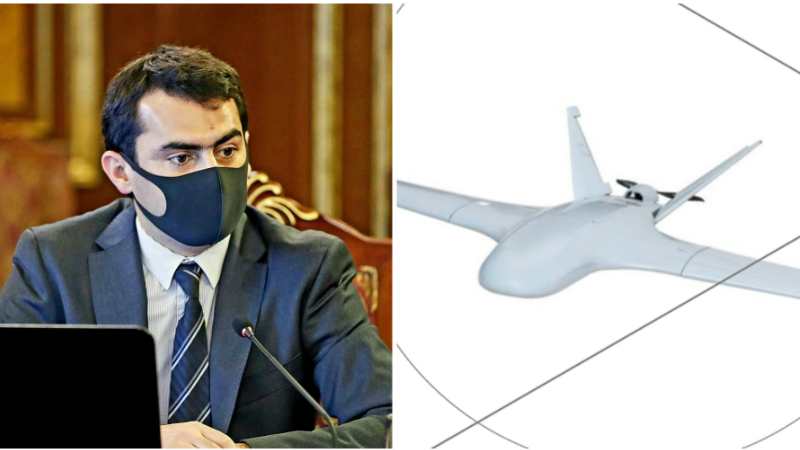
Armenian-made strike drones are already undergoing state tests, and after their successful completion their production will begin, announced today, February 9, during a meeting with journalists, the Minister of High-Tech Industry, Hagop Arshakyan, under whose direction also falls the State Committee for Military Industry.
According to the Minister, the serial production of reconnaissance drones in Armenia began only in 2020; they were also used during the 44-day war and performed well, earning the positive assessment of the armed forces: “Regarding reconnaissance drones, it has already been said that they have been tested and there are production capabilities. As for strike drones, state tests in some cases are already underway; they are at this stage. When we move to military tests, they will go into serial production. That is, the means that were provided to our armed forces have been used. Especially in the reconnaissance direction.”
According to Arshakyan, if in 2017, 1.6 billion drams were allocated from the state budget for military-industrial developments and experimental purchases, in 2018 — 2.4 billion, in 2019 — 3.8 billion, in 2020 — 6.7 billion, then this year 4.6 billion drams have been allocated: “Undoubtedly, the equipment of the future will not be limited at least to drones. These include robotic systems, optoelectronic means, electronic warfare means… The application of artificial intelligence in the defence sector is growing much more, and those same drones without these algorithms, one could say, are not viable. There are developments in that direction as well. Now I can open the quotation marks a little: in the case of Armenian strike drones, artificial intelligence algorithms have already been used in experimental application, precisely for the recognition of structures and their targeting. What does that give? It gives you that you do not need a feedback link for control, because that link can also be detected by various devices. That is, in the case of use in one direction, it orients itself autonomously and goes and finds the target.”
According to the Minister, any new type of armament that enters the armed forces goes through a fairly serious phase of institutionalisation, and time is needed for the armed forces to be able to use it effectively: “You can be armed with the world’s most modern means, but not be able to manage them and as a result lose the war. What we saw in the case of the Artsakh war, our adversary widely involved the Turkish armed forces for its command, both in terms of drones and in terms of troop management. That is, it is not that you have a weapon and today you took it and used it. For that, special forces are created, special units are created, application skills are taught, retraining is conducted, and that is a very serious process. Yes, that process has started with great momentum, yes, and it must continue, improving our defence armed forces.”
According to Hagop Arshakyan, the demand of the Armenian armed forces for artillery and mortar shells and grenades will be fully produced in Armenia from this year. The goal of the State Committee for Military Industry is to gradually expand the Armenian production of required armaments and ammunition, so that the replenishment of the armed forces is as little dependent on abroad as possible.