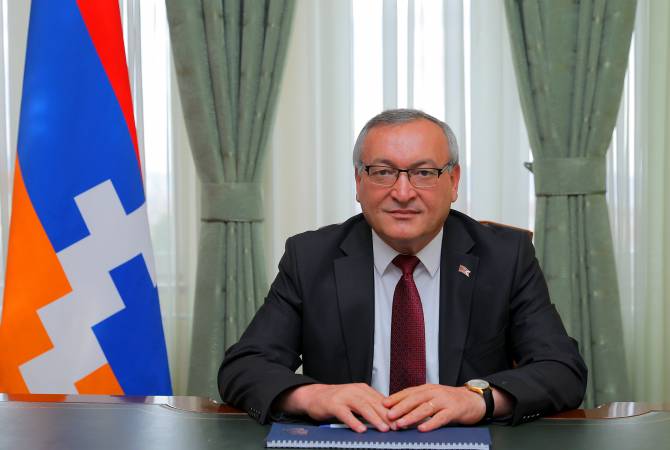
The President of the National Assembly of the Republic of Artsakh, Artur Tovmasyan, has addressed an appeal to UN Secretary-General António Guterres, UNESCO Director-General Audrey Azoulay, the Personal Representative of the OSCE Chairperson-in-Office Andrzej Kasprzyk, and the World Council of Churches.
“We address you to raise the alarm about the growing danger threatening Armenian cultural and spiritual heritage in the territories of Artsakh that have come under Azerbaijani military occupation, during the war unleashed by Azerbaijan against the Republic of Artsakh on 27 September 2020, and following the trilateral agreement of 10 November of the same year on a complete ceasefire and the end of all military operations.
Since as early as the 1920s, there have been documented cases of Azerbaijan’s deliberate and undisguised infliction of irreparable damage to Armenian cultural and spiritual heritage, its wholesale destruction and appropriation, which set a precedent for the atrocities committed with renewed ferocity against historical monuments, works of art and places of worship constituting Armenian cultural and spiritual heritage, as well as against memorial complexes dedicated to the fallen of the Great Patriotic War and the First Artsakh War, in the territories that came under Azerbaijani control during the 44-day war of 2020 and in the months that followed.
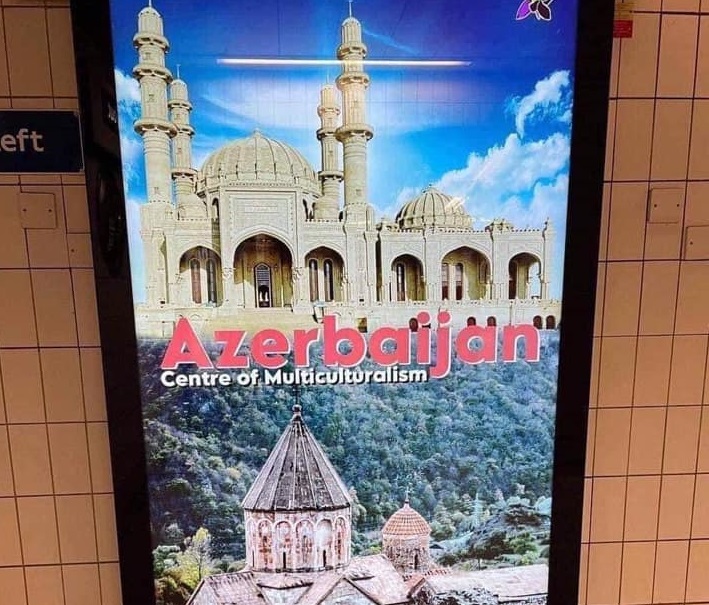
We deem it necessary to emphasise that, following the trilateral agreement of 10 November 2020, Azerbaijan has been implementing at state level with renewed vigour a policy of legitimising the false thesis of the ‘Albanianisation’ of Armenian Apostolic churches, and of appropriating, desecrating and, in individual cases, razing to the ground Armenian spiritual heritage.
The presentation of the 12th-century Holy Mother of God church in the village of Tsakuri in the Hadrut district of the Republic of Artsakh, currently under Azerbaijani occupation, as Albanian, and the destruction of the Church of St John the Baptist in the city of Shushi, are the most recent examples.
Condemnable are the statements made at the highest state level by Azerbaijan regarding the renovation of Armenian Apostolic churches and the removal of Armenian-language inscriptions, with the far-reaching aim of their Albanianisation.
In this way, Azerbaijan has also remained faithful to its traditional practice of rewriting its own history and legitimising its presence in the occupied territories.
It is evident that the aim of this systematic policy and hostile campaign by Azerbaijan, accompanied by gross violations of international treaty and customary humanitarian law, is the destruction of Armenian historical memory and cultural potential and the appropriation of Armenian cultural and spiritual heritage.
In contrast to the policy of destruction of Armenian spiritual and cultural heritage adopted by the Azerbaijani authorities, the Republic of Artsakh has always remained committed to the practice of ethnic and religious tolerance in its territory. The restoration in 2019 of the Persian Upper Mosque of Gohar Agha in the city of Shushi in the Republic of Artsakh is a vivid example and proof of this.
The relevant departments of the Republic of Artsakh and the Republic of Armenia have repeatedly raised the alarm about cases of the systematic and deliberate destruction of Armenian spiritual and material heritage and the appropriation of Armenian spiritual and cultural heritage by Azerbaijan, as disseminated through open information sources.
A comprehensive report has been prepared by the Office of the Human Rights Defender of the Republic of Artsakh concerning the vandalism perpetrated against Armenian cultural heritage and the threat of destruction facing Armenian monuments in the territories of the Republic of Artsakh that have come under Azerbaijani occupation.
We are convinced that, as a result of these alarms, the international community and international bodies are sufficiently informed about what has been done. Even during the 44-day war, the targeting of the cultural heritage of the Republic of Artsakh by Azerbaijan received appropriate condemnatory assessments from the international community.
In this context, we attach great importance to the concerns of the OSCE Minsk Group co-chair countries, the Russian Federation and France, regarding the further fate of Armenian cultural and spiritual heritage in Artsakh, their readiness to provide practical support, and their statements on the importance of involving international specialised bodies. We attach particular importance to the emphasised attitude of the Russian Federation towards this issue and the practical steps it has taken.
We greatly appreciate the statements made at the highest level on sharing universal responsibility for the resolution of this humanitarian problem.
We attach importance to the fact that UNESCO adopted a decision on the introduction of additional monitoring and control mechanisms within the framework of the Second Protocol to the 1954 Hague Convention, and we also welcome the decision to send a UNESCO fact-finding mission for the protection of the cultural heritage of Artsakh and adjacent territories and the prevention of its further damage.
We reaffirm our readiness to support the earliest possible implementation of the UNESCO fact-finding mission in Artsakh and adjacent regions.
We are compelled to note that Azerbaijan is politicising and creating obstacles to the implementation of the fact-finding mission of technical assistance proposed by UNESCO, thereby calling into question UNESCO’s fundamental role and universal significance.
The rich cultural and spiritual heritage of Artsakh constitutes an inseparable part of world cultural and spiritual heritage. Consequently, the criminal and deliberate destruction of cultural and spiritual heritage by Azerbaijan is a challenge to all civilised humanity.
We consider the condemnation by the international community of manifestations of intolerance against Armenian cultural and spiritual heritage in Artsakh, and the drawing of the attention of the international community and bodies, as the only mechanism for preventing the further destruction of the Armenian spiritual and cultural heritage endangered in the occupied territories of Artsakh as a result of the Azerbaijani attack against Artsakh.
We expect preventive action within the framework of the relevant legal norms of international law.
We call for immediate, effective and continuous steps to be taken in developing effective mechanisms to contribute to the fulfilment by Azerbaijan of the international legal obligations it has assumed for the preservation of the cultural heritage of other peoples.
Our concerns can be resolved exclusively within the framework of international law and, in particular, the relevant articles of the Second Protocol to the 1954 Hague Convention for the Protection of Cultural Property in the Event of Armed Conflict, as well as UN Security Council Resolution 2347 of 2017.
We reaffirm that the Republic of Artsakh remains committed to the format of mutual tolerance and respect in matters of the preservation of cultural values and is ready to contribute to ensuring practical solutions within the framework of international law.
We recall that the resolution of the conflict and lasting and stable peace in the region are impossible without the preservation of Armenian cultural and spiritual heritage in the territories seized by Azerbaijan and actually under its control, including the organisation of monitoring by all possible means, in order to prevent actions carried out with the aim of the ethnic cleansing of Armenians.”