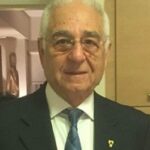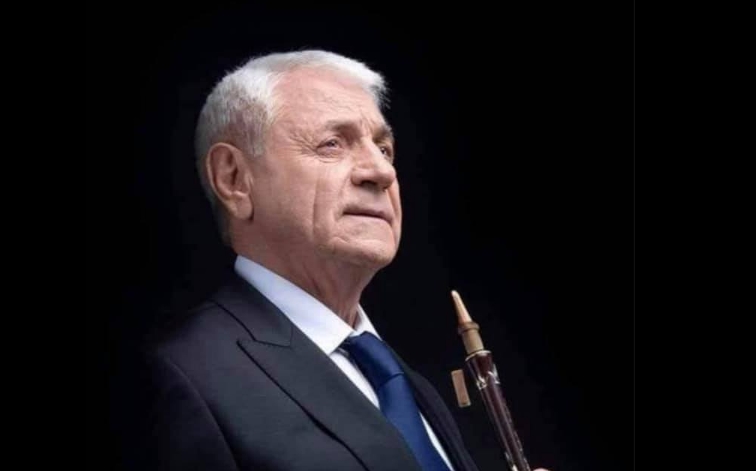
The great master of the duduk, People’s Artist Jivan Gasparyan, has passed away.
Jivan Gasparyan was born in 1928 in the village of Solak in the Kotayk Province. He had a difficult childhood; his mother died early, and his father was a soldier in the Second World War. For this reason, he grew up in an orphanage.
He began playing the duduk at the age of six, without any formal instruction. In 1947, he went to Moscow with a national amateur ensemble, where after a concert he received a Pobeda watch from Stalin. In 1949, he joined the Armenian State Song and Dance Ensemble named after Tatul Altunyan, and his first professional engagement as a soloist was with the Yerevan Philharmonic Orchestra, at a time when he did not yet know how to read music.
In 1956 he received his first prize, and in 1959 his first gold medal at the Fourth International Festival under the auspices of UNESCO. Competing in the same competition, he received a silver medal in 1962, a bronze in 1973, and in 1973 he was awarded the honorary title of People’s Artist of the Republic of Armenia.
In addition to numerous awards and honours, in 2006 he was nominated for the American “Grammy” international music award.
His international musical career began in 1988. That same year, Brian Eno, having accidentally heard the musician’s performance in Moscow, decided to invite him to London. Peter Gabriel used his playing in Martin Scorsese’s film “The Last Temptation of Christ.” He collaborated with the Kronos Quartet and the Los Angeles Philharmonic Orchestra.
Jivan Gasparyan participated in the creation of music for internationally acclaimed films, including “The Last Temptation of Christ” (1988, USA), “Ronin” (1998, USA), “Onegin” (1999, USA), “Gladiator” (2000, USA), “Syriana” (2005, USA), “Blood Diamond” (2006, USA), “Snow and Ash” (2015, Russia), and others.
He released more than 20 albums, has over 1,000 recordings, and performed in the course of some 20,000 concerts.