From the memoirs series From New Marash… to Talapia (Scenes)
By Vartan Tashjian
In my childhood mind, the New Marash quarter of Bourj Hammoud remained a familiar image and hearth, with its humble houses, shops, narrow streets, and at its centre the imposing church of the Holy Forty Martyrs, keeping the word “New” more as an adjective than a reality, within the adornment of the humble post-Genocide conditions.
New Marash…
Those two sweet-sounding words were the very prefix of every building within that district’s boundaries — church, school, club, association, compatriotic union, charitable institution, infirmary, or market. Even the streets had no names, only “New Marash” and the building number, as an address. The local felt a special pride and joy in that poverty, breathing the air of the lush and heroic Marash of ancestral Cilicia under the now-safe sky of this New Marash. A family atmosphere prevailed everywhere, from the church and school to the club, from the shops to the two Great and Small Baths, from the “Arax” cinema to the “Germanik” hall, from the shoemakers’ “takh-takh” to the criers’ call of “pattikh peleti” (choice local watermelon) sold from carts going from quarter to quarter, to the long-melted ice and sunken-eyed “taza semek” (fresh fish), and even to the motley and shameless mosquitoes born of the putrid waters of the Nahr river.
Part of the population was “old Marashtsi,” many related to one another, and if not, certainly acquaintances or friends. There was none of today’s self-contained attitude toward neighbours; instead there were mutual visits for coffee and chatter without appointment, with laughter bursting from windows, as the leaven of daily life. Prepared meals or holiday dishes — chitapour, anoushapour, gatah, pies, coloured eggs — were exchanged plate by plate, from house to house, from kitchen to kitchen, willingly, further cementing the natural degree of relationships.
Another face of that simplicity was the circumstantially rooted Turkish-speaking, the conversational language of the older generation, without however any intention of offending Armenianness or tarnishing the memory of the Genocide victims. Curses and oaths in Turkish rained incessantly upon the age-old enemy, while at the same time professing with faith and consciousness the Armenian spirit to the young generation, until the slogan “answer in Armenian the one who speaks Turkish” and the collective efforts of the Catholicosate of the Great House of Cilicia and national organisations succeeded in putting an end to that undesirable situation.
* * *
Meanwhile, this is the Turk who, ignoring and despising every international law or right, these days, 45 years after his barbaric invasion of Cyprus, wants to greedily appropriate, reopen, and resettle the beautiful but desolate, orphaned Greek seaside city of Famagusta — this time with Turks — and rename it… Marash! New Marash, as if having snatched our old Marash…
* * *
A phenomenon characterising the familiarity of New Marash was also the series of nicknames. Guguir, Sanjakli, Poxer Aram, Emmi Oghlu, Berber Misak, Sayaji Avedis… each one a fragment of old Marash, reborn with family to forge a new life, a new Armenianness in the embrace of a knightly land.
April 24, Vartanants, May 28 were commemorated with the same breath, vow, and hopes for the future, closing shop, office, work, factory, school. Did the church bell sound? Every occupation froze for a moment, to make its God-pleasing sign of the cross. Did one see the priest from afar? One would not ignore him, would not change one’s steps, but would approach and reverently kiss his hand with a “Bless me, Father.” Simple people, old-fashioned, perhaps unlettered, but often more polite, modest, prudent, wise, witty, eloquent than the educated — no matter if instinctively and impulsively a few oaths slipped from that tongue, over the backgammon table, in a moment of bad luck. There was a patriarchalism, devoted to good customs. The rich were rich, the poor were poor, but the lower class did not resort to protest or complaint against the upper class for this class difference. They gave thanks to the Almighty that they enjoyed the happiness of drinking the sun far from the accursed Turk’s yataghan, whatever colours the spheres of social life might show.
Early in the morning, before the sun had yet risen, movement began in the streets. The baker, the milkman, the grocer, the butcher set to work with renewed vigour in preparation for the army of customers gradually pouring in, while the group of employees and workers, lunch in hand, headed toward the public transport station, to reach the workplace an hour early, to sacrifice their Armenian sweat for the satisfaction of the manifold needs of a family that had escaped the clutches of the exile road. A private car was not a common sight along those narrow roads, and human life teemed more on the sidewalks than on the asphalt.
My grandfather, Gaspar Agha, also known by the name “Tashji Gaspor,” despite his advanced age, was not one to sit with legs crossed, passing the “wakht” (time) with a nargileh and seeking rest. He too was an exile Armenian nourished by the worry of making a living; he would wake before the others, descend to the ground-floor “pacha” eatery of our house, boil the meat in small pots with my grandmother’s help, season it with garlic, pepper, and lemon, and serve this nutritious dish with the appetising aroma spreading from the steam of the hot plate to its lovers, especially in winter, multiplying even more the urge to spoon it up against the outside cold and rain. If ever the cholesterol level also registered a rise in the veins, what did it matter? Many mornings they also fed me this “fat soup” before heading to school, insisting that I must swallow the “ilik” (marrow) of the bones too, so that I might “grow strong” before my lessons.
One morning, I happened to find a 5-lira gold banknote on the floor, under one of the tables. It was no small sum in those days. My joy did not last long, however.
– “Pakh oghlum, bu para senin olamaz, onun sahibi var, bana ver bakalim, efferim.”
– “Look, my boy, this money cannot be yours; it has an owner. Give it to me, let me see, bravo.”
This vinegar poured over my elation, however, taught me an important moral lesson, introducing me from an early age to conscientious and just human behaviour. A few days later the owner of the money was found and rewarded me with 50 piastres. Clean work!
My grandfather was a good and upright man, one of the old-generation Marashtsis, rocked by the dream of his ancestral home. The day’s fatigue would dissolve when he found me in his arms.
He was deeply moved by the “Song of the Fighter” — “I Would Fly Home in Thought” — under the influence of a glass or two of oghi. Every time, at his request, when I sang the song through all its verses, he would slip 25 piastres into my palm, with copious tears in his eyes. On several occasions I abused this nobility of his, with childish mischief, and as soon as I pocketed the quarter gold at the first verse of the song, I would wind it up, leaving the remaining verses to his consoling imagination.
Such mischief was surely unimaginable under the arches of my elementary school, the Holy Forty Martyrs School of New Marash, where the principal Sedrak Zaven’s German “discipline,” with a pointed cane swaying back and forth like a censer, was a signal of what was to come to one’s head, in the face of any violation of the school’s internal rules.
“Steal, but don’t get caught,” he would sometimes declare, aloud, to the hundreds of students lined up after recess, before heading to class. “Stealing,” here, meant for him “misbehaviour,” whose definition he well understood and made understood with an authoritative, demanding, and imposing approach that kept the school’s discipline high. Sometimes even running during recess was considered forbidden territory, to prevent the danger of bumping into a little one and inadvertently knocking him to the ground. The yard felt cramped compared to the number of students.
Our Armenian language teacher was Mr. Levon Aghkhacherian, with the literary pen name Zareh Zargun. He was a likable and witty man. I loved him and the subject he taught. His habit of calling on students was to have them stand at the wall, with the textbook, and undergo an examination of fluent reading, vocabulary, and spelling. He would be greatly annoyed by extraordinary spelling errors and, often with a joke sweetening the moment’s seriousness, would give this threat to the class:
– I think I’ll put a few of you in a big sack, tie the mouth well, with a heavy stone, and throw you into the Nahr river…
On one occasion, he wrote two similar-sounding words on the wall, “hajel” and “yajel,” and turning to the student at the wall, asked:
– Now tell me one by one the meaning of these words.
My classmate, somewhat hesitant, wanted to be sure of the answer he would give, and then, highly satisfied:
– The first one, sir, the dog “hajes” (barks), the dog’s sound…
– Good, the other?
– The other is… the man “yajes” (errs), sir…
A great burst of laughter exploded in the classroom, with Mr. Zargun joining in, displaying fully his few gold teeth. Surely my friend meant to say “succeeds,” but at that moment, before everyone’s eyes, his tongue betrayed him, which is always accidental.
As students, we were obliged to attend church every Sunday, at the liturgy, whether we were altar boys or not. The choir master, with his scoldings, was not behind Sedrak Zavenian in severity, if we ever dared to talk aside in church, during the class, before the altar, sitting cross-legged on the floor, during a sermon that was long-winded and incomprehensible to us.
But without exception, “the carrot alongside the stick” expressed its flavour in the face of positive activity.
At the ceremonies, which took place in the church, a beautiful recitation, a solo, an exemplary deed, or top results in lessons would certainly earn praise, a good note, applause. As an altar boy, when we would walk before the coffin of a deceased, holding the candlestick high, cutting through the road stretching several kilometres from the church to the Bourj Hammoud cemetery, another Lebanese gold coin would go into the pocket, a practical appreciation beyond words.
It would sometimes happen that, by an unexpected and unpleasant coincidence, the church’s neighbourhood would take on a contrary state. The caravan announcing the arrival of wedding cars with deafening honks, decorated with white ribbons, would be forced to stop before reaching the main gate, waiting for a coffin borne on shoulders with black ribbons to be placed in the hearse at that very moment, with a group of black-clad mourners weeping and wailing behind it. Bitter reality, or the inevitable phenomenon of life?
Adjacent to the church was an interesting centre: Emmi Oghlu’s bookstore. Well-thumbed books, notebooks, stationery, textbooks, novels, even Shakespeare’s “Othello” could be found there, among those piles. The good thing was that he would buy back used textbooks at a fair price and, after repairing and rebinding them, sell them again at a small profit to the neighbourhood’s little ones, having contributed decades ago to today’s widespread recycling efforts… Emmi Oghlu’s physique never left my mind — tall in stature, with a square beard under his nose, similar to Sedrak Zaven’s.
The houses had bathrooms, but different was the unique pleasure of New Marash’s two Great and Small Eastern Baths. Men and women would take their baths there at different hours of the day, in that intoxicating atmosphere, and later dry their warm bodies on the cushions of carpeted cubicles, with the gurgling bubbles of an ice-cold “gazoz” Jalloul. Innocent and unaware, in my early childhood I would go to the bath with my mother. In those steam-filled rooms, the body would be cleansed like snow, from the rasping of “kese”s and scrubbings, no matter that the reddened skin was scraped and hurt. One ill-fated day, however, having strayed somewhat from my childish innocence, it seems I must have stared longer than necessary, with my mouth open, at the naked young woman opposite me, pouring water over herself from head to foot with a bowl.
– Look, look, look, shameless girl, keep looking, take that…
With my mother’s sudden resounding slap, not only was my mouth shut, but my head was also forcibly turned toward other nakedness — the bath’s wall, close enough to touch with my nose, with a thunderous command multiplying my punishment, whose echo bounced from wall to wall across the bathhouse space.
– From tomorrow on, you come with your father… khalas (it’s over)…
Years later, when we would recall this incident with amusement, my mother would make the following confession to me:
– At the first punishment you made no sound, my son, but at the second you cried a lot… why…?
Across from our house we had a milkman — a good man, who, by the nature of his work, every early morning, while the neighbours were still in sweet sleep, would raise the shop’s metal shutter with an irritating creak, however much he tried to be careful. Then he would load the large milk cans, with no less clatter, onto the three-wheeled “motorcycle” reminiscent of German army vehicles, rattle the shutter again, this time downward, to close the shop, after which would begin the ceremony of deafening the general silence… starting the “motorcycle.” Would that clumsy machine at least start soon? There would be eight or ten attempts — fss, fss… it would die, again fss, fss, fss — until it suddenly roared to life and obeyed its owner’s stubborn efforts. The operation would not end there, and to keep it from dying, the man would then try to warm up the engine with seven or eight terrifying brooms, brooms, but at the same time rattling door, window, shutter, whatever lay within the range of the sound waves. Naturally, people’s patience gave way to serious discontent and protest, upon which the milkman, understanding and apologetic, was compelled to push the loaded “motorcycle” silently to the main road of Sin el Fil, and there, at the quarter’s edge, bombarding the peace, right in front of the bedroom window of our calm-natured neighbour Sarkis Agha. One-two, one-two, until one day Sarkis Agha, now desperate, vented his anger with a bucketful of water hurled from the roof of his house, just as the fss-fss was about to begin… Taking the law of “Eoyle olmaz, boyle olur” — “it wouldn’t be that way, it will be this way” — into his own hands, as a radical solution to the prevailing unpleasantness. It was not right, but after that we never saw the milkman again. He left the shop and went elsewhere. What happened there… God knows.
One year, to remedy the wounded state of the roads, the Bourj Hammoud municipality chose, instead of asphalt, to pave with cement the busiest streets, including the one in front of our house.
For several days the use of the road was forbidden, until the cement dried well and no new wounds would sprout upon it… For passers-by, however, to facilitate the crossing from one sidewalk to the opposite one, special raft-like planks were placed as bridges, temporarily, under the supervision of a municipal policeman’s whistle. On the second day, one of the neighbourhood’s cats, obediently following the rule, while slowly walking over one of the bridges, the policeman from afar blew a severe warning whistle. The poor animal, startled, instead of continuing its way, with an instinctive leap found itself on the wet cement, and in its helpless attempt to flee, like one walking through deep snow, began to shake and splash the cement stuck to its four paws in all directions, until it got away from the danger… The whistle played no rescuing role; on the contrary, it caused the cat’s paws to leave more than fifty pits on the road, like the palms of Hollywood’s legendary actors.
Unbearable was the heat of New Marash and generally of Beirut in the summer season. The suffocating humidity, the sweat, the stench of the Nahr river made the atmosphere unbreathable, when today’s various air-conditioners did not yet exist. People, young and old, would go up to the mountains, for three months, toward beloved summer resorts, particularly on one line to Aley, Bhamdoun, Sofar, Chtaura, Talapia, Zahlé, Anjar, or on the other side to Bikfaya, Dhour Choueir, Bolonia, Mrouj, Mtein, Biskinta.
For our family, the preferred village was Talapia, where my grandfather and grandmother would set to work preparing winter provisions, taking advantage of the village’s facilities and the warm, affectionate welcome of the locals. Sujukh, samsa, bastikh from grape juice, or tarhana, tomato juice, kinds of turshi were prepared with special care, extremely tasty, to meet the long list of orders previously placed from Beirut.
“Zakar’s posta” (the people-carrier) would carry out the families’ transfer to the village, by special appointment and schedule, so booked was the vehicle. Like a migration ceremony, the household goods from kitchen to bedroom, in boxes and bundles, would be loaded onto the “posta’s” roof, rear, and inside, on the chairs, and with song, laughter, and eating we would go up to the mountain, with expectations of pleasant days. My father, a tailor, would remain in Beirut for work and join us on Saturday afternoons, on condition of returning Sunday evening.
Talapia…
It was a purely Muslim village, between Christian Chtaura and Zahlé. Being Armenian, one or two families would go there, despite the fact that the villagers held deep respect and trust toward us, appreciating our decision to choose their village every summer. We felt very safe among them, and in response to the elders’ encouraging attitude, we children played with close Muslim-Armenian friendship, organised expeditions, went hunting, and the birds we shot were equally divided among us.
My grandfather would also rent a shop on the Chtaura-Zahlé main road, filling his time with grocery trade, until the grapes ripened. Next to him was the butcher Ahmed, who would slaughter animals in front of the shop and wash the blood toward the road, an open invitation to the village’s flies and wasps. One day, a half-slaughtered cow broke free from the rope tied to its legs and, in a frenzied state, began running on the main road, right and left, panicking motorists, until, exhausted from its lost blood, it knelt and returned to Ahmed’s knife.
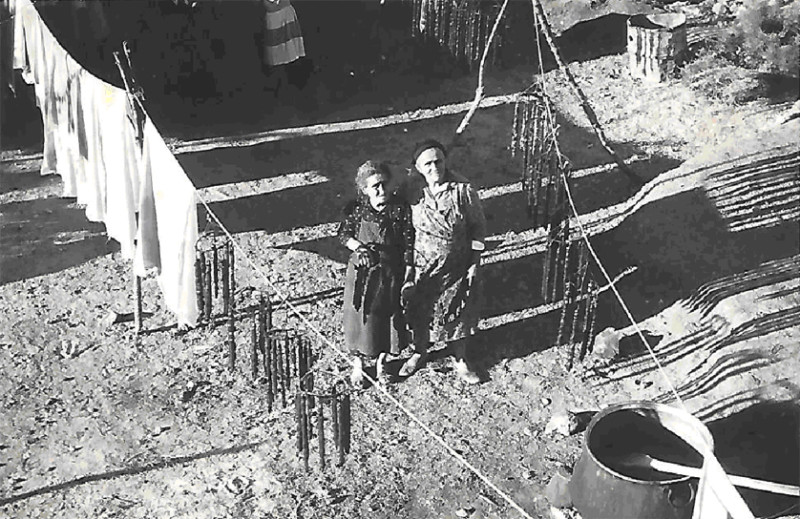
Talapia was famous for its grapes, not far from the sweet figs of Ksara, the clear waters of Anjar’s spring, the dense forests of Tanayil, the rustling poplars of Chtaura, and the paradisiacal Wadi of Zahlé… For the traditional sujukh preparation, the grapes were trampled in long troughs, then their juice was boiled for hours in large pots, until it thickened well and absorbed the choice Damascene walnuts strung on long threads, several times, later to be hung like laundry in the sun, for days on end. And the thirst of fatigue would be quenched with ice-cold, flavourful water gushing from the little spout of the jug placed at the window, from the air to the throat, far healthier than today’s plastic-bottled waters…
Talapia in 1950, the hanging sujukhs, the pot and my grandmother on the left
Grandfather, a few kilometres above the village, on the hillside, every summer, would rent the same wide vineyard for this purpose, and also a donkey as a means of transport along the paths leading to the vineyard. Many days, my sister and I on the donkey’s back, and my twin brothers in the baskets hanging from its sides, we would go to the vineyard for a ride. The donkey too had learned the place by heart.
We would often have visitors from Beirut:
– Gaspar Agha, we’ve come to eat your grapes. Talapia’s grapes are something else. We’ve missed them.
– The donkey is there, tied to the fig tree, in front of the shop. Untie it, let it walk, and you follow, until where it stops. That is our vineyard; eat as much as you want, and take some with you too. I cannot leave the shop.
Talapia’s nights had a dry coolness. The clarity of the sky let us enjoy the stars, when on certain days we slept outside, our eyes on the infinite firmament, in wonder at the Creator’s work, until sleep carried us to the world of dreams, more natural and restful than today’s modern bedrooms. Yes, there were visits from uninvited guests — scorpion, spider, mouse, lizard, snake, and kinds of insects — but when we respected their right to live, without crossing each other, they too let us sleep in peace…
We would go crazy for the train, which came from Rayak’s central station to Saadnayel station, north of the village, and on its way to Dahr el Baydar would cut through Talapia, passing behind our house with a frightening hiss, a tremendous mass, an earthquake-like tremor. When the smoke appeared from afar, with childish curiosity we would run to the railway line and, hands in the air, joyfully greet the drivers blackened with coal, who always responded to our delight with two sharp whistles. We would remain there until the last wagon passed, in the black, unpleasant smoke, until it dispersed with the village breezes.
Now, many, many years after all this, with the feelings of M. Ishkhan’s “Farewell, Childhood,” every time I return to those places where our childish feet caressed the ground from New Marash to Talapia, I see the change time has wrought, everywhere. Neither Gaspar Agha, nor our house, nor the baths, nor my mother and father, nor the cement road, nor my “dense light-centre school of the Armenians across the Nahr,” the Forty Martyrs, nor Sedrak Zaven, nor Zareh Zargun, nor Emmi Oghlu, nor “Zakar’s posta,” nor the train… All belong to the sweet, simple, innocent days of the past, however much we now rock in the cradle of a better, more prosperous, and richer life.
But what is the price of that life? The breathless race — this time on the stage of globalisation and modernity, from the internet to the mobile phone, from political games to economic crises, from national concerns to the future of children, from the struggle for bread to health issues, from the cauldron of hyper-modern cars on boulevards to the turmoil of airports, from the caprice of insufficiency to the competitive selfishness of surpassing one another. Phenomena that devour our daily lives, giving home to that endless “stressful” race — run, run, run, to reach where…
There, where were we yesterday? Perhaps:
14 September 2019
Nicosia