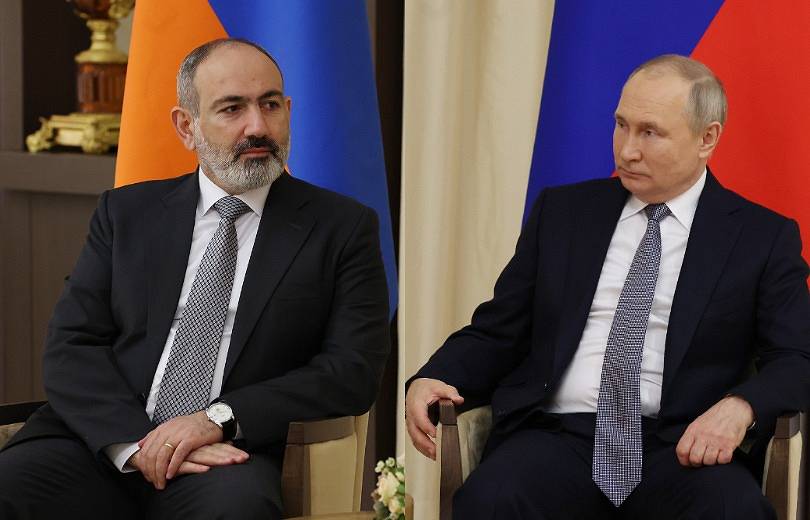
At the invitation of the President of the Russian Federation V.V. Putin, on 19-20 April 2022, the Prime Minister of the Republic of Armenia N.V. Pashinyan paid an official visit to the Russian Federation. The leaders of the two countries issued a joint statement, which reads as follows.
1. In the constructive and trust-based atmosphere characteristic of the allied relations between Armenia and Russia, the leaders conducted a detailed exchange of views on the broad agenda of bilateral cooperation in the political, military and military-technical, trade-economic, scientific-educational, cultural-humanitarian spheres, as well as in the spheres of justice, labour and social affairs, and noted with satisfaction the positive course of development of the multifaceted mutually beneficial alliance between Armenia and Russia. Current issues of mutual interest concerning interaction on regional and international problems were also discussed.
2. Attaching historical significance to the 30th anniversary of the establishment of diplomatic relations between the states on 3 April 1992, the Parties confirmed their intention to comprehensively deepen and expand interstate relations on the basis of the principles enshrined in the Treaty of Friendship, Cooperation and Mutual Assistance between the Republic of Armenia and the Russian Federation of 29 August 1997 and the Declaration of Allied Interaction between the Republic of Armenia and the Russian Federation Oriented towards the 21st Century of 26 September 2000. They expressed confidence that the further progressive development of Armenian-Russian relations will contribute to the realisation of the fundamental interests and aspirations of the peoples of Armenia and Russia, the strengthening of regional security and stability, and the enhancement of the international prestige of the two countries.
3. The leaders agreed that the organisation of joint steps related to the 30th anniversary of the establishment of diplomatic relations in 2022 will serve to promote bilateral interaction and to consolidate its strategic orientation and privileged character. They agreed to hold, in connection with the anniversary, Days of Armenian Culture in Russia, Days of Russian Spiritual Culture in Armenia, the laying of the foundation stone of a monument to Armenian-Russian friendship in Yerevan, and a number of other events that will strengthen interpersonal contacts between our peoples.
It was decided to promote the establishment of a dialogue between Armenian and Russian societies on a permanent basis, with the aim of holding its first session in 2022, dedicated to the 30th anniversary of the establishment of diplomatic relations.
4. N.V. Pashinyan and V.V. Putin noted the priority importance of regular dialogue at the highest level in an atmosphere of trust. In this regard, the timeliness and significance of the Prime Minister of Armenia’s current official visit to the Russian Federation were emphasised for the further strengthening of mutually beneficial political ties, the expansion of interdepartmental exchanges, the deepening of trade-economic interaction and integration processes in the Eurasian region, and the regulation of the situation and the enhancement of stability in the South Caucasus.
The usefulness of the experience of conducting bilateral foreign policy consultations at various levels was confirmed. The necessity of continuing direct Armenian-Russian inter-parliamentary dialogue was stressed. The high level of military and military-technical cooperation between the Republic of Armenia and the Russian Federation was noted.
5. The leaders expressed satisfaction with the results of the work aimed at placing the volume of trade between Armenia and Russia on a trajectory of steady growth. The necessity of further progressive growth in the volume and nomenclature of trade, the development of cooperation in various spheres of production, and the active use of the mechanisms of the Eurasian Economic Union was emphasised.
Agreement was reached to encourage the establishment of close ties between the business circles of the two countries, including through interregional and local self-government formats, with the use of business mission mechanisms. The work carried out towards the finalisation of the programme of economic cooperation between the Government of the Republic of Armenia and the Government of the Russian Federation for 2022-2025 was positively assessed.
6. The high demand for and effectiveness of the Intergovernmental Commission on Economic Cooperation between the Republic of Armenia and the Russian Federation, as well as the working group on industry, were noted from the standpoint of the development and implementation of practical bilateral agreements. Mutual interest was expressed in the regular holding of industrial exhibitions on the territory of Armenia, with an emphasis on cooperation in the field of high technologies.
The Parties welcomed the intention of Russian economic operators to create a complete and modern production cycle in Armenia. They expressed interest in the development of energy, including the development of renewable energy programmes, based on the principles of energy security and independence, care for nature and sustainable development.
It was decided to continue to promote the flow of Russian investments into Armenia. It was emphasised that Russian economic operators are among the main taxpayers of the Republic of Armenia, ensure the creation of a significant number of jobs and expand the possibilities for training qualified personnel.
They noted with satisfaction the work of the Parties towards the creation of the Armenian-Russian Business Council, aimed at expanding ties between the regions of the two countries, strengthening business contacts, creating joint productions and intensifying the investment dialogue.
The Parties confirmed their readiness to expand cooperation in the field of peaceful uses of atomic energy. They welcomed the extension of the operating lifetime of the Armenian Nuclear Power Plant and expressed their intention regarding the development of the construction of new power units.
The joint effective work towards the consistent formation of a common market for energy resources within the framework of the Eurasian Economic Union was emphasised.
7. The Parties expressed their intention to promote the deepening of practical interaction between the regions of Armenia and Russia, including through the use of the mechanism of annual interregional forums. They expressed support for the comprehensive implementation of the programme of interregional cooperation between the Government of the Republic of Armenia and the Government of the Russian Federation for 2022-2027, and the establishment of cross-cutting ties between associations of regions and municipalities.
8. The leaders confirmed their intention to continue joint actions aimed at combating the spread of the new COVID-19 infection, other dangerous infections and animal infections. They considered the politicisation of the pandemic theme inadmissible, and spoke in favour of universal efforts to overcome the consequences of COVID-19 and to prevent the spread of infectious diseases.
9. N.V. Pashinyan and V.V. Putin expressed concern regarding the application of unilateral restrictive measures by a number of countries. They expressed their intention to jointly overcome the challenges caused by these measures, including in the sphere of food and energy security, logistics and other fields of the two countries.
10. The Parties expressed concern regarding the growing trend of the use of modern information and communication technologies for the implementation of unlawful and harmful actions, interference in the internal affairs of states and the undermining of their sovereignty. They emphasised the importance of strengthening bilateral cooperation in the field of international information security. They confirmed their intention to carry out constructive interaction at the regional and global levels, primarily in the UN, aimed at ensuring international information security.
11. The leaders emphasised the importance of the further implementation of the agreements reached between Yerevan and Moscow in the field of ensuring biological security, including on the basis of the Memorandum of Understanding on Ensuring Biological Security of 6 May 2021. It was confirmed that the territories of the two states shall not be made available for use by third countries for the purpose of carrying out activities directed against the interests of each other in the field of biosecurity.
12. The Parties, maintaining unified approaches to the common past, expressed their intention to continue the fight against the revision of the results of the Second World War and the distortion of history. They agreed to increase efforts to counteract racism, xenophobia, neo-Nazism, as well as any manifestations of national, linguistic or religious discrimination, including those relating to the rights and legitimate interests of citizens and compatriots residing in Armenia and Russia.
13. The leaders spoke in favour of the further deepening of cooperation in the spheres of culture and education, labour and social protection, information, tourism, sport and the environment. Important instruments in this context are: the bilateral interdepartmental working group on cooperation in the field of education, the programme of cooperation for 2022-2025 between the Ministry of Education, Science, Culture and Sport of the Republic of Armenia and the Ministry of Culture of the Russian Federation, the action plan for the implementation of the Memorandum of Understanding in the field of sport for 2022-2023 between the Ministry of Education, Science, Culture and Sport of the Republic of Armenia and the Ministry of Sport of the Russian Federation, and the programme for the implementation of the Memorandum of Cooperation in the field of the environment for 2022-2023 between the Ministry of the Environment of the Republic of Armenia and the Ministry of Natural Resources and Ecology of the Russian Federation.
The importance of ensuring favourable conditions for the study of the Russian language in the Republic of Armenia and the Armenian language in the Russian Federation was emphasised, including through increasing the effectiveness of joint educational organisations operating in the Republic of Armenia and branches of Russian higher education institutions.
14. N.V. Pashinyan and V.V. Putin agreed to expand cooperation in the field of fundamental science on the basis of joint scientific-production complexes, with an emphasis on the development of the required high-technology products. They expressed readiness to encourage ties between the universities and research institutes of the two countries and new business projects (startups), as well as to promote the holding of congresses, conferences, seminars, exhibitions and other events aimed at developing interaction in the spheres of science, education and youth policy.
15. The leaders spoke in favour of intensifying youth exchanges between the two countries, based on the Armenian-Russian youth forums and the mechanisms for the admission of Armenian citizens to study at Russian educational organisations of higher education in specialities considered a priority for Yerevan and in preparatory directions at the expense of the federal budget of the Russian Federation.
16. They noted the useful work carried out by the Moscow cultural-business centre “Moscow House”, the Russian Book House in Yerevan and the Yerevan State Russian Drama Theatre named after K.S. Stanislavsky for the strengthening of contacts in the spheres of culture and education. They spoke in favour of holding mass events aimed at strengthening cultural ties between the two peoples, in particular the organisation of joint exhibitions, festivals and tours of leading artists of Armenia and Russia.
17. N.V. Pashinyan and V.V. Putin agreed to promote the realisation of the potential of the Armenian diaspora in Russia and the Russian diaspora in Armenia, with the aim of strengthening bilateral cultural-humanitarian ties and implementing socially significant initiatives of the two countries. The importance of the activities of diaspora associations for the preservation and strengthening of inter-ethnic unity, inter-ethnic accord and trust among various ethnic groups was emphasised.
18. The Parties, recognising the key role of the Collective Security Treaty Organization in ensuring regional security, taking into account Armenia’s current chairmanship of the Organization, confirmed their readiness to intensify efforts to increase the potential of the collective security forces and means, including the CSTO peacekeeping forces, to improve the Organization’s crisis response mechanisms, to strengthen coordination and to support the expansion of the CSTO’s partner ties.
19. N.V. Pashinyan and V.V. Putin spoke in favour of the progressive advancement of integration processes within the framework of the Eurasian Economic Union, the implementation of strategic directions for the development of integration, including the creation of an internal market without restrictions, barriers and exemptions, and an increase in the share of settlements in national currencies.
20. The Parties spoke in favour of the further deepening of interaction in all directions within the format of the Commonwealth of Independent States, including for the coordination of positions on topical international issues, raising the level of socio-economic development of the participating states of the Commonwealth and expanding cultural-humanitarian ties.
21. The leaders noted their commitment to the development of a comprehensive, equitable and representative international system in accordance with the principles and purposes of the Charter of the United Nations, aimed at promoting peace, democracy and the prosperity of all peoples. The Parties will make the necessary efforts to harmonise the positions of Armenia and Russia with a view to deepening interaction within the UN framework and on other platforms.
22. N.V. Pashinyan and V.V. Putin expressed deep concern regarding the complicating situation in the field of international security. In this connection, the Parties intend to continue to strengthen interaction in order to counteract negative trends in this sphere. The leaders proceed from the fact that no state, union or coalition can or should ensure its security at the expense of the security of other states. They note the inadmissibility of the destruction of the architecture of arms control and of actions aimed at obtaining unilateral military advantages to the detriment of the security of others, which undermines the fundamental principle of equal and indivisible security and leads to contradictions and confrontation.
23. The Parties emphasised the necessity of strengthening joint efforts to counteract international terrorism in all its forms and manifestations, extremism associated with it, the illicit trafficking of drugs, weapons, armaments and explosive substances, transnational organised crime, as well as other challenges and threats to the security of the two countries, and efforts to block the sources and channels of terrorist financing.
24. The leaders exchanged views on the situation in the South Caucasus. They spoke in favour of the continuation of constructive work within the framework of the periodic meetings of the leaders of Azerbaijan, Armenia and Russia and the consistent implementation of the agreements of the three leaders of 9 November 2020, 11 January 2021 and 26 November 2021, in the interests of ensuring stability, security and economic development of the region. They stressed the decisive contribution of the Russian peacekeeping contingent to ensuring the security of Nagorno-Karabakh and creating favourable and safe conditions for the life of the population. They emphasised the urgency of resolving pressing humanitarian issues and the necessity of a Nagorno-Karabakh settlement through political and diplomatic means.
In this context, they confirmed the importance of using the potential and experience of the institution of the co-chairmanship of the OSCE Minsk Group, in accordance with its international mandate.
25. N.V. Pashinyan and V.V. Putin emphasised the importance of intensifying the activities of the trilateral working group on the unblocking of all economic and transport links in the South Caucasus, under the joint chairmanship of the Deputy Prime Ministers of Azerbaijan, Armenia and Russia.
The Russian side is ready to participate in projects for the restoration of Armenia’s railway infrastructure, including the railway in the Syunik and other regions of the Republic of Armenia.
26. The Parties agreed, in accordance with the trilateral agreements of 26 November 2021, to accelerate the creation of a bilateral commission on border delimitation and security issues in the area of the Armenian-Azerbaijani border, with the advisory assistance of the Russian Federation at the request of the Parties.
27. The leaders were unanimous in their high assessment of the usefulness of the contacts held between religious figures and representatives of the public of Azerbaijan and Armenia with the support of Russia, which contributes to the “building of bridges” between the peoples of the two countries. Such practice will be continued.
28. The Parties agreed to intensify trilateral interaction between Armenia, Russia and Azerbaijan, with the aim of supporting the regulation of relations between Azerbaijan and Armenia and, in general, in the region.
They noted the importance of access and participation of all interested stakeholders, as well as the International Committee of the Red Cross and UN specialised agencies, including the Office of the UN High Commissioner for Refugees and UNESCO, in the comprehensive provision of assistance for the solution of humanitarian problems in the region and support to all those in need.
29. N.V. Pashinyan and V.V. Putin welcomed the process of normalisation of Armenian-Turkish relations launched with Russian support.
30. The Parties noted the successful launch of the “3+3” regional consultative format, which is called upon to provide additional opportunities for promoting dialogue and multilateral cooperation between all countries of the region.
The Prime Minister of the Republic of Armenia and the President of the Russian Federation expressed confidence that the effective negotiations held in Moscow will contribute to the further strengthening of the multifaceted privileged alliance between Armenia and Russia.
N.V. Pashinyan expressed gratitude for the warm reception shown by V.V. Putin and confirmed his invitation addressed to the Russian leader to visit Yerevan, in connection with the session of the CSTO Collective Security Council in the second half of 2022. The invitation was accepted with gratitude.