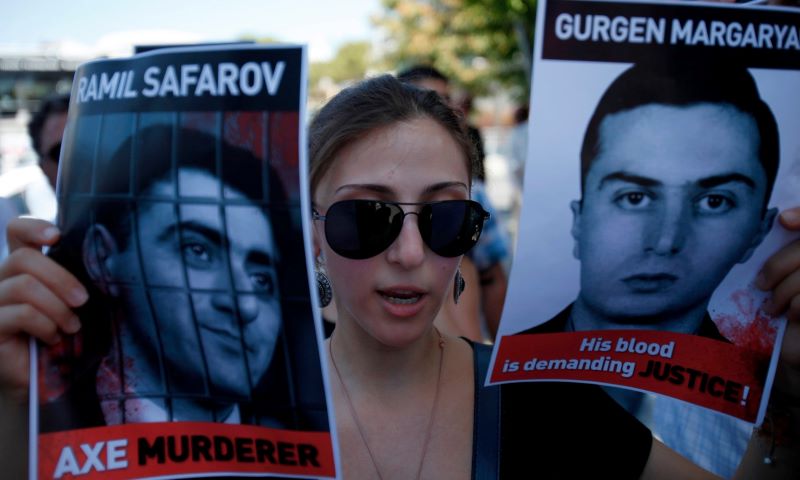
The relatives of Armenian officer Gurgen Margaryan, who was killed by Azerbaijani officer Ramil Safarov, are hopeful that the European Court will deliver a verdict on 26 May against Hungary and Azerbaijan, The Guardian reports.
Gurgen Margaryan was killed in February 2004 while participating in a NATO English-language training programme in Budapest.
During subsequent court hearings, the Azerbaijani officer-murderer confirmed that his actions were motivated by hatred towards Armenia and Armenians because of the war between the two countries, the newspaper noted.
“Although that abhorrent incident took place 16 years ago, it remains in my memory to this day,” said officer Hayk Makuchyan, who was also attacked by Safarov in Budapest. He and Margaryan’s relatives are applicants in the case before the ECHR.
As The Guardian noted, they do not expect material compensation from any government. “We seek justice, not compensation. What matters to us is that the gross violations be recognised, that impunity be ended and that hatred towards Armenians be prevented,” Makuchyan said in a letter sent by email.
Nazeli Vardanyan, the applicants’ lawyer, also stated that Margaryan’s family does not want material compensation. “They want justice,” she said.
As the newspaper noted, “tens of thousands of people were killed in a war in the early 1990s between Armenia and Azerbaijan over the disputed territory of Nagorno-Karabakh. A ceasefire was agreed, but the region still sees periodic military operations. Since those times, there have been no diplomatic relations between the two countries and no tourist links.”
According to the newspaper, “the 2004 killing further inflamed tensions.”
On 31 August 2012, Safarov was extradited to Azerbaijan, where he was immediately pardoned, promoted in rank and given gifts — a house and eight years’ worth of back pay.
“Azerbaijan’s shameful act puts the security of the entire South Caucasus at risk,” then-president Serzh Sargsyan said after Safarov’s release.
“Making a hero out of a criminal is unacceptable,” he added.
In Vardanyan’s words, “we wanted the court to rule that he be returned to Hungary or a third country so that he could complete his sentence, because in Azerbaijan he is considered a hero.”
Philip Leach, director of the European Human Rights Advocacy Centre, who also represents the applicants, said the case covers new legal ground and the court’s decision could have serious consequences for future prisoner transfers.
“Around the world, people are quite often pardoned or granted amnesty for political reasons, but when a state grants amnesty or a pardon, that often violates their obligations in the field of human rights,” he said.
Hungary’s ombudsman’s 2012 report stated that Hungary had not violated any international law, but it nevertheless follows that the Hungarian government “was not sufficiently cautious when it did not demand any guarantees from Azerbaijan.”
The decision was made when Hungarian Prime Minister Viktor Orbán visited Baku.
“As far as Hungary is concerned, I have mixed feelings — gratitude towards the Hungarian judiciary, which was strong enough in the administration of justice… and disappointment connected with the extradition of the murderer, contrary to judicial decisions, and the constant danger of impunity,” Makuchyan said.