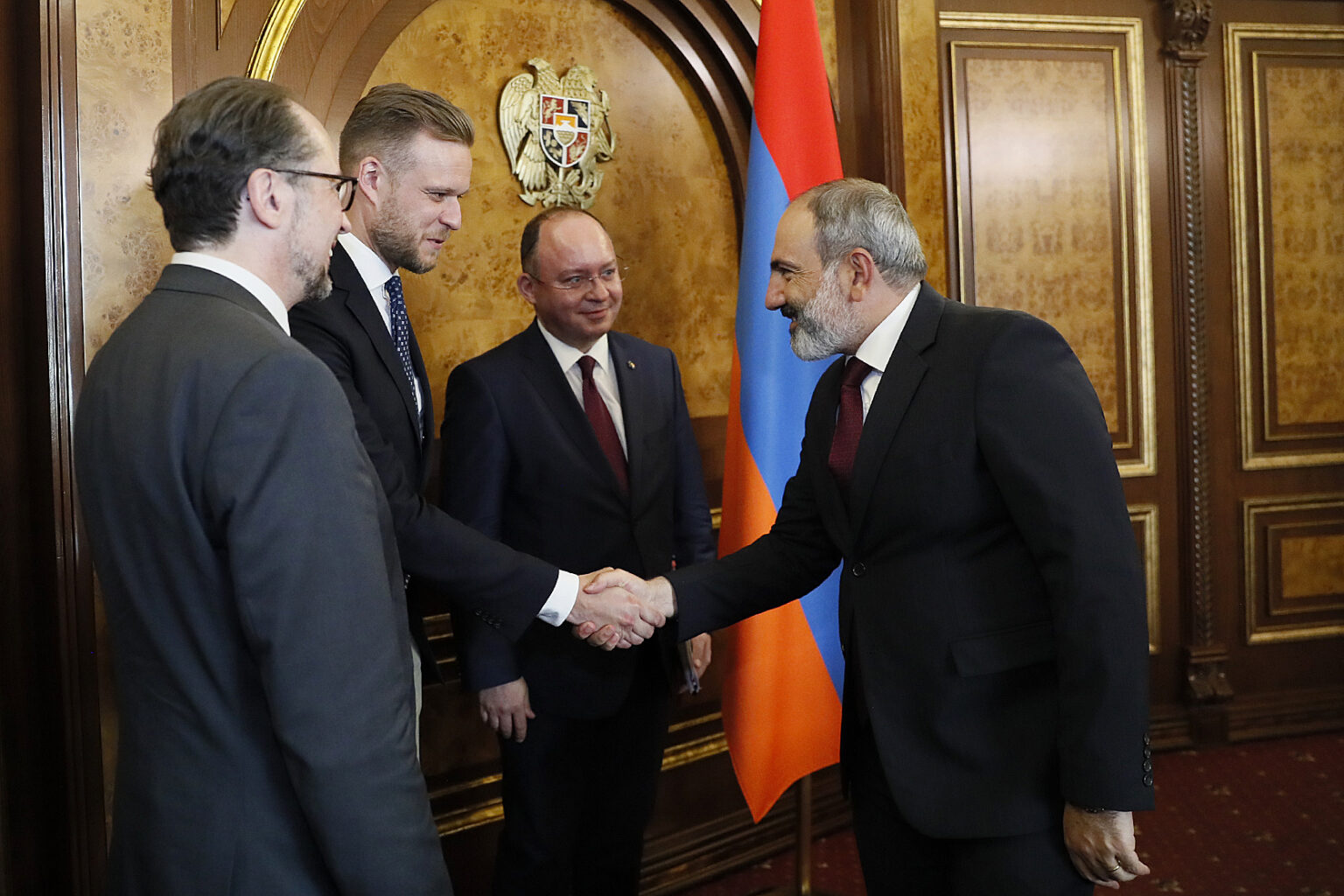
Acting Prime Minister Nikol Pashinyan received Romania’s Minister of Foreign Affairs Bogdan Aurescu, Lithuania’s Minister of Foreign Affairs Gabrielius Landsbergis, Austria’s Federal Minister for European and International Affairs Alexander Schallenberg, as well as EEAS Managing Director for Russia, Eastern Partnership, Central Asia, Regional Cooperation and OSCE Michael Siebert, and EU Special Representative for the South Caucasus and the crisis in Georgia Toivo Klaar. The visit was authorized by the EU High Representative for Foreign Affairs and Security Policy Josep Borrell.
Nikol Pashinyan welcomed such a representative visit to our country, recalling that it had been planned at a time when Armenia faced more crises than solutions. “I am glad that the visit took place at a time when elections were held in Armenia, the results of which confirmed our people’s commitment to democratic values, the quality of which was highly assessed by international organizations,” the acting Prime Minister noted. According to Nikol Pashinyan, the political crisis in Armenia has thus been overcome, and the government can fully return to the implementation of its most important work agenda, including the effective implementation of the provisions of the Comprehensive and Enhanced Partnership Agreement with the European Union.
Romania’s Minister of Foreign Affairs Bogdan Aurescu noted that a regional visit with such a delegation takes place for the first time in history, and one of its primary goals is the promotion of Armenia-EU relations. Romania’s Foreign Minister congratulated Nikol Pashinyan on holding the elections at a high level, on the victory of the “Civil Contract” party, as well as on the entry into force of the Comprehensive and Enhanced Partnership Agreement as of March 1 of this year. He emphasized for Armenia the importance of deriving maximum benefit from the aforementioned agreement and underscored the EU’s readiness to support the Armenian government with renewed vigor in advancing institutional reforms.
Lithuania’s Minister of Foreign Affairs Gabrielius Landsbergis noted the importance of strengthening security and stability in the South Caucasus, adding that it is of key significance for them also in the context of ensuring their own security. Lithuania’s Foreign Minister noted the need to create and strengthen an atmosphere of trust between the parties to the Nagorno-Karabakh conflict, adding that the EU is ready to provide its support in this matter as well. Gabrielius Landsbergis in this regard emphasized the resolution of humanitarian issues, including the return of prisoners of war held in Azerbaijan.
Austria’s Federal Minister for European and International Affairs Alexander Schallenberg also referred to the results of the elections held in Armenia, noting that apart from the victory of the “Civil Contract” party, democracy won in them. According to him, to the joy of the Armenian people, those who predicted problems during the elections in Armenia turned out to be wrong, which also demonstrates Armenia’s commitment to democratic values.
Expressing gratitude for the opinions voiced, Nikol Pashinyan emphasized that the crisis situation created after the war, as well as the elections, recorded the viability of democracy in our country, therefore democracy in Armenia is now an irreversible process.
During the meeting, the interlocutors discussed issues related to the Armenia-EU relations agenda, as well as the situation created in the region and its resolution.
Nikol Pashinyan highly assessed the role of the EU, in particular, the President of the European Council Charles Michel, in ensuring the return of 15 Armenian prisoners of war from Azerbaijan, and noted that Armenia is ready to respond to the humanitarian step with a corresponding step. The acting Prime Minister emphasized the need for the full implementation of the trilateral agreement signed by Azerbaijan on November 9, 2020, the return of all detained prisoners of war, as well as the peaceful resolution of the situation created on the Armenian-Azerbaijani border. The acting Prime Minister stressed that the issue must be resolved exclusively by the withdrawal of representatives of the Azerbaijani armed forces from Armenia’s sovereign territory to their starting positions, and recalled that he had earlier come forward with a corresponding proposal on this issue. Referring to the Nagorno-Karabakh issue, Nikol Pashinyan noted that the process of comprehensive settlement of the conflict should take place within the framework of the OSCE Minsk Group.