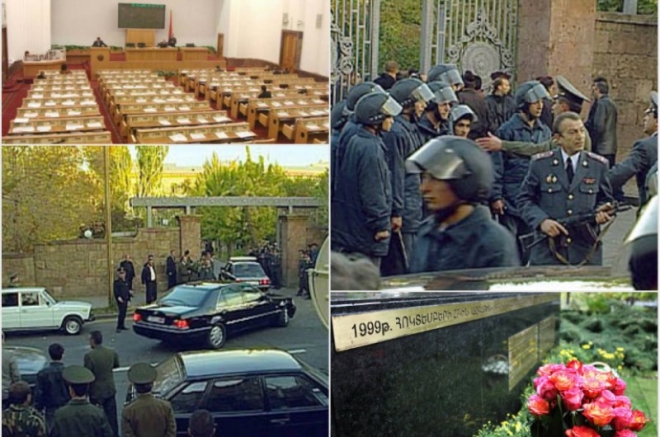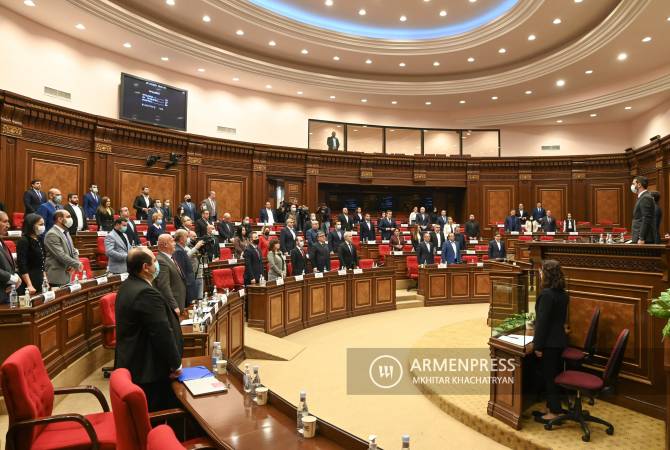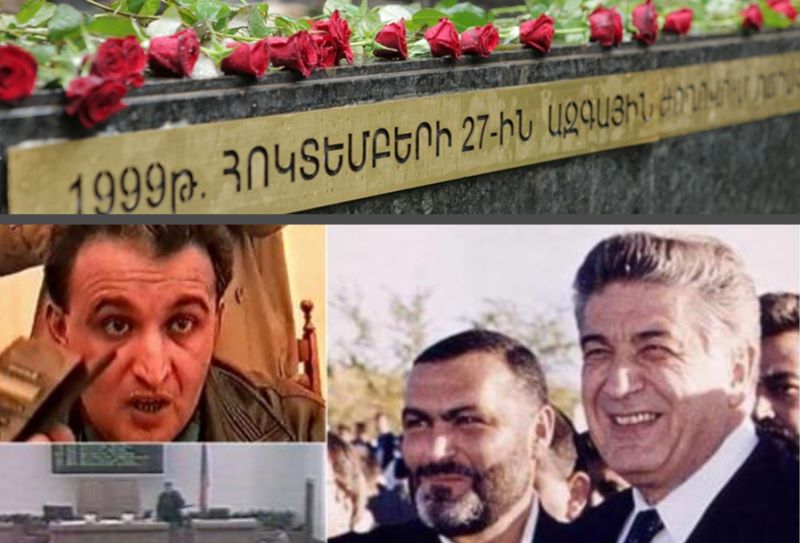
One of the darkest, most tragic and most hope-dashing dates in the modern history of our people is, without doubt, October 27, 1999.
On that ominous and calamitous Wednesday, the terrorist, fully armed group led by Nairi Hunanyan, by means still undisclosed, succeeded in entering the hall of the National Assembly of the Republic of Armenia and, with frenzied savagery, massacred the President of the National Assembly Karen Demirchyan, the Prime Minister of the Republic of Armenia Vazgen Sargsyan, the Deputy Presidents of the National Assembly Yuri Bakhshyan and Ruben Mirzoyan, the Minister of the Republic of Armenia for Governmental Affairs Leonard Petrosyan, and the deputies of the National Assembly Armenak Armenakyan, Henrik Abrahamyan and Mikael Kotanyan.
There were also numerous wounded. And the 91 hostages, for the most part deputies of the National Assembly, were released only at dawn the following day.
Abominable and utterly horrifying was, certainly, the brutal massacre, but even more disquieting is the fact that Hunanyan and his other loathsome wretches, by beheading our government and the leadership of the National Assembly, not only alarmingly shook the very foundations of our statehood, but also trampled upon and violated our national dignity.
The developments related to the blood-soaked incident further entangled the already strictly perplexing tangle of events. Literally moments after the shootings and killings, with astonishing “flair,” employees of the American CNN news agency appeared in front of the National Assembly building, armed with their recording devices. The American journalists, considering him a most reliable source, turned to Hagop Avetikian, editor of the “Azg” newspaper, who, with equally remarkable diligence, had immediately arrived at the scene.
After the release of the hostages, the armed terrorists demanded to conduct direct negotiations solely with the President of the Republic of Armenia Robert Kocharyan and, it is known, succeeded in obtaining exhaustive assurances that a fair trial would take place and that a death sentence would be categorically excluded. However, to this day, all other details of the negotiating conversation remain unknown.
According to the testimony of journalists who witnessed the killings and were then taken hostage, the terrorists had clearly declared that what had been done was a blow against the state, from which it could be inferred that other persons were also involved in that treasonous adventure. There were also other well-founded data which, likewise, in a certain way suggested the presence of accomplices; however, in this direction, the investigations carried out remained completely fruitless, and their conclusions more than unconvincing. The trial, which lasted nearly three years, also failed to provide any clarification on this matter. In other words, the true motives of the crime remain unknown to this day.
Indisputably clear, however, is one thing. As a direct consequence of this merciless violence, the parliamentary “Miasnutyun” alliance, which had been brought to life with the support of Karen Demirchyan and Vazgen Sargsyan and which, evidently, until that accursed day, was the politically dominant force in Armenia, suffered greatly.
The murderers were, in the end, sentenced to life imprisonment. But, while Hunanyan continues to be in perfect health, many of the participants in the treacherous act, as well as many of those who testified about the tragic event, are, to this day, dead, with vague or questionable explanations. The criminals Eduard Grigoryan, Norayr Yeghiazaryan, Vram Galstyan and Hamlet Stepanyan died under almost suspicious circumstances. Meanwhile, journalist Tigran Naghdalyan, a close acquaintance of Hunanyan, witness Mushegh Movsisyan, official of the state records department Hasmik Abrahamyan, former nurse of the National Assembly Roza Hovhannisyan and former correspondent of state television Tigran Nazaryan (the latter two in the United States), all died under extremely mysterious conditions.
Regarding the horrifying incident, there certainly exist hypotheses, none of which, however, has been authentically substantiated so far. One of the hypotheses, surprisingly, coincides with the Artsakh issue currently agitating us as a nation. Apparently, during that period, especially with the direct intervention of foreign states, diligent work was being carried out to implement the “Meghri option” of exchanging territories between Armenia and Azerbaijan, which proposed that the regions of Shushi and Lachin be officially given to Armenia, while the Meghri region be given to Azerbaijan. There is a conviction that Karen Demirchyan and Vazgen Sargsyan were extremely opposed to this option.
The following facts, however, are certain. On the eve of the great crime, that is, on October 26, an American three-member delegation led by the Deputy Secretary of State of the United States Strobe Talbott departed for Baku, where official negotiations took place. The same delegation arrived in Yerevan on October 27, was received by President Robert Kocharyan, and negotiations took place, in which also participated Foreign Minister Vartan Oskanian and Prime Minister Vazgen Sargsyan. At the end of the negotiations, the late Prime Minister hurried to the National Assembly hall, where a parliamentary session was in progress. And Vartan Oskanian accompanied the foreign diplomats to the airport, from where the American delegation was, in the end, to depart for Ankara.
To what extent all this is directly or indirectly related to the subsequent abominable events has not yet been revealed.
However, the bloody atrocity of that day is an UNFORGIVABLE crime aimed at undermining the foundations of our statehood and directed against the credit and prestige of our homeland, whose remaining unresolved is a most grave shame and an alarming, unending nightmare for all of us, without exception.
Twenty-two long years have already passed. It is necessary that, promptly and definitively, we wipe this degrading stigma from our brows, once and for all.
Asadour Devletian
Nicosia, Cyprus