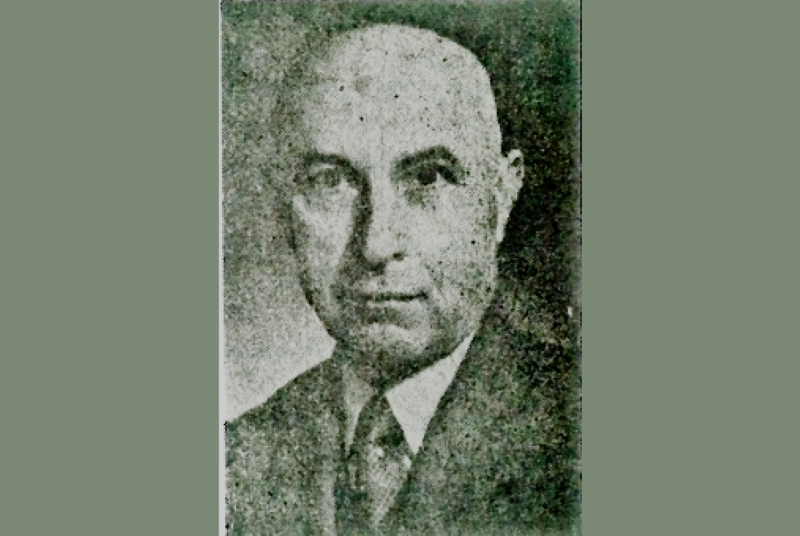
Gurgen Hamalian
1896: Aintab – 18 October 1968: Beirut
The esteemed Gurgen Hamalian was born in Aintab (present-day Turkey) in April 1896, under the Armenian-loving roof of Hagop Hamalian and Zaruhi Pastajian. In 1899, the Vartanian Society of Aintab laid the foundation of Aintab’s national kindergarten. His father, Hagop, was known in Aintab as a church-loving and education-loving national figure, and was one of the directors of the Vartanian Society. Gurgen became one of the first children to attend the national kindergarten, entering there to continue through the primary and secondary sections of the Vartanian School.
In 1912, for higher education, Gurgen entered the Cilician Seminary, becoming one of the institution’s first students. In September 1915, the Hamalian family was forced to join the caravan being deported to Der-Zor (Syria).
Gurgen’s father, Hagop, who was widely known as Hagop Effendi, had been a master weaver in a textile factory in Aintab. Through a Turkish friend, he managed to escape via Birecik and settle in Nusaybin, where he entered a government workshop as head of the textile department. This workshop in Nusaybin became a blessing for hundreds of Armenian deportees, including Gurgen, who was saved from conscription and received his initial training in creativity and handicrafts there. In 1918, when the Ottoman state’s strictures against deported Armenians periodically relaxed, Gurgen chose as his life partner the daughter of an Aintab family, Levonik Hindoyan.
In 1919, when the Urfa-Birecik-Aintab region came under the control of the British army, the Hamalians were among the first to return to Aintab, throwing themselves into the work of reconstruction. The following year, when Aintab’s self-defence was being planned, Gurgen joined the Armenian Regiment, because in Aintab he had been a member of the local Constitutional Ramgavar club, while his father was already a member of Aintab’s National Union.
By 1922, after the evacuation of Cilicia, the Armenians of Aintab too had begun to leave their ancestral homes and properties. After settling in Aleppo, Hagop Effendi, together with his compatriot Levon Nazarian, founded the Hamalian-Nazarian silk goods store. Gurgen preferred to undertake his own personal business, and established a furniture factory on Aleppo’s busiest avenue. Over the years, his furniture factory became one of the city’s finest establishments.
With his membership in the ranks of the Ramgavar Party, Gurgen became an enthusiastic participant in the party’s local unit in the Aleppo district.
The bustle of public life had already absorbed Gurgen. Aleppo, known as the first station, had become an important centre for Armenians fleeing the genocide and displacement, with its educational institutions. An auxiliary administrative body had been formed for the “Aleppo Aintab Educational School,” of which Gurgen was an active participant, following his father’s example. In Aleppo, Gurgen became a member of the local branch of the Armenian General Benevolent Union, whose mission had become the work of gathering orphans under its care, especially after the evacuation of Cilicia’s Armenians.
Gurgen and Levonik’s marriage blessed them in Aleppo with five children, three boys – Hagop, Sarkis and Onnik – and two girls – Zaruhi and Gekhanush – all of whom, in the future, would participate in the youth programmes of the AGBU’s “Armenian Youth Association” (AYA) in Aleppo.
In 1927, when the Armenian Democratic Liberal Party undertook the publication of the “Yeprad” daily newspaper, whose ownership was assumed by the “Syrian-Armenian Publishing Society,” and whose editorial board members were chosen as Tigran Piranian, Nazareth Fistigjian, Dr. Khatchig Boghosian and Hampartsum Berberian. Gurgen became responsible for materially supporting the newspaper. The publication of “Yeprad” had become an extremely important obligation for the esteemed figure, and in 1930 the daily became the official organ of the Armenian Democratic Liberal Party of Syria. During that period, Gurgen was also entrusted with important positions, and he frequently travelled to various regions of Syria undertaking organisational missions.
Apart from the “Yeprad” daily, the esteemed figure considered important the gathering of his compatriots from his birthplace, Aintab, and took an active role in Aleppo within the advisory body of the Aintab National Union. Gurgen had made the “Hay Aintab” periodical the object of his affection, becoming the unofficial managing clerk of the Aintabtsis’ Union.
Gurgen Hamalian’s fruitful participation in years of national and public activity was not without its encouragement of the publication, in 1946, of Aris Shaklian’s book “Midink.” Shaklian, in those years, was the editor of “Yeprat,” the ADL’s official organ, before repatriating to the homeland.
In 1945, in Syria, the “Repatriation Committee,” organising repatriation to the homeland, was formed, of which the esteemed Gurgen Hamalian became treasurer. The work of repatriation was considered by Gurgen a duty of serving patriotism. For about two years, even setting aside his business, he devoted himself to that programme. It must be said that the contribution of Syria’s repatriation committee was great in the realisation of the repatriation programme in 1946-47.
In 1950, Gurgen lost his father. Thereafter, his eldest son, Hagop, assisted him in the work of keeping the furniture factory establishment open. In 1956, in Aleppo, he was awarded the AGBU’s veteran’s certificate. Gurgen had limited his activity in national-public life to regularly following the Armenian press of the time, with “Hayastani Gochnag” as a serious publication, and “Zartonk” as the official organ of the ideology, having become his permanent sources of information. As for “Nayiri,” “Pishig” and “Shirak,” he would often seek them out to accumulate knowledge.
Gradually, the members of his family, and especially his children, had begun to move to Beirut, Lebanon, and to continue their lives there, as well as their organisational activities. Gurgen too would surely join his relatives. After losing his wife, he would surely remain surrounded, especially by his growing grandchildren.
As a pilgrim of patriotism, in 1965 he visited Armenia and also enjoyed the Nor Aintab town near Yerevan. And in 1967, he had the opportunity to visit his birthplace, Aintab.
The second joy of visiting the homeland was not granted to him, due to a relentless illness, of which he would become the victim at the age of 72, in Beirut, in October 1968, receiving a funeral ceremony with national solemnity.
XXXXXXXXXXXXXXXXXXXXXXXXXX
The author of these lines, during his student years in Beirut, had become closely acquainted with the organisational-public activities of the esteemed figure’s three sons.
Ara Aharonian