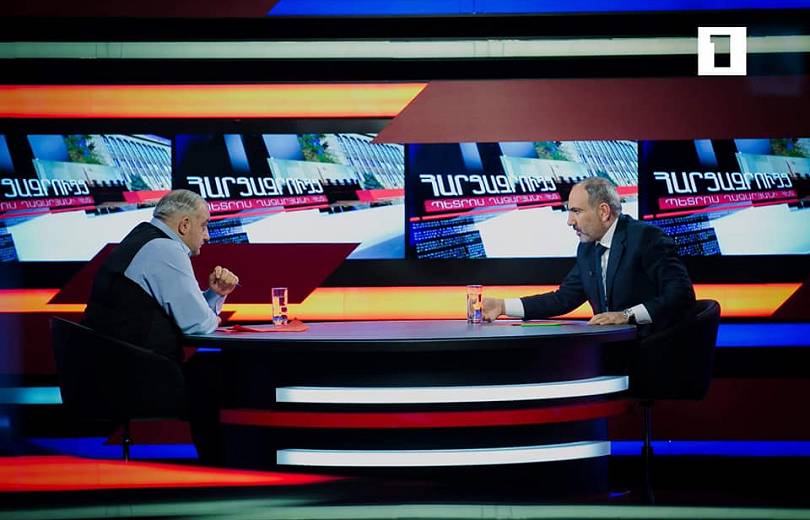
I believe that the discussion on the Nagorno-Karabakh issue with Azerbaijani President Ilham Aliyev within the framework of the Munich Security Conference has turning-point significance. This was stated by Armenian Prime Minister Nikol Pashinyan on 20 February in an interview given to the Public Television Company.
“Since May 2018, Azerbaijan has been trying to convince the entire international community that Armenia has a destructive position on the Karabakh issue. That conversation very clearly showed the international community that Armenia has a constructive position on the Karabakh issue, while Azerbaijan has a destructive position, reaching even racism, on the Karabakh issue. This is the most important result,” he noted.
According to the Prime Minister, the second most important result is that he has fulfilled one of the most important promises made to the Armenian people: “I said that I would have no secrets from the people of the Republic of Armenia regarding the negotiation process on the Karabakh issue. The times are past when a narrow circle of experts had to master the essence of the Karabakh issue. The entire Armenian people must be aware of the content of the Karabakh issue.”
In addition, in his words, as a consequence of that meeting, something very important took place: “A new negotiating content for the Karabakh issue is being formed, which I conditionally call the Munich principles.”
Nikol Pashinyan stressed that if there is a proposal for an equally effective instrument for ensuring security, let that proposal be formulated, and the Armenian people will discuss whether it is acceptable to them or not: “We say that when that ‘status quo’ was formed, when the self-defence forces of Artsakh took those territories under control, they did so in order to remove Azerbaijan’s aggressive actions from Nagorno-Karabakh as far as possible, to the point of making them unreachable. If there is a proposal for an equally effective instrument for ensuring security, let that proposal be formulated, and the Armenian people will discuss whether it is acceptable to them or not.”
The Prime Minister stressed once again that Nagorno-Karabakh gained independence just as Azerbaijan did: “When they speak of the principle of territorial integrity, they speak of the principle of the territorial integrity of a country. When Azerbaijan gained independence, did it preserve the territorial integrity of the Soviet Union? A counter-question may be raised that the state of the Soviet Union no longer exists, but neither does the state within which Nagorno-Karabakh was part — that state is the Azerbaijani Soviet Socialist Republic. This thesis has nuances that must be taken into account.”