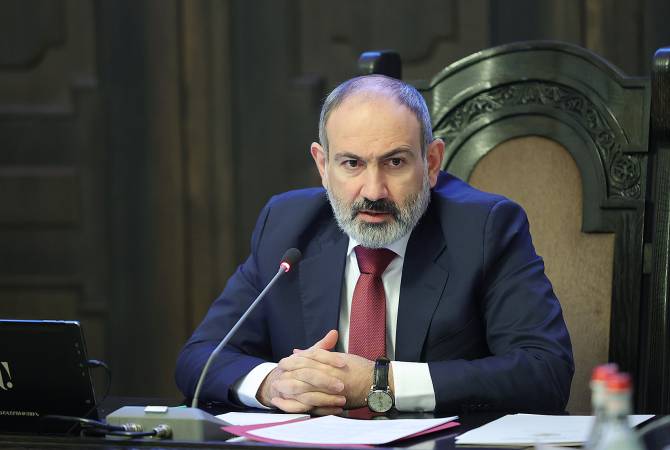
“As for handing over Artsakh, asking forgiveness a thousand times, I am compelled to note that Artsakh is not his to hand over; it is not an object that you hand over or do not hand over,” Prime Minister Nikol Pashinyan said during a government meeting.
“I want you to be aware that I have kept the President of Nagorno-Karabakh informed, in a working manner, about the content of my Moscow negotiations related to the settlement of the Nagorno-Karabakh issue,” he added.
Pashinyan noted that this working style is not new; it has always been the practice following negotiations and discussions held in Russia, Europe, and Armenia, and the President of Artsakh, for his part, has presented the results of those negotiations to Artsakh’s political elite.
“This practice will always continue; moreover, after every stage of negotiations, I share detailed information with the most diverse governmental and political circles in Armenia, and I have always shown readiness to share that content also with the parliamentary opposition, but the latter have always refused such discussions — perhaps for understandable reasons, in order to create myths about various conspiracy theories and place those myths at the foundation of their activities,” he said.
Pashinyan added: “Particularly after 9 November 2020, before practically every foreign visit of mine, rumours have been spread through all possible sources that I was preparing to sign some document regarding the Nagorno-Karabakh settlement, by which Artsakh was to be handed over to Azerbaijan. I say with responsibility that during this period and at this moment there has been and there is no project or draft of a Nagorno-Karabakh settlement that is on the table or has been put into circulation. As for handing over Artsakh, asking forgiveness a thousand times, I am compelled to note that Artsakh is not his to hand over; it is not an object that you hand over or do not hand over; Artsakh is first and foremost the people living there. If we were the ones handing over Artsakh, after the 44-day war we would not have spent tens of billions of drams to ensure the return of Artsakh residents to their homes. One who hands over Artsakh would, on the contrary, have simply undertaken nothing after the war, and the handing over of Artsakh would in essence have become a reality.
We, on the contrary, are making investments of unprecedented scale in Artsakh, because keeping Artsakh means keeping the Artsakh resident in Artsakh. Keeping Armenia means keeping the Armenian resident in Armenia, and also bringing back those who have left. And this is impossible without peace. Not to mention — I simply rule out that there exists a document more or less close to signing that would be signed without broad public discussion, including with all segments of Artsakh’s society. This is an iron guarantee that the fate of Artsakh cannot be decided behind the people’s back,” he said.
According to Pashinyan, in this regard the pessimists cite the example of the trilateral statement of 9 November 2020, which was signed without broad public discussion. “This is a strange comparison, because under conditions of war, decisions had to be made within hours, sometimes minutes, on the question of saving the lives of thousands of Artsakh residents, 25,000 soldiers, and Artsakh from depopulation. The comparisons are simply not apt. But, on the other hand, all our policy and steps are directed precisely at ensuring that we are not compelled to make decisions under such conditions,” he said.
According to Pashinyan, at this moment the public is familiar with the content of all the papers that are the subject of the Armenian-Azerbaijani negotiations. That is the 5 points conveyed by Azerbaijan to the Armenian side, and the Armenian side’s response to them, which has been published in full.