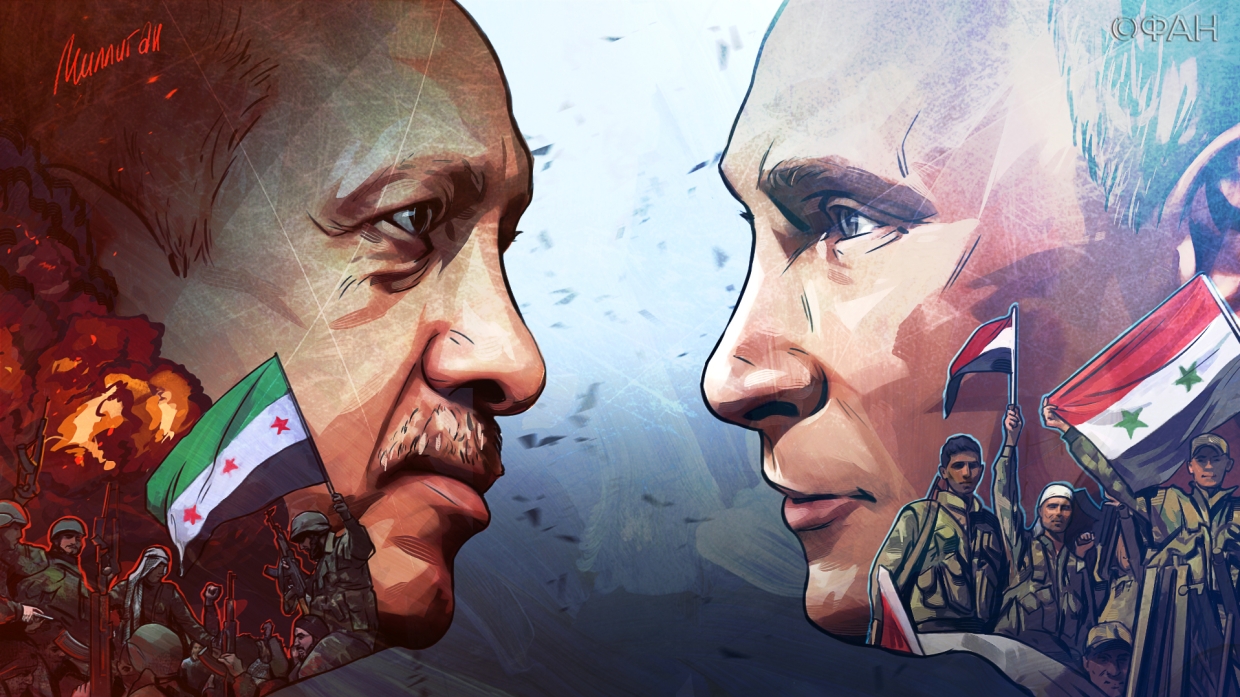
A historically insoluble and endless contradiction exists between the preservation of the territorial integrity of the Russian Empire and the programs of Pan-Turkism — the creation of the Turkish state of Greater Turan. Throughout the course of history, the national ideologies of Russians and Turks collide. The Russians, guided by the foundations of their own national ideology, have over the centuries conquered vast territories and created a powerful multinational empire, which includes a large number of Turkic-speaking peoples. Turkey strives to realize the programs of Pan-Turkism — the creation of the state of Greater Turan, which pursues the dismemberment of the Russian Empire, the separation of territories inhabited by Turkic-speaking peoples from Russia.
Historical overview.-
After the fall of the Kingdom of Cilicia, the main struggle to possess the Armenian homeland was waged between the Ottoman Empire and Persia. That struggle came to an end with the treaty of 1639, according to which Western Armenia passed under Turkish rule, and Eastern Armenia — to Persia. From the second half of the 17th century, Russia began to show great interest in the shores of the Black Sea, the Dardanelles and the Bosphorus, Transcaucasia and the territories of the Balkan Slavic peoples. The Eastern Question created great opportunities for the Tsarist Empire to intervene in the division of the inheritance of the “sick man” — Turkey.
The Russian Empire aimed to capture the shores of the Black Sea, the straits, the territories of the Christian peoples of the Balkan Peninsula, Transcaucasia and Western Armenia. The Tsarist Empire struggled to reach the Mediterranean Sea. Towards the end of the 18th century, Russia managed to capture the northern shores of the Black Sea, and at the beginning of the 19th century — Transcaucasia. By capturing Transcaucasia, Tsarist Russia became the most powerful military-political factor in that region. Obviously, no problem in this region could be solved without Russia’s participation.
Persia, having annexed Persian Armenia, passes into the political life of the region as a secondary actor. The arena of the struggle for Armenia remains between Russia and Turkey. Both Russia and Turkey are colonial powers. If Russia sought to dismember the Ottoman Empire, capturing part of its territories and gaining access to the Mediterranean Sea, then Turkey fought to preserve the integrity of the Ottoman Empire and for the creation of the state of Greater Turan, most of whose territories were within Tsarist Russia.
Undoubtedly, the creation of the state of Greater Turan would lead to the disintegration of the Russian Empire — the separation of the living spaces of Turkic-speaking peoples from Russia. Therefore, historically, the confrontation between Russia and Turkey is inevitable. Both Russia and Turkey avoid having a major clash, waiting for the opportune moment, but both sides understand the inevitability of that clash. In the event of defeat, Russia would cease to be a superpower. It is precisely for this reason that the consistent anti-Turkish policy (except for the period 1917-1923) pursued by the Tsarist Empire for centuries is explained.
But that by no means meant that Russia was fighting to grant independence to the peoples conquered by the Ottoman Empire. Colonial Russia fought to conquer new colonies. Tsarist Russia never had a real plan to give Armenia independence. However, in certain circumstances, compelled by historical situations, Russia was forced to recognize the independence of a number of peoples liberated from the rule of the Ottoman Empire.
However, there were radical differences between the colonial conquests of Russia and Turkey. Turkey conquered and appropriated the homelands of other peoples, while physically annihilating the population. Russia, on the contrary, pursued a traditional colonial policy — with all its negative consequences. The colonized peoples in the empire ensured their physical existence, cohesion, and the preservation and development of their national culture. This is why Russian rule is characterized in Armenian historiography as the “lesser of two evils”. In the created historical situation, the Armenian people, it seems, has no alternative. The historical destinies of the Russian Empire and Armenia are intertwined.
From the perspective of solving the strategic problems of its national ideology, the Armenian people must always remain within the orbit of Russia’s strategic programs, regardless of the fact that Russia adopts whatever social system as its form of government. For our newly independent statehood, it would be preferable to cooperate with a democratic, lawful and predictable Russia.
Here it must also be fairly emphasized that the RATIFICATION by Russia of the infamous treaties of Moscow and Kars, signed in March and October of 1921, is UNACCEPTABLE. By those treaties, Turkey was given Kars, Ardahan and Surmalu — with Mount Ararat, Georgia received Batum, and Nakhichevan was given to Azerbaijan.
The Russians today are fully reaping the fruits of that anti-Armenian activity in Syria and other countries, and it is no coincidence that in March of this year, well-known Turkish political figures threatened to “blow up Russia from within with 25 million Muslims”, which is also a threat to Armenian statehood. Thus, the future of Russia’s geopolitical interests in the South Caucasus largely depends on Armenia. Recently, on the Syrian question, the well-known Russian expert Stanislav Tarasov expressed the following thought: “Putin is not Lenin, and Erdogan is not Atatürk”, and continued by saying, “Turkey and Azerbaijan strike from behind Russia’s back, and Russia has serious trump cards (referring to the treaties of Moscow and Kars) against Turkey and Azerbaijan, and it is time they be revised”.
The Russian-Turkish conflict has a centuries-long history, which has very often led to wars. That struggle continues to this day and must ultimately end with the victory of one of the parties. Here, it seems, there are no compromise options, and an uncompromising struggle of the national ideologies of Russians and Turks is unfolding, in peaceful and non-peaceful forms. The existential struggle of Russia and Turkey, governed for centuries by the policy of land-grabbing, is INEVITABLE. In this historical existential struggle of these two states, in which the defeat of Turkey is inevitable, the Armenian people also has its important place and role, and the Armenian Question is dependent on and connected to its outcome. This is why, in the Russian-Turkish struggle, the Armenian people cannot take a neutral position, and our newly independent statehood must certainly have its tactical and strategic programs in relation to this important issue.
Kevork Haleblean