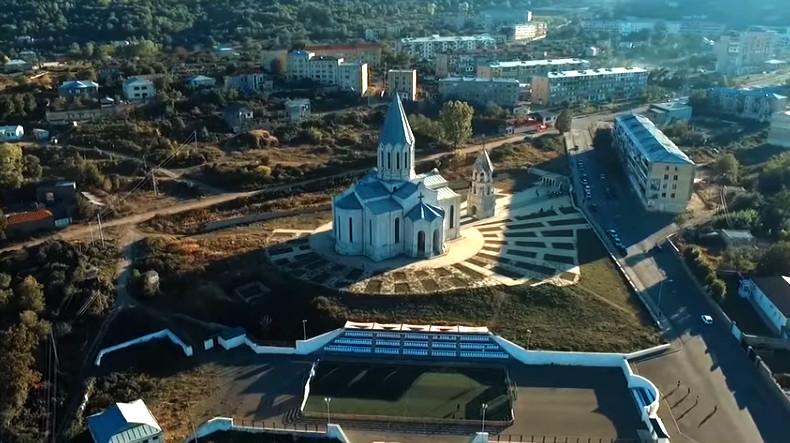
By the agreement signed on November 9, 2020 by Russia, Armenia and Azerbaijan, the historic fortress city of Shushi was surrendered to the Azerbaijani authorities.
This elevated city, full of architectural monuments, holds a special place within the territory of the land of Artsakh. There stand buildings and structures that were the cultural and architectural riches of our people. There were born Leo, Marajakht Baghramyan, Catholicos Karekin I Hovsepian, Muratsan, World War II hero Nelson Stepanyan, Gen. Daniel Pirumyan and other worthy Armenians.
Shushi, by its natural position, has military-strategic importance, especially for the Armenians of the Varanda district, who in the past had turned the city into an impregnable fortress to defend against the attacks of barbarians.
Among Shushi’s historic monuments, one may mention the Holy Savior Ghazanchetsots Cathedral (built in the years 1868-1887), as well as three churches bearing the name of the Holy Mother of God: Kusants (1816), Aguletsots (1822) and Meghretsots (1838).
Shushi, as an important medieval fortress, is mentioned in various manuscripts as the fortress of Shushi or Karaglukh.
In the 18th century, the population of Shushi was able to resist the Ottoman army on numerous occasions, thanks to the fortress wall built in 1724 by the region’s melikdom.
In the middle of the 18th century, the melikdom of Varanda, including Shushi, unjustly passes into the hands of Melik Shahnazar. This situation causes anger among the other four melikdoms of Karabakh, especially since Shahnazar establishes friendship with Panah Khan, the chief of the wandering Tatar tribes of Lowland Karabakh or Ganja, and in 1752 hands over to him the fortress of Shushi, which becomes Panah’s seat and is named Panahabad. During this same period, Panah cultivates friendly relations with the Ottoman Empire, which begins to sharpen its appetite for conquering Artsakh, but since the Persians had a similar appetite, the Ottoman advance is halted.
Particularly in the decade of 1780-1790, Shushi becomes one of the most important military-political centers of Transcaucasia, always successfully resisting the attacks made upon it.
It was only in 1795 that the fortress city was to surrender to an aggressor, the Persian Agha Mohammad Khan Qajar, who was planning to conquer all of Transcaucasia and, in order to halt the advance of the Russian army, felt the need to have Shushi under his counterweight.
In 1805, the Russo-Persian agreement stipulates that Artsakh be placed under the Russian counterweight, and Russian military detachments enter Shushi.
Two decades later, in the summer of 1826, the Persian forces make a final attempt under the leadership of Abbas Mirza to capture Shushi, but in vain.
In 1828, when the Caucasus becomes a Russian possession, the Armenians of Artsakh and the city of Shushi find the opportunity to engage in fruitful educational and cultural activity. A period of awakening begins. Schools are built, the number of which reaches 20 by the turn of the century. Printing presses are founded and newspapers are published: “Haykakan Ashkharh”, “Krunk”, “Azgagrakan Hantes”, “Paylak”, “Tsiatsan”, “Gharbaghi Surhandak” and others.
Alongside these, Shushi has libraries and a theater hall, to whose activities Proshyan and V. Papazyan are said to have contributed their participation.
Shushi also becomes an important commercial center. Factories, workshops and trading houses are established in its vicinity. The shoes produced there reach as far as the northern cities of Russia.
With its rich national life and pleasant climate, Shushi becomes a sought-after summer resort for the Armenians of the Caucasus at the beginning of the century.
The population of the fortress city at the turn of the century numbered around 25,000 Armenians, but the insecure conditions created after the appointment of Khosrov bek Sultanov become the occasion for Azerbaijanis to massacre around 30,000 Armenians there. And in 1923, by Stalin’s infamous intrigue, Shushi is placed entirely under Azerbaijani domination, and throughout the entire duration of Soviet rule the city’s Armenian population fluctuates between 2,000 and 2,400.
***
In late February 1988, while the Artsakh claim struggle was gaining momentum in Yerevan and Stepanakert, Azerbaijanis in Shushi displace some 2,000 Armenian residents, and the fortress city is used for the purpose of bombarding Stepanakert, located 7 miles away.
On January 26, 1990, by decision of the Soviet authorities, after the notorious pogroms of Baku, Gen. Safonov is sent to Artsakh, who establishes close ties with the Azerbaijanis. The Azerbaijani OMON units, without hindrance, displace and subject to every kind of hardship the Armenians of Shahumyan and lowland Ganja. Safonov further orders that Stepanakert’s means of communication be cut off from the outside world, and the OMON units, using their exceptional military position, become a scourge for the Armenians of the region.
The situation continues thus until the beginning of 1992. On January 6 of that year, the people of Artsakh elect their parliament under the presidency of 33-year-old Artur Mkrtchyan, as well as a government under the prime ministership of Oleg Yesayan. And during the period extending from February to April, heroic Artsakh fighters liberate the territories seized by the Azerbaijanis and put the OMON units to flight. There remains one final task: the liberation of Shushi, from whose heights the Azerbaijanis continued to deal deadly blows to the Armenians. The indomitable spirit of the Artsakh people overcomes that barrier as well, and on May 8, 1992, taking the enemy by surprise, the brave fighters of Artsakh liberate it, and on May 10 remove the last Azerbaijani from there, forever saving the residents of Stepanakert from Azerbaijani bombardments.
The very next day, the courageous leader of Artsakh, Bishop Pargev Martirosyan, celebrates the Divine Liturgy in the Holy Savior Ghazanchetsots Church, and displaced Shushintsis begin to return to their homes.
After the liberation of Shushi, the Artsakh detachments were also to neutralize the heights of Lisagor and, on May 17, clear the Lachin corridor, opening the unifying road between Artsakh and Armenia, which extends from Goris to Stepanakert.
The liberation of Shushi is one of the important events of our modern history, which was made possible by the full cooperation of the Republic of Armenia.
SHUSHI-BORN HAMBARDZUM ARAKELYAN
THE BENEFACTOR OF THE RAMGAVAR AZADAGAN PARTY
(Shushi 1855 – Tiflis 1918)
Founder of the Armenian Popular Party
Arakelyan was born in Shushi in 1855, where he attended the local primary school for his early education.
He then moves to Tabriz to continue his studies.
His thirst for learning takes him to Baku, where there existed the bustle of an Armenian colony; there Hambardzum was to receive his higher education, and his talents for writing were discovered in him when he was only 17 years old.
The newspaper “Mshak”, published in Tiflis, reached Baku and Tabriz in those days, fostering among the Armenian-speaking generation of the local colony an awakening of Armenian identity preservation.
The paper’s publisher, Krikor Artsruni, being acquainted with Hambardzum’s abilities and writing talent, asks that he contribute correspondence for the Caucasian Armenian paper, particularly related to the daily life of the Persian Armenians.
During the same period, he also collaborates with the pages of “Megu Hayastani”, further absorbing his time with journalistic work.
In Tabriz, he succeeds in undertaking the founding of a reading hall, where students who had completed their secondary education would attend to become acquainted with the newspapers arriving there and, through them, with information and the way of life of the colonies.
Beginning with the teaching profession, Arakelyan first worked within the schools of Tabriz, and then in 1881 was invited to his birthplace, Karabakh.
In Karabakh, he becomes the inspector of the local coeducational schools, a position which he competently held for the following ten years.
The ideology spread by Mkrtich Portukalian in Van, as a source of enlightenment for the Armenian masses, was to serve as a foundation for Arakelyan to begin the Armenian Benevolent Society of the Caucasus in Shushi.
Within a short time, the Society has its own reading room; Arakelyan had already, during his time in Tabriz, founded the first Armenian reading room there, where copies of the “Mshak” newspaper were always available, alongside the novels of Raffi.
After the death of Krikor Artsruni, he is invited to Tiflis to edit “Mshak” in 1892, assisting Aleksandr Galandarian, a publication that had been for Arakelyan the first step of his journalism and public life.
But for him, the editorial position seemed insufficient, and in Tiflis he was to found a branch of the Armenian Benevolent Society, becoming its director.
The newly created branch of Tiflis gradually becomes a beacon for the strengthening of the Armenian colony of the Caucasus, and unfolds public activity through the library founded by Arakelyan, whose directorship he was to assume until the year 1898.
During this period, we find him absorbed in the national and public daily life of Tiflis, becoming a trustee of the local schools, and then president of the national trusteeship.
In addition, he also represents the diocese of the Armenians of Georgia at the election of the Catholicos of All Armenians in Etchmiadzin, and was also to be elected president of the Armenian branch of the People’s University of Tiflis.
Arakelyan had become a worthy representative of the Armenian colony, unconditionally enjoying popularity and sympathy, and for that reason was to be elected for a period as a member of the Tiflis city council, further strengthening his ties with Russian and Georgian officials.
His daily involvement with the press, and his privilege of mastering foreign languages, were to open wide horizons for him to spread his ideology of enlightenment on the pages of both the Armenian and foreign press. He maintained frequent collaboration with the newspapers “Hantes Amsorya”, “Ararat”, “Kordz”, “Hayrenik”, “Haykakan Ashkharh”, “Arevelk”.
The translation of “Wilhelm Tell” was for Arakelyan the work of sowing the spirit of freedom, after which translations of “Guy de Maupassant” and “Clarimont” also came to add to his rich series of labors.
At the turn of the century, the Armenian colony of Tiflis did not lack intellectual figures, editors, press workers and especially educational workers, among whom it was Arakelyan’s lot to gather around himself, through “Mshak”, a host of qualified intellectuals.
He believed in the necessity of making the Armenian Question known to foreigners, and for that purpose in 1901 in Glasgow (Scotland), he participated in the peace congress, succeeding in raising the Armenian Question.
And a year later, in Paris, he succeeded in presenting reports on the Armenian Question to the French Congress, on the basis of which it was possible to convey decisions to the relevant states. In 1904, for the same purpose, he participates in the Congress convened in The Hague, after which he was to become convinced that the liberation of Armenian lands would always remain dependent on the strengthening of the Russian army.
Gradually, Arakelyan was to become a sought-after envoy for the Eastern Armenians, joining international associations, among which may be counted the Russian Geographical Society and the “Société Asiatique” of Paris.
In 1910, alongside the “Mshak” newspaper, he undertakes the publication of the monthly “Aror”, which over time was to enjoy the unconditional appreciation of the intellectual class.
But unfortunately, Arakelyan’s multifaceted situation was to cause the monthly to cease in 1913.
Alongside his fruitful public life, he was also to make literary attempts, presenting himself to the public under the pen name Shahriar.
By 1917, Arakelyan was already ready, together with the national figures gathered around “Mshak”, to found the Armenian Popular Party, which was not the result of chance, but was the ideology preached by Hambardzum Arakelyan, sowing popular principles to lead the homeland-deprived Armenian people toward enlightenment.
Joined to Arakelyan were the party’s leaders, Samson Harutyunyan and Mikael Papajanyan.
Within a short time, the newly formed party was to enjoy popularity in Tiflis, and when in the autumn of that same year the Russian revolution broke out and the tsarist government collapsed, for Arakelyan it remained to further strengthen the organization.
During this period, uncertainty certainly prevailed among the peoples of the Caucasus, and the Eastern Armenians were greeting alarming months.
He had become a sought-after orator and knew how to lead the people with his speeches.
But the hostility of the socialist forces had become evident within that period, and the number of those persecuting him had increased on the eve of the Battle of Sardarapat.
Not long after, on July 6, 1918, some 40 days after the declaration of the First Republic of Armenia, he was to fall victim to the bullet of a Dashnak, while from the stage he was proclaiming the spirit of popular ideology.
The party movement founded by Arakelyan, thanks to his like-minded associates, was to remain standing within the Republic of Armenia and was also to form part of its government.
Ten months after the Sovietization of Armenia, the Popular Party was also to become one of the democratic currents forming the Ramgavar Azadagan Party, on October 1, 1921.
From the scholarly labors of the benefactor Hambardzum Arakelyan, there remains to us as inheritance booklets of the “Popular Mesropian Library” series, as well as an encyclopedia, the second volume of which is found in the state of an unpublished manuscript at the Charents Museum of Art and Literature in Yerevan.