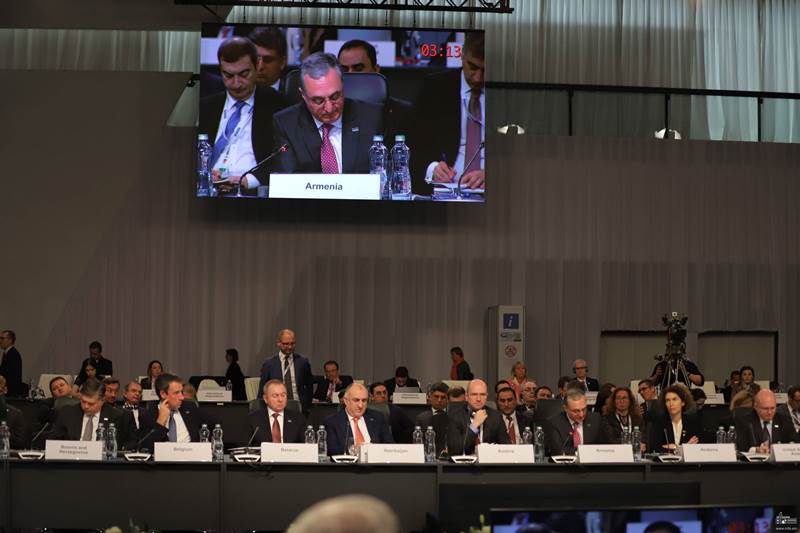
Armenia’s Minister of Foreign Affairs Zohrab Mnatsakanyan delivered a speech at the 26th OSCE Ministerial Conference taking place in Bratislava, and primarily presented Armenia’s position on the key issues of the peaceful resolution of the Nagorno-Karabakh conflict.
The Minister stated that a day earlier he had a meeting with his Azerbaijani counterpart and the OSCE Minsk Group Co-Chairs, and that the regular consultations were held, which were the fifth of their kind during this year. In this regard, he highlighted the seven main points of Armenia’s position regarding the key issues of the peaceful settlement of the Nagorno-Karabakh conflict.
“First. The conflict, which is being addressed within the framework of the OSCE Minsk Group Co-Chairmanship, which enjoys an international mandate and support, has no alternative to peaceful settlement.
“Second. The inalienable right of the people of Artsakh to self-determination is the fundamental principle and basis of peaceful settlement. Recognition of this principle implies that the determination of the final status of Artsakh cannot be subject to any limitation, which must be clearly and unambiguously accepted. The term ‘without limitations’ clearly points to the right of the people of Artsakh to have and determine their status, outside Azerbaijan’s jurisdiction, sovereignty and territorial integrity. Azerbaijan’s ongoing hostile policy and the actions deriving from it create an existential physical security threat for the people of Artsakh, which was also expressed in April 2016 in the latest aggression carried out by Azerbaijan against Artsakh; all this highlights the illegitimacy and impossibility of implementation of Azerbaijan’s claim of jurisdiction over the people of Artsakh.
“Azerbaijan must assume the direct obligation to recognize the right of the people living in Artsakh to self-determination without any limitation, through a legally binding free expression of will.
“Third. The security of the people of Artsakh is not subject to concession. Under no circumstances should the people of Artsakh be left without the security lines necessary for their protection. There can be no situation that would create an immediate danger to the existential security of the people of Artsakh, as was the case in 1991-1994 and in 2016. To further emphasize this point, I wish to refer to the situation created in the territories of Artsakh currently under Azerbaijani occupation, where Armenians were subjected to ethnic cleansing and which are now fully resettled by Azerbaijanis. This reality has recently been presented by the Azerbaijani leadership as a good example of the settlement of the Nagorno-Karabakh issue.
“Fourth. The peaceful settlement must be inclusive, with the direct involvement of all parties to the conflict. Therefore, Artsakh, through its representatives elected by its people, must be a direct party to the negotiation process. In this regard, we emphasize the need for the full involvement of the elected representatives of Artsakh in the peace process, particularly in substantive matters. The Government of Armenia will never resort to actions that could violate the right of the people of Artsakh to freely determine their own political status and deprive them of a sense of ownership over this process.
“Fifth. The process of peaceful settlement of the issue has no alternative. Artsakh has the full capacity to protect itself and its people. Armenia continues to be the sole guarantor of Artsakh’s security. A peaceful settlement cannot proceed in an environment of tension and escalation of risks. Consequently, the ceasefire agreements of 1994 and 1995 between Azerbaijan, Artsakh and Armenia must be strictly observed and strengthened. Risk reduction mechanisms must be introduced, including OSCE mechanisms for investigating ceasefire violations and monitoring the ceasefire regime, including through the expansion of the capacities of the office of the Personal Representative of the OSCE Chairperson-in-Office.
“Sixth. There must be unconditional adherence to the fundamental principle of non-use of force and threat of force. The policy of hatred, intolerance, xenophobia and Armenophobia instigated and directed by the Azerbaijani leadership must be condemned. Efforts must be invested in preparing the peoples for peace and in shaping an environment conducive to peace.
“Seventh. Azerbaijan’s maximalist positions, which do not take into account the will and concerns of the people of Artsakh, are fundamental obstacles to substantive progress in the peace settlement process. Evidence of this is the inability of the Azerbaijani authorities to reciprocate Armenia’s call for compromise. I recall that the Prime Minister of Armenia demonstrated strong political will by declaring that any settlement must be acceptable to the peoples of Armenia, Artsakh and Azerbaijan, which means that a settlement is possible only through compromises,” enumerated Minister Mnatsakanyan.
Armenia’s Minister of Foreign Affairs confirmed that Armenia is committed to the negotiation process and will continue to work consistently towards a peaceful settlement. At the same time, he deemed unacceptable the preconditions presented by Azerbaijan for the peace process in light of the current domestic political developments unfolding in that country, which were published in a document circulated on the eve of the ministerial council.
“Armenia rejects such a non-constructive approach. Last month we demonstrated a modest but important example of confidence-building between all parties to the conflict. The exchange of journalists from Armenia, Artsakh and Azerbaijan is a promising example of confidence-building and inclusive dialogue at the public level between the parties. We are ready to build further on this experience. Also, the relatively low level of violations along the line of contact and the interstate border, as well as the use of direct communication links, must be maintained and expanded. Nevertheless, we continue to be seriously concerned by the fact that despite these measures, casualties and injuries have continued to be recorded, which could have been avoided.
“The implementation of already undertaken commitments is of key importance for building confidence towards the prospect of a final settlement of the issue,” concluded Mnatsakanyan.