Let us set aside the irony, however, and turn to the essential question of the expansion of the Armenian state’s borders. As is well known, the dissolution of the Ottoman Empire was decided by the Treaty of Versailles, but the settlement of the manifold problems arising from it — the Balkan, Arab, Armenian, Kurdish and other questions — was left to subsequent negotiations and conferences. The negotiations, disputes and bargaining lasted more than a year, and in the summer of 1920, at the Sevres conference, it became possible to have the Ottoman government accept the burial of the mighty empire of the Selims and Suleymans. The Treaty of Sevres was signed on 10 August 1920. Beneath it, their signatures were placed by the representatives of the “great allies” and “minor allies” (Armenia, Greece, Poland and others — Hamdi Pasha, Riza Tevfik Bey and Khalil Bey). On behalf of the Republic of Armenia, A. Aharonyan signed. Hejaz and Yugoslavia were dissatisfied and refused to sign the treaty.

SEVRES – FRANCE, Where the Treaty Was Signed
Naturally, we are interested in those articles of the treaty that pertain to Armenia. Here are the most important passages of those articles.
Article 88._ Turkey declares that it recognises Armenia as a free and independent state, as the allied states had done before.
Article 89._ Turkey and Armenia, as well as the other high contracting parties, agree to submit to the arbitration of the President of the United States the question of determining the border between Turkey and Armenia in the provinces of Erzurum, Trebizond, Van and Bitlis, and to accept all the provisions prepared by the President regarding the military neutralisation of all Ottoman Armenians.

Article 90._ When, in accordance with Article 89, the border having been determined, all or part of the lands of the said provinces are transferred to Armenia, Turkey hereby declares that, from the date of the decision, it renounces all its rights over that transferred territory… (etc.).
Article 91._ When part of the lands mentioned in Article 89 is ceded to Armenia, for the purpose of drawing the border between Armenia and Turkey on the ground in accordance with the decision given, a boundary commission shall be constituted within three months from the decision provided for in the said Article 89, the composition of which shall be determined later.
Article 92._ The borders of Armenia with Azerbaijan and Georgia shall be determined by a collective agreement among the interested governments.
If, in any way, the interested powers, at the time the decision mentioned in Article 89 is given, fail to determine their borders by a collective agreement, then that border shall be determined by the principal allied powers. The authority to draw that border on the ground shall also belong to them.
Article 93._ Armenia accepts and agrees to implement the provisions to be included in a treaty to be concluded with the allied states, which the said states shall deem necessary for the protection of the interests of the people in Armenia who differ from the majority from the standpoint of race, language and religion… (etc.).

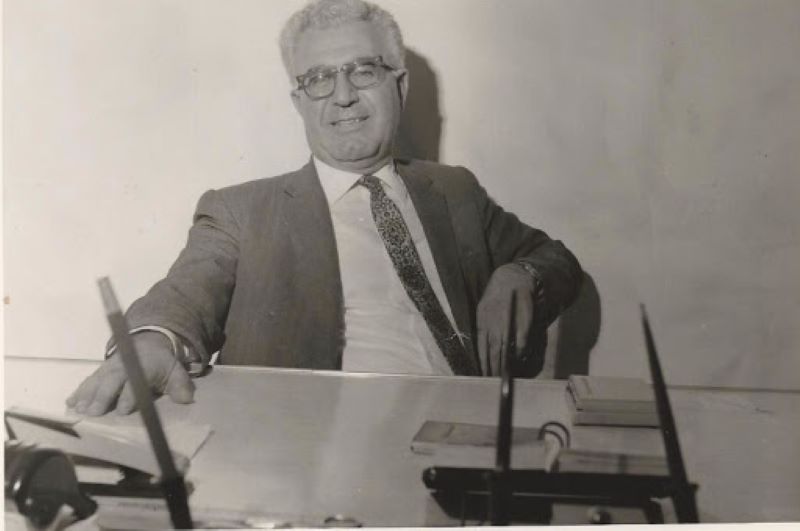
Kersam Aharonyan
It must be added here immediately that, in the few months following the delimitation, it was realised “by the arbitration of the President of the United States”, and on 22 Nov. 1920 the map of Armenia with the Wilsonian borders was published. “The Wilsonian borders“ would have given us 68,500 square kilometres of territory from the vilayets of Van, Bitlis, Erzurum and Trebizond, and Trebizond would become an Armenian port: In fact, if the “Wilsonian gift” were added to the territory actually in Armenian hands and the Eastern Armenian lands rightfully ours in principle (Karabakh, Nakhichevan, Akhalkalak and others), we would have had a great state of around 130,000 square kilometres.
A sweet promise and a sweet prospect. But when we look at the last date we recorded above, we shall realise immediately that our people were face to face with a mirage, an illusion or a delusion. It was far too late to appropriate and enjoy the great gift of Sevres: this region of the world had been turned upside down, and fateful upheavals had been recorded in the Middle Eastern situation. And unfortunately, the Treaty of Sevres had taken on the character of a historical irony.
Excerpt: From Kersam Aharonyan’s
volume “On the Road of the Great Dream”
Beirut-1964
The Treaty of Sevres – 10 August 1920