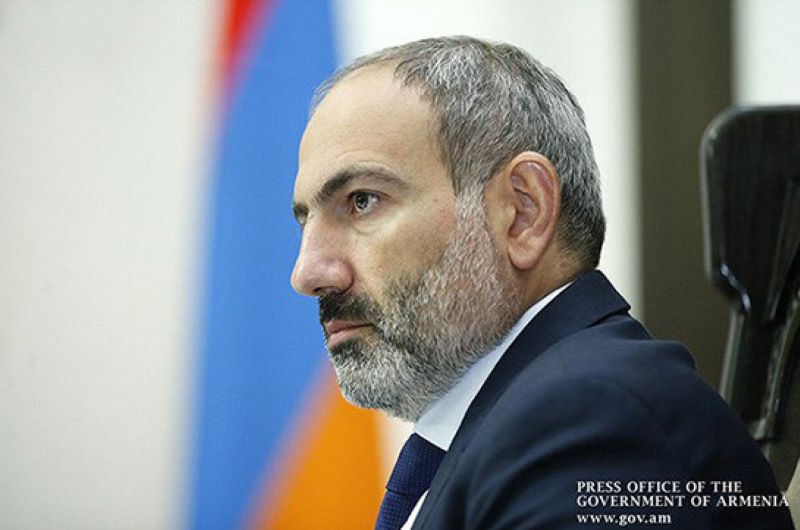
A conference titled “The Treaty of Sevres and the Armenian Question,” dedicated to the 100th anniversary of the Treaty of Sevres, has commenced at the National Academy of Sciences of Armenia in Yerevan. The Prime Minister of the Republic of Armenia, Nikol Pashinyan, addressed the conference participants with his welcoming remarks, which were read by the Vice-President of the National Academy of Sciences, Academician Yuri Shoukourian. Armenpress reports this.
“I welcome all participants of the conference dedicated to the 100th anniversary of the signing of the Treaty of Sevres. I express my deep gratitude for initiating this most important event. The Treaty of Sevres occupies a significant place in the modern history of the Armenian people. It is no coincidence that it continues to remain the subject of scientific studies and analyses. Therefore, it is highly important that our scholars’ impartial analyses of that document signed a century ago, the events preceding it, and the developments that followed be accessible to both our people and the broad international community. Today’s conference serves that very purpose, and I wish success to its proceedings, wishing everyone fruitful discussions and new important discoveries,” the Prime Minister of the Republic of Armenia stated.
In his welcoming remarks, Nikol Pashinyan emphasized that the Treaty of Sevres is a historical fact. It remains so to this day.
“Why is that document important for the Armenian people? Why does it remain at the center of our attention to this day? First, the Treaty of Sevres was concluded on the basis of the outcomes of one of the most dramatic pages in the history of humanity—the First World War—approximately two years after its end. Just as the Treaty of Versailles established peace in Europe, so too did the Treaty of Sevres in the territories of the Near East formerly belonging to the Ottoman Empire. It put an end to the sufferings and deprivations endured by the peoples of that region because of the war. It heralded the end of the ‘cursed years.’ Just as the Treaty of Versailles in Europe, so too did the Treaty of Sevres shape a new system of interstate relations in the region. It introduced new principles and values, establishing not only peace but also justice in the Near East,” Nikol Pashinyan stated, adding that the treaty was based on the most advanced ideas of its time. In his words, the key element was the principle of the self-determination and equality of nations. It put an end to the centuries-old slavery imposed by empires and granted freedom and independence to the peoples of the region.
“Moreover, by granting the right to establish national states in historical territories, it created favorable conditions for the coexistence of Muslim and Christian peoples in the region, their peaceful cohabitation, and the preservation and further development of the region’s civilizational diversity. Second, the Treaty of Sevres is the international document that recognized and codified the independence of Armenia. The Republic of Armenia acted as an equal party to that treaty. Centuries after the loss of independence, the authorities of Armenia, for the first time, concluded an international treaty together with the great powers of the world. The Republic of Armenia was recognized within the borders outlined in the treaty as a full member of international relations and an equal subject of international law,” Nikol Pashinyan stated.
The Prime Minister of the Republic of Armenia emphasized in his speech that, by being a party to the treaty, recognition was also given to the contribution of Armenia and the Armenian people to the victory of the Allied powers in the First World War and to the establishment of peace. The role of the Armenian people in international relations and the postwar governance of the world was emphasized and duly appreciated.
“Third, the Treaty of Sevres, through its Article 89, attested to and codified the Armenian people’s indisputable historical connection with the Armenian Highland, where for millennia the Armenian people had been born, lived, and built statehood and culture. And finally, the Treaty of Sevres was concluded in the period following the years of the Armenian Genocide. The Armenian people had been subjected to the most cruel and inhuman sufferings. Its losses were enormous. Yet the Treaty of Sevres paved the way for overcoming the consequences of the genocide. Through the establishment of independent statehood in the historical homeland of the Armenian people, the Armenian Question received a just solution, historical justice was restored, and favorable conditions were created for the restoration of our people’s economic and demographic potential, its normal development, and progress. Although the Treaty of Sevres was never brought to life, it continues to exist as a historical fact; it is our duty to remember it, to be aware of it, and to preserve its meaning,” Nikol Pashinyan concluded his remarks.