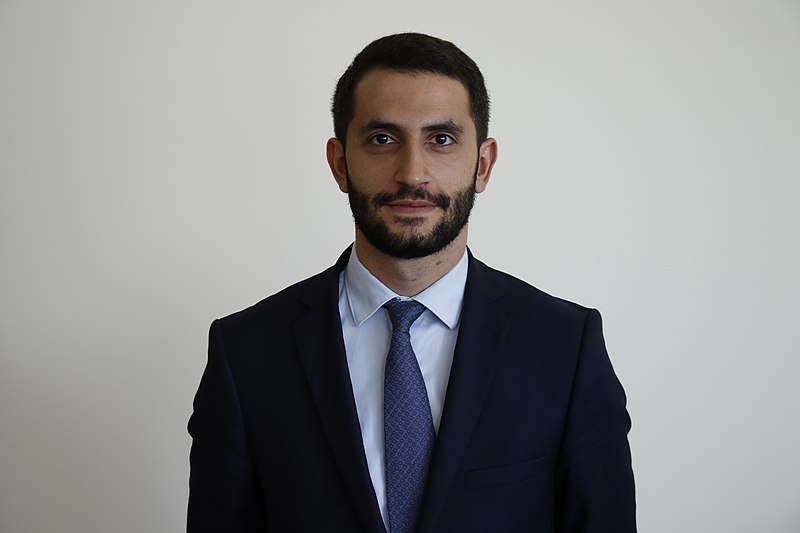
«Ramgavar Mamoul»’s exclusive interview with the Chairman of the RA National Assembly Standing Committee on Foreign Relations, Ruben Rubinyan.
– Mr. Rubinyan, many are of the opinion that after the Velvet Revolution, the spirit of the revolution seemingly did not enter the Ministry of Foreign Affairs. This is not only about a “cadre purge,” but about the approaches of the Ministry of Foreign Affairs, because we witnessed a more conservative policy. How do you interpret this situation?
First, I must say that I do not quite agree that the Velvet Revolution did not enter the Ministry of Foreign Affairs. It is true that there was no “cadre purge” and professional diplomats continued to work, but at the same time I must say that during the revolution a promise was made that there would be no political appointments among ambassadors, and we all know that before the revolution our diplomatic staff was full of non-diplomat ambassadors who, with some exceptions of course, were engaged in various other, non-diplomatic affairs, and this practice was stopped, and as a result of political appointments many so-called ambassadors were recalled. And in this regard, there is a change. In our foreign policy, although there have been no changes in the main directions, as was promised during the revolution, it should also be noted that there is at least a change in the manner of conducting foreign policy, and our foreign policy is now much more sovereign and based exclusively on the interests of Armenia, and we have no problem. The issues we see, we have presented and discussed with all states, including allied states. As for conservatism, I think it is the Foreign Minister’s job to be conservative, no matter how strange it sounds, because foreign policy does not like abrupt actions, abrupt turns and abrupt statements, if they are not necessary, and whoever the Foreign Minister is, yes, he is obliged to show a certain conservatism, which does not at all mean stagnation. After all, I do not think the current Foreign Minister is in stagnation, absolutely not. I see changes; we see very significant activity in some directions, for example the decision to establish an embassy in Israel, also in Ethiopia, which in reality is not discussed much, but I consider it a most important step. So I think we are moving forward and the Ministry of Foreign Affairs is moving forward. There are also changes in internal structures, which I am also pleased with.
– The RA Prime Minister often speaks with positive emphasis regarding the adversary Azerbaijan and highlights his observations about establishing peace. These approaches are certainly understandable to us, but we saw that there is no similar response from the other side. How would you interpret this situation, because in any political process, we cannot clap with one hand?
I unequivocally agree that you cannot clap with one hand and one side cannot achieve peace alone. Establishing lasting peace requires the work and readiness of all parties to the said conflict, and we see that the RA Prime Minister, as well as the Artsakh authorities, are ready for peace and are constructive, but at the same time we notice that we do not receive the same signals from Azerbaijan. The pain is that Azerbaijan is not constructive and, in essence, does not want a resolution of the conflict, and I think the international community, as well as the Minsk Group Co-Chairs, see this and see that there is not the constructiveness expected from Azerbaijan, and in this regard, I must say that this presents the Armenian sides, that is, the Republic of Armenia and Artsakh, in a more positive light.
– And at what stage is the negotiation process currently? We know that the opposition press has been speculating a lot on this topic since you came to power.
Regarding the speculation, I will say that for me it is unacceptable to speculate on the Artsakh issue in the internal political context, and I am not saying this now because I am in power. When I was in the opposition, speculating on the Artsakh issue was equally unacceptable to me. The situation is as follows: we say that for effective and substantive negotiations, an appropriate atmosphere is necessary, an atmosphere free from bellicose statements, free from bellicose actions, free from destructive statements, and this is very natural, because it is impossible to discuss something if the other side is not ready to discuss anything with you, or if the other side says from the outset, this is my line and I will not cross this line, that is, it kills the substance on the spot; it is impossible to discuss it with a side that is firing at you and killing your civilian population; it is impossible to have a substantive discussion with a side that constantly uses hate speech against your people. This is the situation, and we voice this position of ours, and we await corresponding changes in Azerbaijan’s policy.
– Let us turn to Turkey. Recently, Russian Foreign Minister Sergey Lavrov made a very noteworthy statement that Russia is ready to assist to some extent in opening a new page between Armenia and Turkey, to which the RA Prime Minister Nikol Pashinyan reacted by saying, “You don’t go swimming in Lake Sevan in winter…” What can you say in this regard?
I am, of course, glad that our partners are ready to assist in the normalization of Armenia-Turkey relations, but it must be emphasized that it is impossible to assist a process between two sides if one of the sides is not ready for it. The Armenian-Turkish border is closed by Turkey, not by Armenia. Armenia has always been ready and continues to remain ready, without any preconditions, to establish diplomatic relations with Turkey and is ready for the opening of the border, but we all know that Turkey conditions all this on other issues. Like Azerbaijan’s, Turkey’s approaches are not constructive. In any case, at this moment I do not particularly see signals regarding any positive change in Turkey’s policy on this issue.
– And on your table, as a body of the “Committee on Foreign Relations,” what is the agenda?
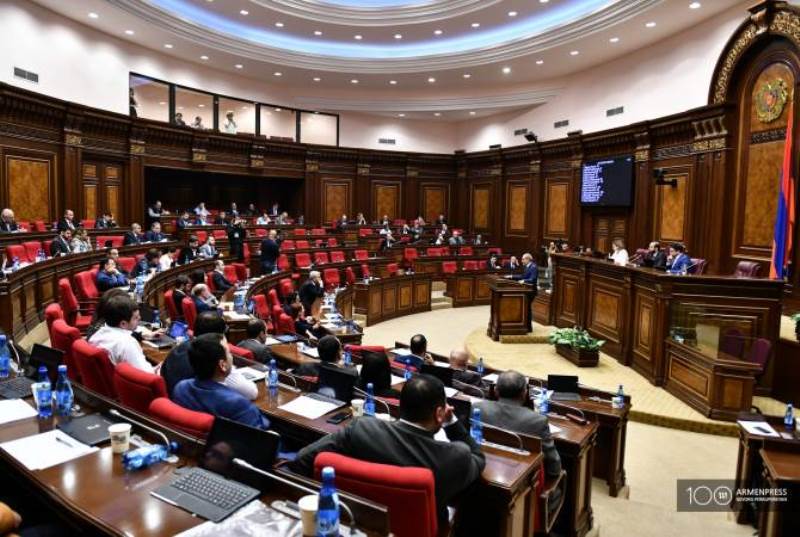
I think that the parliament, the deputies, and in the case of foreign policy, precisely the Committee on Foreign Relations, is the link that connects the agenda with the people, because foreign policy must be understandable and controllable for citizens, that is, there should not be a case that takes us by surprise. And such cases, unfortunately, have happened in the past, when citizens woke up one day and noticed that some significant foreign policy event had occurred and they did not understand why this event happened, on what grounds, and where it is leading.
The Committee on Foreign Relations has two main functions, the first of which, naturally, is parliamentary oversight, and the second function is the conduct and coordination of parliamentary diplomacy of the Committee on Foreign Relations.
I think parliamentary diplomacy is no less important than the diplomacy carried out by the executive, and in places parliamentary diplomacy has tools that the executive lacks.
– We started with the Velvet Revolution, and we want to end it that way. Do you have any concerns that there will be counterattacks against these authorities, because we see that especially in the media environment, there are constant arrows and mudslinging?
It is not that I have a concern, but those counterattacks exist; they have existed since the first day and continue. The representatives of the removed authoritarian regime and persons connected with them have not shied away from using any opportunity for manipulations during this year and a half. They have not shied away from throwing mud at both the current democratic authorities and the Velvet Revolution in general. I cannot say this was unexpected, but I think democracy in Armenia has no alternative and a return to the past is impossible, not because we, that is, the new authorities, are infallible, holy, or composed of superhumans, but for the simple reason that the citizens of Armenia have realized their strength and have realized that everything depends on them. The citizens of Armenia have realized that democracy, justice and the law have no alternative.
– We have noticed that a large percentage of the figures in power consist of young names. The large number of young figures is a novelty in Armenia. How do you explain this phenomenon, and what difficulties have we gone through?
The average age of the parliament is now close to 40, because there are 4-5 older deputies and the average changes, but I think the deputies of both the “My Step” and “Bright Armenia” factions are very young; 80 percent of the “My Step” faction will be in the 25 to 35 range. Of course, there is a legitimate concern about the lack of experience, so to speak. If we take my case, for example (now they say it a little less, naturally), immediately after the revolution, when I was appointed Deputy Foreign Minister and one heard, “but he is young, he has no experience,” I could in no way consider that concern illegitimate; it was a recording of fact. I think, however, that our team has shown during this year and a half that in any case the lack of experience has been compensated by political will, the desire to bring changes, and integrity, and why not, knowledge. Let us agree that it is better to be a 25-year-old inexperienced, well-educated and honest politician than a 58-year-old corrupt, illiterate scoundrel. It is natural; in general, history has cycles, and not only in Armenia — in all countries of the world where something changes, young reformers come, then some time passes, those reformers turn into stable figures, then after some period, people want changes again, new reformers come, and so the cycles continue. I think Armenia unequivocally needed reforms, drastic, large-scale reforms, a generational change if you will. And I am very glad that we achieved that generational change, and I do not think our inexperience has been an obstacle to it; I would even say it has helped in places.
The interview is by «Ramgavar Mamoul»
Biographical data
Ruben Karapeti Rubinyan
Born on 8 March 1990, in Yerevan.
Armenian politician, diplomat, deputy of the 7th convocation of the RA National Assembly, founding member of the “Civil Contract” party, member of its board, son of Karapet Rubinyan, former Vice-President of the RA National Assembly. Chairman of the RA NA Standing Committee on Foreign Relations.
Education
From 2006-2010 he studied at the Department of International Relations of Yerevan State University, after which he attended University College London (UCL) for one year, receiving a master’s degree specializing in “Politics and Security.” In 2012, he received a master’s degree in “European Studies” from the Jagiellonian University in Poland.
From 2012-2014 he served in the RA Armed Forces.
Professional activity
On 29 May 2018, by the decision of the RA Prime Minister Nikol Pashinyan, he was appointed Deputy Minister of Foreign Affairs.
In the National Assembly elections held on 9 December 2018, he was elected deputy on the national list of the “My Step” alliance.
He is the Chairman of the RA NA Standing Committee on Foreign Relations.
During the 5th congress of the “Civil Contract” party, held on 16 June 2019, he was elected a member of the CP board.