Prime Minister Nikol Pashinyan has given an interview to The Washington Post, in which he addressed Azerbaijan’s attack and military operations unleashed in Nagorno-Karabakh. The Prime Minister of Armenia also spoke about Turkey’s involvement.
We present David Ignatius’s article below.
“The escalating conflict between Armenia and Azerbaijan took a dangerous new turn Tuesday after Turkey shot down an Armenian warplane. Armenia’s prime minister expressed fear in an interview that it could draw Turkey and Armenia into a wider war.
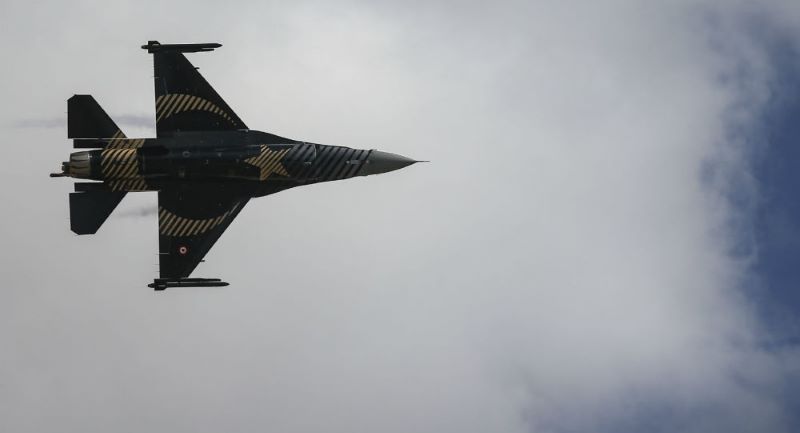
Armenian Prime Minister Nikol Pashinyan said in a telephone interview that Turkey is ‘creating instability in neighboring countries, in the eastern Mediterranean, the Middle East and now in the South Caucasus. This is a growing threat to global security.’ He said that apart from the aforementioned F-16 incident, since the resumption of the conflict on Sunday, Turkey has been helping Azerbaijan with drones and mercenaries.
The United States, Russia, France and Germany are calling on the parties to turn to diplomacy. Pashinyan said that he and his colleagues have already spoken with senior officials of all those countries. But so far no visible progress has been recorded toward a ceasefire or settlement negotiations.
The State Department is increasingly concerned about the confrontation between a key U.S. ally (NATO member Turkey) and Armenia, an ally of Russia.
Pashinyan said that the attack unleashed by Azerbaijan with Turkey’s support on the territory of Armenia proper has ‘now become a reality’ with the shelling of the Vardenis region east of the Armenian capital Yerevan.
He said the Turkish F-16, which reportedly shot down the Armenian Su-25 fighter, was supporting the Azerbaijani offensive in the Vardenis area. Russia’s TASS news agency reported on Tuesday the shooting down of the Armenian aircraft, citing a statement by Armenia’s Defense Ministry.
‘What is happening today is a declared war against the Armenian people,’ Pashinyan insisted. He said that because of the historical conflict with Turkey, his country today faces a ‘threat to its existence.’
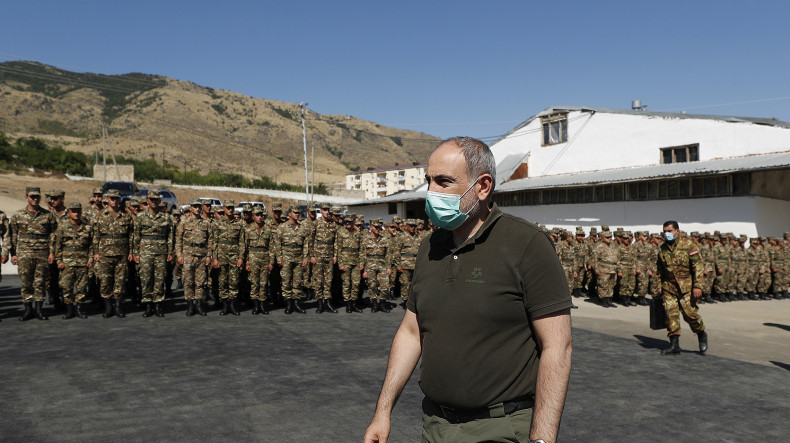
Responding to the threat of a possible attack from Azerbaijani Nakhichevan in the southwest of Armenia, Pashinyan said he had declared martial law and stressed: ‘We must use all means to defend ourselves.’
Elaborating on the Turkish threat, Pashinyan cited the massacre of more than 1 million Armenians in 1915 at the sunset of the Ottoman Empire, which, although recognized as ‘genocide’ in resolutions adopted by the U.S. Congress and many other countries, continues to be denied by Turkey.
‘The president of Turkey has turned denialism into the official policy of his state,’ Pashinyan said, adding: ‘Denialism is one of the preconditions for a new genocide.’
The Armenian prime minister said that since the fighting resumed on Sunday, Armenia has had dozens of casualties and around 200 wounded. He noted that the Azerbaijanis have lost several hundred soldiers, plus more than 100 artillery pieces, several helicopters and other equipment. He also said that since Armenian forces have repelled the attacks both toward Karabakh and toward Armenia, ‘I hope that eventually the president of Azerbaijan will understand that the Karabakh issue has no military solution.’
According to Pashinyan, during the week he discussed a possible diplomatic settlement with Russian President Vladimir Putin, French President Emmanuel Macron, German Chancellor Angela Merkel and UN Secretary-General Antonio Guterres.
The State Department said on Sunday that the United States is ‘alarmed by reports of large-scale military actions in Karabakh’ and warned ‘external actors to refrain from participating in the escalating conflict,’ indirectly alluding to Turkey.
The statement noted that Deputy Secretary of State Stephen Biegun called the foreign ministers of Azerbaijan and Armenia, ‘urging both sides to immediately cease military operations.’ Pashinyan indicated that further negotiations with U.S. officials are planned”