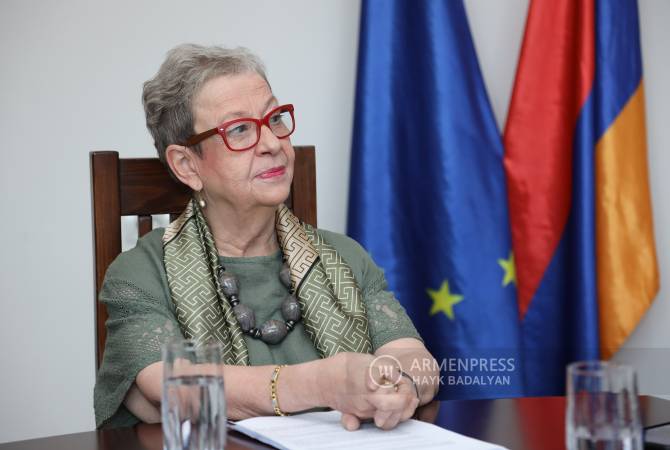
The European Union is interested in the reconciliation of Armenia and Azerbaijan and a lasting solution to the problem, said the head of the European Union Delegation to Armenia, Ambassador Andrea Wiktorin, in an interview with Armenpress, stressing that they mourn every incident.
More needs to be done to return the remaining prisoners, in the field of demining, and to achieve progress in the search for the missing, the ambassador noted.
Welcoming all efforts aimed at regulating Armenia-Azerbaijan relations, Andrea Wiktorin stressed that the European Union is in favour of a comprehensive settlement of all issues related to the conflict.
The European Union fully supports the advancement of the process under the auspices of the OSCE Minsk Group, the ambassador said, stressing that the process was, in fact, led by the co-chairs of the OSCE Minsk Group.
Referring to the regular consultations and visits to Yerevan and Baku by European Council President Charles Michel, as well as the EU Special Representative for the South Caucasus and the crisis in Georgia, Toivo Klaar, Andrea Wiktorin at the same time stressed that the European Union has now assumed a more active stance and plays a visible role at the highest possible level.
These efforts, according to the ambassador, are in no way intended to compete or are directed against other actors. “I must stress this, because there is much speculation on this issue. We must speak of complementarity, not competition. The three trilateral meetings — in December 2021, April and May 2022 in Brussels — were aimed at supporting a lasting settlement. At the same time, EU Special Representative Toivo Klaar initiated high-level meetings between the Secretary of the Security Council of Armenia, Armen Grigoryan, and the adviser to the President of Azerbaijan, Hikmet Hajiyev. These high-level mediations, the quality of contacts, are the contribution we can have in this matter, and the European Union is truly committed to continuing our efforts in these formats. Naturally, we listen to the wishes of both countries. But I repeat — this is not competition, this is complementarity through other efforts.”
Wiktorin also welcomed the direct contact between the foreign ministers of Armenia and Azerbaijan, which took place on July 16 in Tbilisi. “I believe that all these elements are coming together, and efforts are being made to find a lasting solution between the two countries,” the ambassador said.
Referring to Armenian-Turkish relations, Andrea Wiktorin said that the European Union supports the initiative of direct discussions between Armenia and Turkey, expressing the hope that this will lead to normalisation.
“The telephone conversation between Armenian Prime Minister Pashinyan and Turkish President Erdogan was an important step forward. The European Union has been active and supportive of the normalisation of Armenia-Turkey relations for years. We want to see progress, because we believe it is beneficial for the peoples and will open new opportunities,” the ambassador concluded.