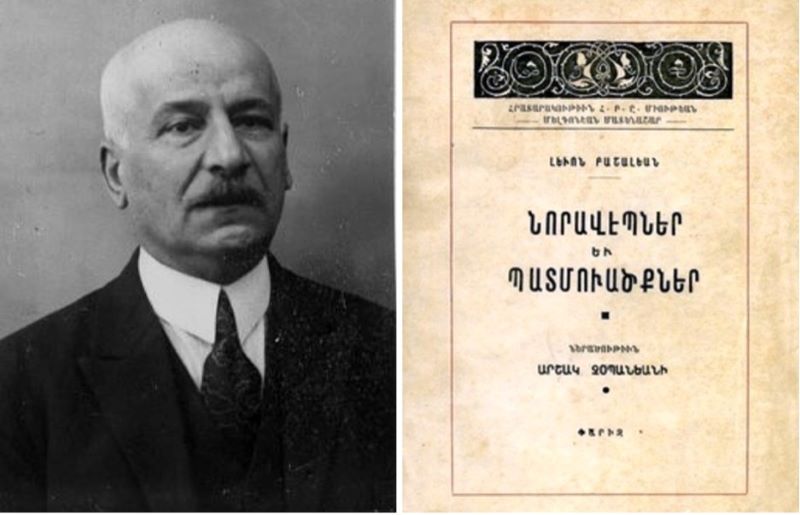
Levon Bashalian
(1868: Constantinople – 1943: Paris)
The benefactor Bashalian was born in the Scutari district of Constantinople, under the roof of parents from Kharpert. His father, a well-known architect in Constantinople, had designed and built the residences of the Ottoman state dignitaries of the time. As a youth, Levon attended the renowned Berberian secondary school of his district, studying under the school’s founder and principal, the noted educator and pedagogue Reteos Berberian. He completed his secondary education in 1883, gaining proficiency in Armenian and especially French. Without pursuing higher education, Levon preferred from a young age to seek journalistic work in Constantinople, and he was advised to apply to the editorial office of the Masis daily newspaper, for which his translations of short French news items made him a permanent staff member at the age of 16. During this period, Bashalian had already mastered the English language as well, and he translated for Masis from the English-language Times.
Bashalian was already in constant communication with his contemporaries Krikor Zohrab and Arpiar Arpiarian when, in 1885, he reviewed Zohrab’s novel A Vanished Generation in Arevelk.
As a literary work, his novella titled Hmayatap appeared in Masis in 1888, bringing popularity to the 20-year-old Bashalian among the Armenian community of Constantinople.
This novella marked the beginning of Bashalian’s realist literary legacy, and thanks to his journalistic career, he became closely acquainted with the daily life of the Armenian people, from which he drew the material and spirit of his subsequent novellas, imparting a unique style to his pen.
His ideological inclination went toward the Hunchakian Party, and together with Arpiarian he became a member of the party in Constantinople.
In August 1890, the Patriarchate demonstrations had created a wave of persecution and imprisonment for the intellectuals of Constantinople. To stay away from the persecutions of the Ottoman Empire, Bashalian took refuge in Paris, where he continued his journalistic work, this time for the Hayrenik newspaper published by Hovhannes Shahnazar and Arpiarian.
In 1892 he returned to Constantinople and assumed the editorship of Hayrenik, with Surent Partevyan as his assistant. Hayrenik had become the mouthpiece of the Hunchakian Party in Constantinople.
Thanks to the benefactor’s energetic work, Hayrenik had secured a certain height, becoming an important platform from which calls for awakening were directed especially to the provincial Armenians, and for this effective editorial work the newspaper was frequently subjected to Turkish censorship.
The Hamidian massacres of 1896 created a deadly atmosphere among the Armenian intellectuals of Constantinople, and before the end of the year Bashalian came to settle this time in London, where Arpiarian was already present, and together, in 1897, they founded the Mart monthly, which enjoyed popularity within a short period of time.
In 1896, after the split of the Hunchakian Party, the Reformed Hunchakian Party was formed in London in 1898 through the efforts of Damadian, Arpiarian, Mihran Svazlian and Vahan Tekeyan, whom Bashalian joined. That same year, together with Arpiarian, they undertook and published the biweekly Nor Gyank, which became the official organ of the Reformed faction in London. It should be noted that the Reformed faction had also undertaken to publish Mart in Alexandria as an official organ, through the efforts of Garabed Papazian.
During his time in London, the benefactor frequently contributed articles to Chobanian’s Anahit literary monthly published in Paris. Bashalian’s famous story, titled The Voice of the Race, also appeared there, alongside other literary works. After devoting some three years to editorial work in London, he received an invitation from a European company to leave for Baku. At the turn of the century (the 20th century), the Caspian Sea port had become an oil hub, and in 1901 Bashalian assumed an office position as a translator for an oil company. Without interrupting his journalistic work, he also contributed to the Murch monthly published in Tiflis.
In 1903, as an employee, he again received an invitation to work in Baku from the Mantashian brothers’ oil company. During this period, continuing his literary work predominantly, his works enriching his literary legacy appeared in Murch, keeping him close to the Caucasian Armenian and Constantinopolitan Armenian literary circles. Bashalian frequently established contact with his ideological comrades in Constantinople and Egypt, as well as those in London, corresponding with the party press of these circles.
The benefactor enthusiastically welcomed from Baku the formation in Alexandria in 1908 of the Armenian Constitutional Ramgavar Party, of which his former ideological comrades became members.
In 1909 Bashalian came to Constantinople to participate in the First Delegates’ Assembly of the Ramgavar Party, where he met party figures arriving from various diaspora centers, with whom he later established lasting ties, even supporting from afar and bringing his share of work to the party press of these circles.
For some time, due to his position, he was sent to Tiflis and then invited to London during the period of the First World War. After completing a full year, before the end of 1915, he returned to Saint Petersburg, where he was briefly detained for being an Ottoman subject. Being away from Constantinople proved providential for Bashalian on April 24, 1915, when other Constantinopolitan Armenian intellectuals and fellow writers fell victim to the horrors of the Great Catastrophe.
After the armistice of the First World War, Bashalian came to Constantinople for the last time, for a short period, again engaging in journalism.
Before the end of 1920, Bashalian permanently settled in Paris, where he would complete a full quarter century, devoting himself to national and social activity.
In Paris, after the Sovietization of Armenia, he took part in the meetings of the Ramgavar and Liberal currents, which were attended by Arshak Chobanian, Avetis Terzibashian, Dr. Arshak Safrastian and other notable intellectuals and public figures.
In 1922 he received an invitation from Boghos Nubar Pasha to become part of the assembly of advisors to the National Delegation, and he participated in the peace conference in Lausanne on July 24, 1923. Under his preparation, the archives of the Lausanne conference were compiled for the National Delegation, which are preserved in the Nubarian Library in Paris.
Bashalian was also entrusted by Boghos Nubar with the general secretaryship of the Central Committee for Armenian Refugees, a position he handled with competence for many years, becoming an advisor to the Central Board of the Armenian General Benevolent Union (AGBU) established in Paris. For a certain period he also held the position of director of the Central Board of the AGBU, primarily organizing the archival section of the Nubarian Library.
By decision of the Refugees Committee, a program was developed by Bashalian, in particular, to respond to the diaspora centers of the Middle East, undertaking orphan-relief beneficiary programs, while the proceeds of the AGBU’s bequests were sent to the United States, giving birth to a Central Committee headed by the well-known benefactor Mihran Garakoezian. It should be noted that this committee worked closely with American charitable organizations to assist needy refugees, as well as in orphan-collection efforts.
In 1924, with the commitment of the committee for a significant series of bequests of Boghos Nubar to the AGBU, Bashalian was sent to Yerevan to meet with the Construction Ministry of the Armenian government of the day, as well as to develop a publishing project that was to be realized especially with the benefit of the Gulbenkian and Markosian bequests. This construction program contributed especially to the housing of orphans in Leninakan (now Gyumri), as well as to the work of repatriating Armenian refugees from Eastern Europe to the homeland.
All this was accomplished through Bashalian’s efforts, and by an official agreement with the Soviet Armenian government of the day.
In these beneficiary programs, he had as collaborators his ideological comrades Mikael Papajian and Vahan Musheghian, who were members of the Central Board of the AGBU in Paris.
In 1927, Bashalian appealed to charitable organizations developing orphan-relief programs, including Near East Relief, to reach the needs of Armenian orphans in the orphanages of Syria, many of whom were transferred to Lebanon by the French authorities.
Bashalian, of course, alongside his position, also continued his journalistic work. In 1928 he was entrusted with the editorship of the La Fuaye monthly, with separate French and Armenian sections.
In 1934, the benefactor’s fifty years of literary activity were celebrated in Paris with due ceremony, organized by the Association of Armenian Writers of Paris (the text of the speech Bashalian prepared for this occasion is kept by the author of these lines).
During this period Bashalian continued to contribute to Teotig’s Everyone’s Almanac yearbook. And 1939 was marked by his autobiographical work, titled The Adventures of an Ottoman Subject During the Great War.
This devoted benefactor, with his rich social and literary legacy, closed his eyes forever in 1943, at the age of 75.
After his death, with an introduction by Arshak Chobanian, Bashalian’s finest works were published in the volume Novellas and Stories, in the AGBU’s Melkonian series.
Ara Aharonian