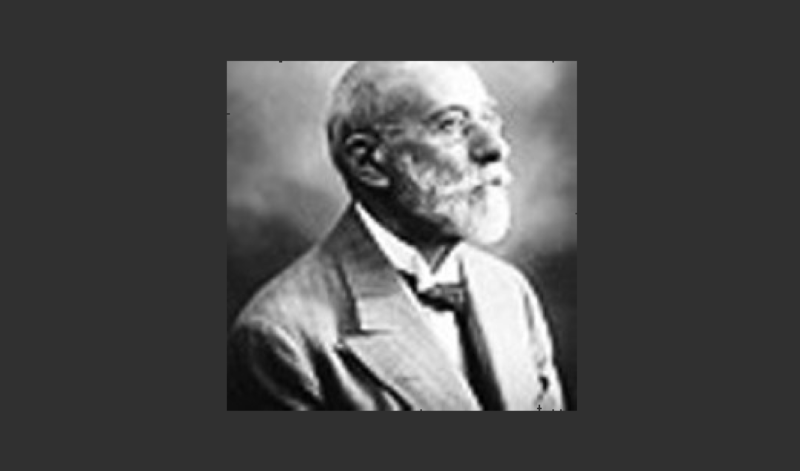
Mkrtich Andranikian
(1851: Constantinople – 1939: Cairo)
The esteemed Andranikian was born in the Yeni (New) Kapu district of Constantinople in September 1851. Baptised Tigran, he later decided to change his name to Mkrtich.
For his early education he attended the neighbourhood’s National School, where a prosperous Armenian community existed. During his primary schooling, Andranikian showed a particular love for calligraphy and was noted within his class for the neatness of his handwriting.
Barely a youth of 14, in 1865 he was offered the post of teaching calligraphy at the district’s girls’ school. He willingly agreed to carry out this duty for the following three years, while simultaneously continuing his secondary education at the Saint Pierre School of Galata.
In 1867, with the consent of the Ottoman Empire, the renowned French secondary school “Galata Seray” opened its doors in Constantinople, and Andranikian became one of the school’s first pupils. Mastering the French language as well as the art of drafting, he successfully completed his secondary education in 1871.
The French secondary school “Galata Seray” was known for its high educational standards, and the ministries of the Ottoman Empire at the time preferred to choose their officials from among that institution’s graduates. Thus, Andranikian was invited to serve as a draughtsman for the geometric department of the Ministry of Public Works.
After working for about two years and gaining some experience, it was deemed appropriate to send him to Anatolia, where he supervised the construction of a railway line for about a year. In 1874, the ministry sent him to the Balkans, where he became acquainted with the prominent national figure Kevork Efendi Aslanyan and became his assistant as a geometric draughtsman.
This vast project in the Balkans was suspended in 1876 due to the Russo-Turkish War, and Andranikian returned to Constantinople to resume his previous post.
In 1878, Andranikian became the assistant for Nubar Bey’s Kavala project in Egypt, thanks to his acquaintance with Kevork Efendi Aslanyan and the trust he enjoyed.
Nubar Bey had at that time succeeded in obtaining a concession from the Ottoman government to convert the lake of the Kavala region into land for tobacco cultivation, and over the course of about two years Andranikian succeeded in carrying out the project entrusted to him.
In 1880, Nubar Bey, who had already noted Andranikian’s abilities following the success of the Kavala project, invited Andranikian to move to Cairo, entrusting him with an important post in the Bahera company.
The Bahera company was known especially at the end of the 19th century as an institution of Middle Eastern financial speculation, and in a short time the esteemed figure had become a skilled financier, for which he was awarded the “Medjidie” honour in 1889.
Within the institution, the esteemed figure had already become a respected personality for his exceptional administrative abilities, as well as his meticulousness in accounting.
In 1895, he left his post at Bahera and worked solely for Nubar Pasha for about two years. Nubar Pasha, as an engineer, had developed numerous construction projects in Cairo and entrusted their supervision to Andranikian.
In 1897, Andranikian became acquainted with Nubar’s son, Boghos, with whom he would later work for many years on important national missions.
Besides being a close associate of Boghos Pasha, Andranikian was also entrusted with putting Boghos’s speculative affairs in order.
In 1899, the Nubarian family entrusted the esteemed figure with their family stewardship, particularly the care of the Nubarians’ estates.
By the beginning of the 20th century, the Armenian community of Egypt already enjoyed perhaps the most vibrant bustle of the diaspora. The presidency of the Diocesan Council operating in Cairo was assumed by Boghos Nubar, whose collaborator was the esteemed Mkrtich Andranikian.
Andranikian became the chairman of the Estates Council and devised a plan to sell the barren lands belonging to the Prelacy and, with that sum, build apartment buildings in Cairo whose income would benefit the Prelacy. This plan was not to reach completion, owing to certain governmental obstacles.
On 15 April 1906, the Armenian General Benevolent Union was to be brought to life in Cairo under the leadership of Boghos Nubar Pasha. Andranikian was part of the body of 9 founding members, becoming the first treasurer of the newly formed union, chiefly for his financial skill. The post of union secretary was entrusted to Dr. Nazareth Daghavarian, who was to become a deputy in the parliament of the Ottoman Empire. The post of union general director was entrusted to the renowned jurist Vahan Malezyan.
Alongside his union enthusiasm, the esteemed figure had also begun his personal speculative ventures and had become a sought-after and experienced figure in the field of speculative projects.
In October 1908, when the Armenian Constitutional Ramgavar Party was brought to life in Alexandria through the merger of Armenians and Reformists under the presidency of Mihran Damadyan, Andranikian, Malezyan, Daghavarian and the Vice-President of the AGBU, Yervant Bey Aghaton, formed part of the founding body and, through the AGBU, supported the rise of a genuinely democratic Armenian political party.
Despite being immersed in his personal affairs, Andranikian was devoted to the organisational work of the newly formed pan-Armenian union.
The formation of the AGBU in Cairo, at the turn of the century, had made the union’s work be greeted with enthusiasm in other smaller communities.
The established Armenian community of Egypt unconditionally enjoyed the organisation expanding under the leadership of Boghos Nubar, whose financial expert was Andranikian.
One of the union’s first and important aims was to support the structure of the Armenian Church, as well as to assist the Armenians of Cilicia and the provinces of Western Armenia, who found themselves in a not very bright or hopeful situation. The union’s Vice-President Aghaton was so impressed by Andranikian’s discipline that he had a decision passed that all the union’s organisational programmes be undertaken with Andranikian’s knowledge. In a short time, Andranikian, with his professional experience, regulated the union’s finances, and the AGBU Central Board’s meetings came to have their own office and staff, which, under the leadership of General Director Vahan Malezyan, laid the foundation for the AGBU’s subsequent structure.
The esteemed figure was destined, with Malezyan — chiefly at Daghavarian’s suggestion — to set out for Western Armenia, where, after both visited their birthplace and met with the Patriarch of Constantinople, they first headed to Van and decided to expand the National School there with the AGBU’s assistance.
The school of the United Society of Van, whose care was undertaken by the AGBU, was transformed into a teachers’ college by the school’s director, Hovsep Guyumjian. Later fleeing the Great Genocide, he settled in Cairo and, with his comrade-in-ideals Andranikian, became one of the leaders of the Armenian community of Egypt.
In 1913, Boghos Nubar came to settle in Paris, where the AGBU Central Board also operated, enjoying the respect of the French-Armenian community. The esteemed figure, during that period as well, remained in the body as a founding member, as an honorary member at large.
In 1914, Andranikian officially retired from his profession, while at the same time keeping the stewardship of the Nubarians’ holdings. There was no rest for him, especially within the national life of the Armenian community of Egypt — the Diocesan Council, the AGBU and the Ramgavar Party.
In 1915, in Cairo, the esteemed figure became one of the encouragers and supporters of the “Arev” daily newspaper under the editorship of Vahan Tekeyan.
After the Great Genocide, and especially after the emptying of Cilicia, he strove at all costs to assist the refugees through the AGBU.
In his advanced years, he was devoted to programmes for the stabilisation of the communities and to the cause of spreading the ideological press.
In January 1939, at the age of 88, with a meritorious record of service, he closed his eyes forever in Cairo, receiving a proper national funeral.
Ara Aharonian