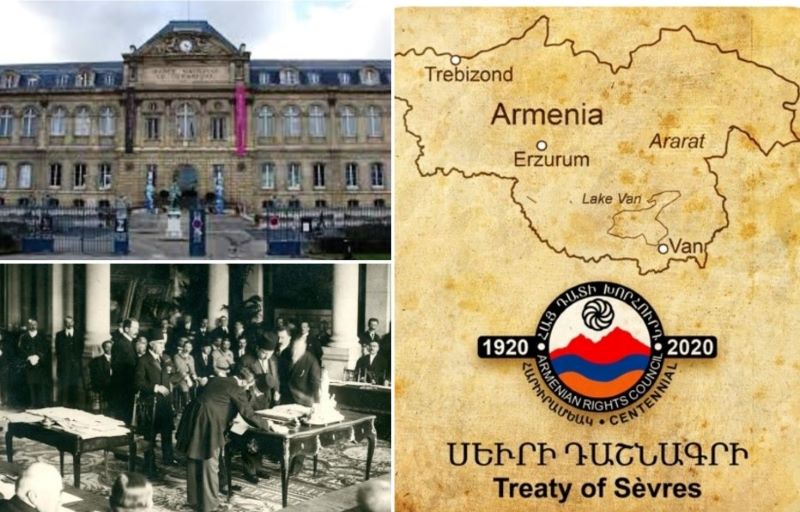
The Treaty of Peace of Sèvres was signed on 10 August 1920, in Sèvres, on the outskirts of Paris. It was signed between the Sultan’s government of Turkey and the Allied Powers victorious in the First World War of 1914-18 — Great Britain, France, Italy, Japan, Belgium, Greece, Poland, Portugal, Romania, Armenia, Czechoslovakia, and the Kingdom of the Serbs, Croats and Slovenes:
The treaty was signed on behalf of the Republic of Armenia by Avetis Aharonyan. He and the representative of Western Armenians, Boghos Nubar Pasha, concluded with the Allied Powers a supplementary agreement concerning the rights of national minorities and diplomatic and commercial relations. In terms of international law, the Republic of Armenia, as a signatory party to the treaty, was thereby recognised by all the other states that signed it. What is the Treaty of Sèvres? To be sure, the basis of the treaty is formed by the provisions of the Sykes-Picot Agreement of 1916 and the decisions of the San Remo conference of the powers in 1920.
The Treaty of Sèvres consisted of 97 sections and 578 articles, concerning frontiers, the protection of minorities, military, naval and air prisoners and penalties, as well as labour questions. Under the Treaty of Sèvres, Constantinople and its surroundings would remain with Turkey; the Straits would then be demilitarised and placed under international administration. Turkey would renounce its sovereignty over Thrace, the Aegean islands, Cyprus, Egypt and the Arab territories. Greece was to administer Smyrna and its environs, and if its population so wished, could annex that territory. Asiatic Turkey would be reduced to the frontiers of Western Anatolia. The Hejaz would gain independence, while Egypt, Palestine, Syria and Mesopotamia (Iraq) would be entrusted, through the League of Nations, as mandated territories, to Great Britain and France. The Treaty of Sèvres, in many respects, favoured the continued exploitation of the Middle East by the European powers, facilitating their administrative, legal, military and economic control over those regions. Sèvres and Armenia — What is the connection between the Treaty of Sèvres and Armenia?
Articles 88 to 93 of the treaty concern Armenia. Here let us quote, in particular, Articles 88 and 89 of the treaty: Article 88. — Turkey declares that she recognises Armenia as a free and independent State, as the Allied Powers have done before. Article 89. — Turkey and Armenia, as well as the other High Contracting Parties, agree to submit to the arbitration of the President of the United States of America the question of the determination of the frontier between Turkey and Armenia in the vilayets of Erzerum, Trebizond, Van and Bitlis, and to accept his decision and all the provisions he may lay down regarding Armenia’s access to the sea and the demilitarisation of all Ottoman territory adjacent to the aforesaid frontier.
Thus Turkey recognised the Republic of Armenia as a free and independent State. Turkey and Armenia agreed to leave the determination of the frontiers between the two states in the vilayets of Erzerum, Trebizond, Van and Bitlis to the decision of the United States of America, and to accept that decision, together with the proposals concerning giving Armenia an outlet to the sea and demilitarising all Ottoman territories adjacent to those frontiers. As for Armenia’s frontiers with Azerbaijan and Georgia, these were to be determined through direct negotiations with those states.
If those states did not agree, then the Principal Allied Powers were to settle the question through a special commission. The relevant articles of the Treaty of Peace of Sèvres allowed the free transfer of populations; those over the age of 18 could choose citizenship in another country of the region, according to their national or religious affiliation, wherever they formed the majority. They would retain the right to their property, but would be obliged, within the course of a year, to transfer their possessions to the country of their choice. The Ottoman government’s law of 1915 concerning abandoned property was declared null and void. The protection of the minorities remaining in Turkey — their life, liberty and equality before the law — was to be ensured by the government. For the atrocities committed in Turkey during the war, the Ottoman government was obliged to render every kind of assistance, on its own part and on that of the Ottoman authorities, particularly in finding and releasing all persons of every nationality and religion who had been lost, abducted or imprisoned after 1 November 1914.
In the section on penalties, the Turkish government accepted that the Allied Powers had the right to bring before military tribunals the perpetrators of violations of the laws and customs of war, and to provide information and documents concerning the crimes they had committed. The Allies were to have the right to constitute tribunals and to try them.
The parties agreed that Georgia, Armenia, Azerbaijan and Persia were to have free access to the Black Sea through the port of Batum.
The Allies were disposed to the idea of an Armenian corridor from Kars through the Chorokh valley to Batum, but at the moment of signing the treaty, Georgia offered the Armenians the construction of a railway through Georgian territory. Given that it was not yet known whether the port of Trebizond would be included in Armenia or not, a special article granted Armenia special transit privileges, and a portion of that port was also granted in perpetual lease. Before the signing of the Treaty of Sèvres, the commission formed by United States President Woodrow Wilson had studied the region — its topography, economy, means of transport, water resources, trade routes, demographics and other questions that had to be taken into account in the process of determining the frontiers. The commission presented its recommendations in September 1920, and President Wilson submitted his decision to the European powers in November.
According to Wilson’s decision, Armenia was to receive two-thirds of the vilayets of Van and Bitlis, almost all of Erzerum, and the greater part of Trebizond, including the port. That entire territory was around 90,000 square kilometres. Joined to the Republic of Armenia existing in Transcaucasia, the independent Armenian state was to have a territory of around 160,000 square kilometres, with an outlet to the Black Sea. What fate befell the Treaty of Sèvres? Although the Treaty of Sèvres was an important step on the road to the solution of the Armenian Question, by which the Armenian people would have gained a considerable vital territory, it nevertheless remained on paper, and the map of Armenia with the Wilsonian frontiers became a memory hung on walls. Even the Sultan’s government did not ratify the treaty.
The Kemalists resorted to every means to make it fail, even launching a new attack against the Republic of Armenia, with the aim of finally destroying it. Taking advantage of permissive international conditions, particularly Russia’s closeness to Turkey, the Kemalists were able to have the Treaty of Sèvres revised and, ultimately, to have it abolished.
The treaty evaporated with the signing of the Treaty of Lausanne in 1923. The Treaty of Lausanne in effect buried the Treaty of Sèvres. The Allies recognised Mustafa Kemal’s government and its right to Eastern Thrace, Smyrna and Cilicia, as well as to all the territories that had been assigned to Armenia by the Treaty of Sèvres. They even recognised Turkey’s new frontiers, which included the former regions of Eastern Armenia — Kars, Ardahan and Surmalu. Thus the Turk carried off the greatest victory. Of historic Armenia only a small territory remained. The historical and contemporary significance of the Treaty of Sèvres. The Treaty of Sèvres is a document of historical, political and legal value, in which the rights of Armenian statehood over Armenian lands were clearly recognised. Though perhaps unrealisable today in the direction of the solution of the Armenian Question, the treaty, 100 years later, has still not lost its historical significance and value, from the standpoint of legal foundations on the road to the reclamation of the rights of the Armenian people.
To assess the Treaty of Sèvres correctly, we must ask whether the knotty political questions set out in the treaty were resolved by it. And those questions were: the Armenian Question, the Kurdish Question, the struggle against crimes against humanity, and the punishment of the criminals.
One hundred years have passed since the signing of the treaty, yet all three questions remain unresolved. Moreover, the failure of Sèvres was the cause of numerous calamities in subsequent years. So it is that the Treaty of Sèvres, which fell victim to the interests of the Great Powers, and the Wilsonian arbitral award, may one day again be imposed on Turkey, by those same powers. And we, for our part, must be ready, at the appropriate opportunity, to raise it realistically before international tribunals.
Kevork Halebleyan