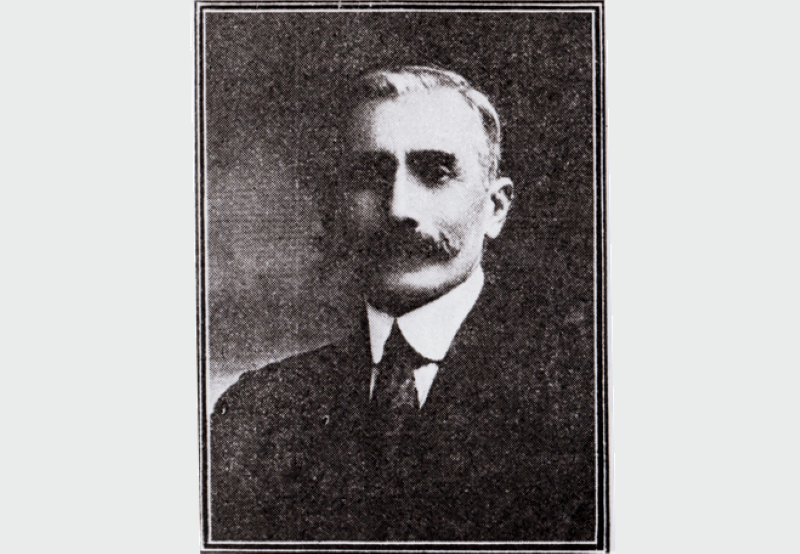
Shavarsh Hovivyan
(1862: Akn – 1937: Virginia)
The distinguished Hovivyan was born in one of the villages of the Akn region, under the modest roof of the Chobanyan family, who were distant relatives of the parents of Arshak Chobanyan, the ambassador of Armenian culture and a distinguished figure of the ADL.
After receiving his primary education in Akn, he moved to Constantinople to stay with his relatives from Akn. From an early age, Shavarsh decided to Armenianize his surname, changing it to Hovivyan.
In Constantinople, he pursued the craft of photography and sought his path in life, becoming a renowned photographer in the city.
His first participation in national public life came when he joined the “Ararat” society in 1887, and his immediate collaborators became Mihran Damadyan and Arpiar Arpiaryan, as well as the young Arshak (Chobanyan).
The main purpose of the “Ararat” society was to open schools within the provinces of Western Armenia and, especially, to lead the youth toward progress, development and revolution.
In 1889, the “Gortsoghner” (Workers) union formed in Constantinople, as a patriotic organization, would arouse enthusiasm in Hovivyan, and by joining the union, he would in a short time become an energetic member of it, and gathering around him his compatriots from Akn who had settled in Constantinople, he would prepare the provincials for national self-defense.
Constantinople, as the capital of the Ottoman Empire, was considered important by the Hunchakian Party formed in Geneva in 1887, and, by decision of the center, activists were sent to Constantinople. Planned work was carried out to approach the members of the “Gortsoghner” union, among whom was Shavarsh Hovivyan.
In June 1890, 140 unarmed Armenian sons were shot dead in Karin, who had been pursued for years as revolutionary elements, especially since the fermentations that began in 1882, which is known to us through the national revolutionary song “A Voice Resounded from the Armenian Mountains of Erzurum.” The alarming news turned into a struggle for the national life of Constantinople, and, as a national protest, it was decided to appeal to the Sublime Porte, and it was proposed to entrust that task to the then Patriarch of Constantinople, Khoren Ashigyan, who submitted the protest letter to the Sublime Porte’s national authorities, while at the same time presenting his resignation, because the Patriarch had refused to express the national protest only through a peaceful demonstration. The Hunchakian active body in Constantinople, deeming the existing national protest futile, decided to come out into the open and express the people’s anger through the well-known Kum Kapu demonstration on July 15, 1890.
It is certainly known from the pages of the revolutionary history of the Armenian people that this demonstration caused numerous innocent victims and subsequent killings, as well as arrests.
After this event, the Ottoman government attempted to carry out special persecutions, especially in the Constantinople region, targeting the Hunchakian party.
In those days, Hovivyan’s close friend Mihran Damadyan, having been betrayed, took refuge in Athens, while Shavarsh, who had a secure position in an English institution in Pera, remained beyond suspicion. Through that position, he served as a link for newspapers and letters arriving from abroad to Constantinople in envelopes, addressed under the pseudonym “Madame Vel,” which he distributed to important members of the party branch, remaining free from all suspicion and persecution.
After the Kum Kapu demonstration, the Hamidian government in Constantinople had focused its attention on the destruction of existing revolutionary organizations.
After the Hamidian massacres of 1895-96, even in Constantinople it would become very difficult to expand national activity, especially for revolutionary suspects, among whom was Shavarsh Hovivyan, who was forced to leave Constantinople and, after staying in Greece for a short time, at the request of the institution where he worked, reached London, where his comrades of ideology, the delegates of the Hunchakian Party, had come. His Constantinople Armenian friends who knew him were aware that he had worked in Constantinople with utmost secrecy.
In 1896, the proceedings of the Hunchakian Party’s delegate assembly would lead to the separation of the party’s liberal and democratic forces, who, under the leadership of Mihran Svazlyan and Mihran Damadyan, laid the foundation of the Reformed Hunchakian Party in London. The founding body was also joined by Suren Partevyan, Arpiar Arpiaryan, Suren Aurenian, Vahan Tekeyan and, of course, Shavarsh Hovivyan.
In London, he continued his craft at the English institution, in whose Constantinople branch he had served for a period.
With the founding body of the Reformed, he would closely collaborate in London, where in 1898 the proclamation of the Reformed Hunchakian Party would take place, and immediately in Cairo the Reformed would undertake organizational work. During this period, the Reformed center in London was in close relations with Mkrtich Portugalian in Marseille, through whose newspaper “Armenia” it became possible to disseminate the declarations of the newly formed party. Hovivyan moves to Paris and from there to Cairo, where his comrades of ideology arriving from Constantinople had already taken refuge. Hovivyan again serves at the English institution, the “Starless and Soldiers Institute.”
Within the then Armenian colony of Cairo, Hovivyan enjoyed the respect of the community, especially from his comrades of ideology, for his realistic and far-sighted politics, which many knew from his period in Constantinople.
In 1908, the Armenian Constitutional Ramgavar Party was brought to life in Alexandria, on October 31. Krikor Peyozikian (Shikahair), a member of the founding body of the Armenakan Party, coming as a representative from Van, meets with Mihran Damadyan, Dr. Tigran Enfiadjian, Shavarsh Hovivyan and Hagop Papazian, and the Armenian Constitutional Ramgavar Party is declared.
Through the fusion of popular currents, the new party is led by Mihran Damadyan. Around the Ramgavar Party, in a short time, well-known Egyptian-Armenian figures gather: Vahan Malezyan, Dr. Taghavaryan, Vahan Tekeyan, Bedros Gmgmyan and Eugene Babazian.
Before the end of 1908, after 12 years of absence, Hovivyan returns to Constantinople to continue his craft of photography in the Ittihadist Constantinople.
Already after the proclamation of the Constitution, the framework of the Ramgavar structure had been formed in Constantinople, and Hovivyan, with his enthusiastic participation, throws himself into organizational work.
That enthusiasm of Hovivyan and the Constantinople Armenian nationalists would not last very long, because in April 1909, the news of the planned Adana massacre plunged national life in Constantinople into confusion. Hovivyan’s close friends (Babigian and Mkrtichian) are sent to Adana by the Constantinople Patriarchate to investigate and report the details of the massacre.
The report prepared by Babigian would seem to have been lost, because after returning, Babigian died a violent death.
Secretly, it became possible to photograph that report and the telegrams sent from Constantinople related to the planned Adana slaughter, through Hovivyan, and through Mihran Damadyan and Hampartsum Boyajian in Constantinople, to hand them over to Patriarch Archbishop Yeghishe Tourian.
The details of the report worry Hovivyan, who had begun, especially among the leadership of the Ramgavar circle, to revive his old plan of secretly preparing the provincials for self-defense.
In 1911, the First General Delegate Assembly of the Armenian Constitutional Ramgavar Party is organized in Constantinople, where Hovivyan informs the delegates of the hidden aspects of the Adana massacre planned by the Ittihadist government.
After the delegate assembly, when, as a reaction to the Ittihadists’ plan, a secret program is developed by the Ramgavar Party’s Constantinople circle to prepare the Western Armenian provinces for self-defense, an invitation comes from the Vaspurakan circle for Hovivyan to depart for Van.
The chairman of the Constantinople circle, the well-known publicist Tiran Kelekian, who closely followed the assimilation and annihilation policy adopted by the Ittihadists, gives his testimony to Hovivyan before his departure for Van. To the bachelor like Hovivyan it falls to reach the Armenian-populated city at the heart of the Vaspurakan province in March 1912.
In Van, he becomes an activist for the Vaspurakan Ramgavar circle, and deems necessary the publication in Van of the newspaper “Van Tosp,” equipping it with a capable editorial staff.
The activity of the Ramgavar circle disturbs the Dashnaktsakan structure of Van, who were not aware of the Ittihadist plan brewing in Constantinople, of which their deputies and well-known Constantinople Armenian activists would later become victims.
Shortly after, the leadership of the Dashnaktsakan structure also becomes aware of the self-defense plan, and through Hovivyan’s efforts, the mixed military council of Vaspurakan is formed, whose priority task becomes the program of procuring weapons. The joint council entrusts this duty to Hovivyan, who before the end of the year sets out for Tiflis, taking with him the well-known Russian-speaking Margar Der Papazian. After cultivating certain acquaintances in Tiflis, he has a meeting with A. Kalantarian and then with Hampartsum Arakelyan, whom he had known in Constantinople. After expressing his mission to the two editors of “Mshak” and then presenting a request by telegram to the Ramgavar Regional Board of America, he secures the necessary funds, and in a short time, with the assistance of the Armenian colony of Tiflis, weapons and ammunition are secretly transported to Van and handed over to the mixed military council.
During the following two years, until the beginning of 1915, Hovivyan travels on various occasions to Trebizond, Tiflis and Erzurum.
In 1915, the heroic battle of Van, forged under the leadership of Armenak Yekarian, managed to halt the Turk’s sword and save the Armenians of Vaspurakan. As a party activist, he was the driving force and the disciplinary planner on the self-defense positions.
Together with the Armenians of Vaspurakan, he too left Van, coming to Tiflis, where another Ramgavar circle was formed and “Van Tosp” continued to be republished.
But in 1917 Hovivyan was disillusioned with the great powers, when the Russian army withdrew from Erzurum, leaving the Western Armenian masses defenseless. In the same year, he decided to leave the Caucasus and depart for America, to his cousin, in the city of Richmond, Virginia, and continue his photographic expertise in the land of promise.
The distinguished figure did not remain far from party and national life and became part of the ADL’s local club in Richmond, frequently contributing articles to the “Baykar” daily newspaper.
Hovivyan’s second disillusionment came in 1920, when Knightly France reneged on its promise regarding Cilicia.
The distinguished figure closely followed the Ramgavar press and rejoiced at the formation of new party circles.
His violent death occurred on March 28, 1937, when a black criminal killed the distinguished figure for robbery, at the age of 75.
His comrades of ideology from the ADL’s Eastern circle were also present at the national funeral.
Ara Aharonian