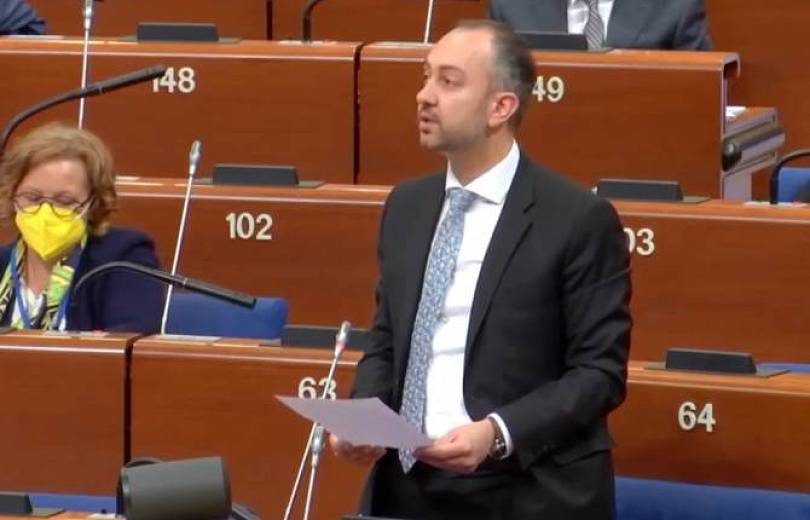
Eduard Aghajanyan, Chairman of the Standing Committee on Foreign Relations of the National Assembly of Armenia and member of the Armenian delegation to PACE, delivered a speech at the plenary session of the PACE spring session.
In his speech, Aghajanyan noted that the Ukrainian crisis and its humanitarian consequences are currently of utmost importance for the Council of Europe, adding that, as could be expected, Azerbaijan took advantage of the international community’s complete focus on the situation around Ukraine by undertaking blatant actions in violation of the European Convention on Human Rights and Fundamental Freedoms.
“In particular, on the basis of the Government’s request, the European Court of Human Rights applied interim measures, calling on Azerbaijan to refrain from actions that would contribute to violations of the guarantees enshrined in the Convention with respect to the civilian population, as well as calling for respect for its obligations under the European Convention on Human Rights and Fundamental Freedoms.
Notwithstanding the foregoing, even after the Court’s interim measures, Azerbaijan has continued to violate its obligations under the Convention. As such, since February 2022, the Azerbaijani armed forces have continuously terrorised the population of border villages of Artsakh through various criminal acts of physical threat and psychological pressure, as well as through direct, threatening and intimidating statements made through loudspeakers directed at the civilian population. In the regularly recurring statements, the border population is called upon to cease farming and leave their homes, otherwise families are threatened with physical assault,” Aghajanyan said.
He added that during the same period, on 7 March, the gas supply in Nagorno-Karabakh was cut off, leaving more than 150,000 people without heating in conditions of snow about 1.5 metres deep and unprecedented cold.
“Under pressure from the international community, Azerbaijan restored the gas supply on 19 March, but stopped it again 2 days later.
Dear colleagues, the foregoing is a classic example of ethnic cleansing.
And while Azerbaijani officials often declare on international platforms that the Nagorno-Karabakh conflict is over and that the Armenians of Nagorno-Karabakh can live peacefully in their homes, in fact Azerbaijan is trying to complete the final phase of the ethnic cleansing of the Armenians of Nagorno-Karabakh, taking advantage of the international community’s complete focus on the situation around Ukraine.
Nevertheless, Armenia remains committed to the peace agenda in the South Caucasus and sees the final and peaceful resolution of the Nagorno-Karabakh conflict under the auspices of the OSCE Minsk Group co-chairmanship,” concluded Eduard Aghajanyan.