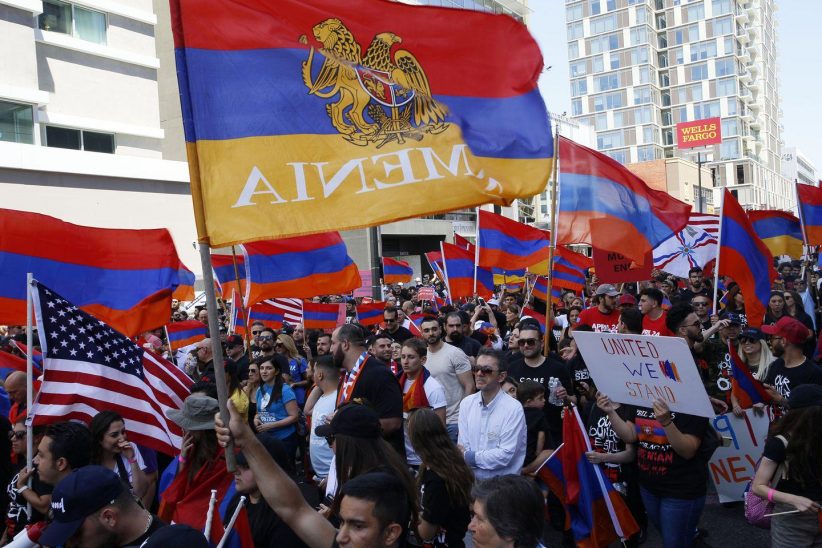
History matters. It is time for the United States to call the systematic killings of Armenians in 1915-1923 a genocide. Historical facts affirm this, and so does the United States’ stance toward those who suffer from mass atrocities. Armenian Genocide Remembrance Day, April 24, is a fitting occasion for President Biden to set a historic precedent, wrote Knox Thames, former special adviser on religious minorities at the US State Department, in his article published in Newsweek:
The Ottoman Empire, located on the territory of modern-day Turkey, carried out mass killings of Armenians, as well as Assyrians and Greeks. Historians estimate that 1.5 million Armenians perished. That is no secret. In 1915 alone, the New York Times published 145 articles about the mass killings.
The US government was aware. US Ambassador Henry Morgenthau documented the brutal violence he witnessed while travelling through the rural communities of the Ottoman Empire. His memoirs describe the plans of the Turkish authorities as “a death sentence for an entire race; they understood this well and made no attempt to conceal the fact when talking to me.”
The UN Convention on the Prevention and Punishment of the Crime of Genocide defines genocide as “any act committed with intent to destroy, in whole or in part, a national, ethnical, racial or religious group, through killings, causing serious bodily harm, or other means.” The fact of 1.5 million murdered Armenians fits that definition.
From the standpoint of history and law, no question arises about the fact of these crimes or about calling them genocide. However, there is a so-called political question:
Since the days of Ronald Reagan’s presidency, the White House has not called the events of 1915 the Armenian Genocide, despite both houses of Congress passing a genocide resolution by a large majority in 2019.
Previously, geostrategic considerations have prevailed over facts. Modern Turkey categorically opposes calling these events a genocide. Turkey is a NATO ally located at the crossroads of Europe, Asia and the Middle East. Its borders meet those of the former USSR, Iran, Iraq and Syria. We have given it veto power.
Regarding the Armenian Genocide, President Biden faces a unique confluence of events that allows him to set a historic precedent. He leads an administration, while Turkey’s President Erdogan pursues a more problematic policy. Having the opportunity, it is time to call the genocide by its name.
Of course, this will be unpleasant for some Turks, and Erdogan will begin to bluster, but many will agree that it is the truth. The United States should not remain silent because of eloquent interests with an unreliable ally. As President Biden has said, “silence is complicity.”
The Armenian Genocide happened. Candidate Biden recognized it, and I hope President Biden does the same on April 24.