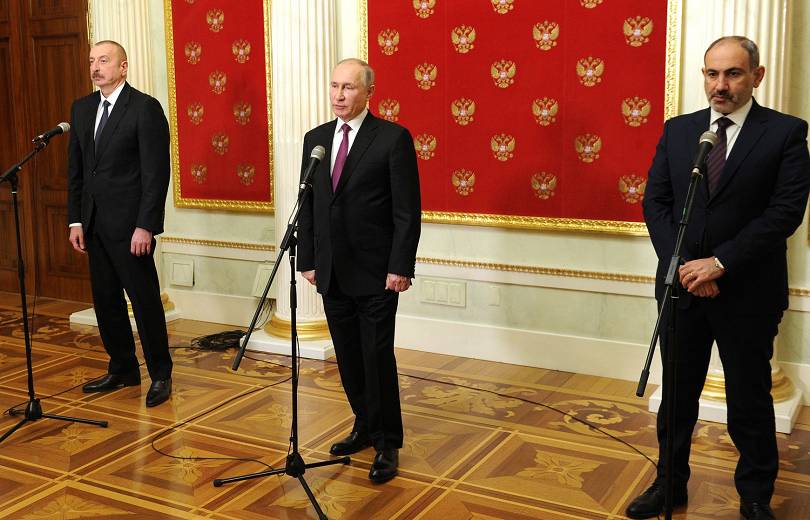
The Kremlin has announced that a Putin-Pashinyan-Aliyev trilateral meeting is being planned, but there is no precise agreement on when the video summit of the three leaders will take place.
“Indeed, we have confirmed that work is underway to prepare such a meeting, but here I want to note that so far there is no precise agreement or mutual understanding regarding when such a video summit could take place,” Kremlin spokesman Peskov told journalists.
On November 8, a contradiction emerged between the statements of the Kremlin spokesman and the Armenian prime minister regarding the planned trilateral meeting. First, in the first half of the day, the Kremlin announced that a trilateral meeting was scheduled for this week, and the Russian state television channel Rossiya-1 wrote that it did not rule out the meeting taking place on the anniversary of the signing of the November 9 document.
A few hours later, Prime Minister Nikol Pashinyan’s recorded interview with the Armenian Public Television was published, in which he contradicted the Kremlin’s statement, noting that there was no agreement to meet on November 9.
“But the content of those meetings is very important, the symbolism of those meetings, the possible result expected from those statements. Where we can record a result, we will not refuse any meeting, but we are also not in favour of meetings as an end in themselves. And regarding November 9 specifically, I can say that at this moment there is no such agreement,” Pashinyan said.
In the extensive interview, he also spoke about the “3+3” format, answering the question of why Yerevan has not yet taken a position on the cooperation platform advanced by Ankara and Moscow: “In fact, two days ago our government expressed a position at the level of the deputy foreign minister in that regard, and our position is the following: the possible ‘3+3’ format should not have on its agenda such issues that we are already discussing in an agreed manner in other formats. In particular, the issue of opening regional communications, the issue of the settlement of the Nagorno-Karabakh problem.”