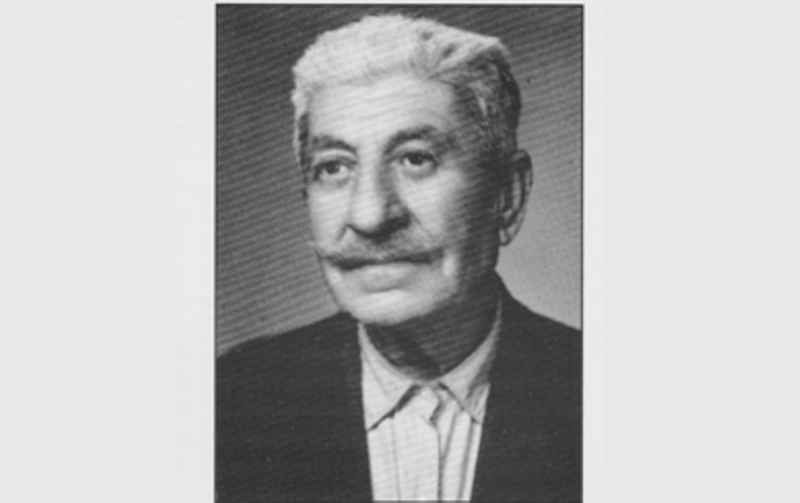
MINAS VARTANIAN
(Known as Evik Minas)
(1887 Chork Marzban – 1973 Yerevan)
Among the valiant fighters who served under the banner of the Armenian Democratic Liberal Party, a place of honor as a devoted hero, for the deeds of bravery displayed in the struggle for the liberation of the Armenian people and for devoted patriotism, belongs to Minas Vartanian, the principal hero of Chork Marzban’s liberation struggle, known as Evik Minas.
Minas Vartanian was born in 1887 in the village of Ojagly in Chork Marzban. At the age of 4 he lost his father and remained under the care of his mother. But unfortunately, at the age of 14, the youth also lost his mother.
Deprived of an education, the youth was forced to take up farming in the village, and gradually became a cart driver. His relatives and family acquaintances, to distinguish him from the other Minases of the village, called him Evik Minas, giving him the appellation of his mother Eva’s son.
Having no desire for education, Minas devoted his free time to hunting, roaming the forests near Chork Marzban and becoming a master marksman.
After the proclamation of the Ottoman Constitution in 1908, Minas, along with some young men of his age from Chork Marzban, was conscripted into the Ottoman army.
After the Adana massacres of 1909, Armenian youths conscripted from the towns of Cilicia were always under pursuit by the government’s secret services and were pursued as deserters. In 1913, the Cilician company of the Ottoman army besieged Chork Marzban, using the pretext of searching for army deserters from the villages surrounding the town.
Evik Minas, with three of his companions, was hiding in his birthplace; one of his companions, the well-known hunter Vahan Chojuk Garabed, was caught in a fight and fell victim to the soldiers’ fire, while Minas, with his other companions, hid in the Armenian village of Najarly in Chork Marzban. The National Union, fearing that the army might discover the others, advised Evik to leave.
With the help of some locals, Evik hid in the nearby forests for a certain time, then, disguised and with his identity changed, came to settle in Adana.
At the beginning of 1915, Evik returned to Chork Marzban to join his family. But in June of that tragic year, the deportation of Chork Marzban and the surrounding villages began.
On the road of exile, Evik, learning of the annihilation planned in the direction of Mesopotamia and Der Zor, undertook to keep his relatives in the village of Almaly near the town of Beredjik, whose mayor was his old friend Edip Bey, who had been raised under the care of an Armenian mother. Edip Bey agreed to provide Evik and his relatives with dwellings in the village, and the next day Evik managed to leave for Beredjik, and from the passing deportation caravans rescued two dozen Armenian minors and brought them to Almaly, keeping them under his and his wife’s care.
Under the benevolent attitude of Edip Bey, the minors under Evik’s care and the relatives of his family were saved from the planned genocide.
Before the end of 1918, after the end of World War I, Evik Minas, with his family, as well as the survivors from the deserts of Mesopotamia and Syria, gradually came to Chork Marzban to resettle their smoldering and ruined ancestral home. Within a short time it became possible to revive the national life of Chork Marzban, the church and the school. The National Union was reorganized and a self-defense committee was formed.
The newly formed self-defense committee elected as commander a Hunchakian from Musa Dagh who had been reorganized, who was later to become a prominent Ramgavar figure, Zora Iskenderian, and Evik Minas was appointed deputy commander.
Under the sponsorship of Zora Iskenderian, Evik joined the reorganized ranks, a local club was formed for Chork Marzban, with Adana as the regional center. Already the Armenian community of Chork Marzban had regained its former Armenian-flavored bustle.
In the summer of 1919, Kara Hassan Pasha, subject to the Turkish government, with his organized band, besieged the forests surrounding Chork Marzban, to closely watch the national life there, as well as to harass the villagers from trading with the neighboring provinces. The band had even begun to harass and plunder the Armenian villagers. In the vicinity of Chork Marzban, Kara Hassan managed to capture Evik’s brother-in-law, Keol Iskender. This incident caused turmoil in Chork Marzban, and the National Union appealed to the governing official commissioner of the region, who approached the matter with indifference.
Kara Hassan, taking advantage of the opportunity, sent a threatening ultimatum addressed to Evik. The National Union filed a protest with Jim Zangalian, an American-Armenian volunteer commander under French command in Cilicia. Immediately Zangalian appeared before the French commissioner to convey the protest, that Kara Hassan’s band be disarmed and removed from the region of Chork Marzban. The commissioner’s answer was that they did not have sufficient force to take that step. Evik, outraged, resorted to his plan, and learning that Kara Hassan’s sister’s young son was to pass from the mountain pass of the nearby forest toward Adana, he set up an ambush and managed to disarm the policemen accompanying the young man, captured Kara Hassan’s young nephew and brought him to Chork Marzban and imprisoned him at the self-defense committee. The day after this incident, the Turkish government agreed with the French commissioner, and a condition was set for the National Union that Evik, with his group, be disarmed and surrender to the French command, but Evik, learning of the set condition, came with his group to his forest hideout. The National Union of Chork Marzban, fearing French wrath, decided to hand the Turkish youth over to the Turks. The decision was conveyed to the Dashnak Baghdasar Balian Agha, to hand the captured Turkish youth over to the Turks. Balian immediately carried out the decision taken. Evik, learning of all this, secretly entered Chork Marzban with his group, and in his home beat Balian, unaware of the National Union’s decision. Only Zora Iskenderian managed to restrain him and inform him of what had happened. Evik set a condition for the National Union, that a means be found to free his brother-in-law, which would cost 1000 liras, to be paid as tribute to the bandit chief Kara Hassan. The French, sensing the danger of Evik Minas’s presence in Chork Marzban, again appealed to the National Union that Evik surrender to the command, but in vain, Evik with his group had again taken refuge in his hideout. After Kara Hassan’s bandits handed over Keol Iskender, they had managed to kill two Armenians in the market and create new unrest.
The French command, during this period, to please Mustafa Kemal, exaggerating minor incidents, undertook to raise new criminal cases in the militant Chork Marzban. The National Union showed a defiant and firm stance, relying on the steadily strengthening self-defense committee. The French commissioner decided to invite Zora Iskenderian for consultation, as the author of anti-French unrest, and arrest him, but Iskenderian, sensing the tense trap, resorted to flight. The National Union replaced him, entrusting the post of commander to his assistant, that is, Evik Minas. And Iskenderian returned to his birthplace, Musa Dagh, where he was later to become a prominent party figure.
In the spring of 1920, Chork Marzban, with its surrounding villages, was already besieged by Kara Hassan’s expanded band, and the possibility of communicating with other regions of nearby Cilicia was almost cut off.
To escape this terrible situation, the National Union appealed to the respected national figure Karnig Efendi Koyoghlanian, to go to Payas to meet the French military commander, whose answer was to be negative, with the pretext that the necessary means were not available to disperse Kara Hassan’s chetes. This news alarmed the Armenian community of Chork Marzban. Evik Minas, learning of this provocative news, came out of his hideout and, armed, advanced to the government building and took the Turkish deputy commissioner hostage, taking him to his forest hideout.
News of Evik’s move immediately reached Alexandretta and Adana. Immediately the French mandatory government sent a telegram to the National Union, demanding the surrender of Evik Minas to the commissioner, failing which the most severe military measures would be resorted to. This telegram was signed by the governor of Cilicia, Colonel Edouard Brémond, and the commander of the French forces, General du Fieux.
***
Note: In 1966, the original of this telegram was handed over by Zora Iskenderian to the Museum of Armenian History.
In light of this telegram, the National Union was forced to convince Evik to hand over the deputy commissioner, but Brémond, under Turkish pressure and the wishes of Mustafa Kemal, did not find the order sufficient and appealed to the garrison commander to discover Evik’s hideout. On Mustafa Kemal’s instruction, this time another bandit chief, Dana Boruk, joined Kara Hassan, whose bands surrounded Chork Marzban, completely paralyzing this town of Cilicia, considered a commercial center.
Again, on behalf of the National Union, Karnig Efendi went into action and found a way to reach Alexandretta, but in vain he received the same answer from the military command.
A week later, at the beginning of July 1920, this disgraceful French move, stirring the Armenian community of Chork Marzban to fury, under the leadership of Evik Minas, they began through a crier to awaken the entire population of Chork Marzban that their town was to become a victim of French treachery, and that there were daily Armenian victims in the surrounding villages at the hands of Turkish chetes. Evik Minas, with the core of his self-defense committee composed of fighters, gathered Armenian men from 14 to 70 years of age and armed them with axes and daggers. To the formed core joined Potur Oglu Mesrob and Gudik Khacher, who with their fighters knew well the hideouts of the Turkish chetes.
After the signal for attack was given, besieging the stations of Kara Hassan and Dana Boruk from 3 sides, the bands of the two great Kemalist chetes took to flight, and the horsemen of Chork Marzban also slaughtered the fugitives over the course of two days. Kara Hassan and Dana Boruk fled to their villages. On Evik’s orders, after putting the Turks to flight, the Armenian fighters with their group leaders put four large Turkish villages to the torch. As a result of this victorious march, which took place on July 22-23, 1920, the deported and those who had left their birthplace returned to Chork Marzban and other regions of Cilicia. It should also be said that after the blameless self-defenses of Chork Marzban in 1896 and 1909, followed the preemptive and unprecedented victorious march of July 1920, becoming the wonder of the chivalrous French.
Two weeks after the victorious march, Mihran Damadian was to proclaim the independence of Cilicia, which, through a notorious French conspiracy, was to last only 1 day (August 4-5). And during this period, the National Union of Chork Marzban was still continuing its office, and was overseeing the affairs of the self-defense committee.
At the beginning of 1921, Dashnaktsakans from Musa Dagh made an attempt to transport the ammunition located in Chork Marzban to Musa Dagh, with the pretext that after the Sovietization of the First Republic of Armenia, a new attempt should be made to make Cilicia independent again.
Evik, learning of all this, as well as of their murder of the brother of his ideological comrade Zora Iskenderian, beat the Musa Dagh men, who fled and left.
Chork Marzban and the hero Evik were not to enjoy for long the victory forged in their birthplace, because by the Treaty of Ankara of 1921, the Armenian population of Cilicia was to evacuate its settlements and disperse to the nearby Syrian regions. This exhortation became particularly audible when it was instructed by the Catholicos of the Great House of Cilicia, Sahak Khapayan. After mandatory France handed over Armenian-populated Cilicia to Turkey, it had not forgotten to pursue those Armenian refugees against whom a judicial decision had been taken, among whom was Evik, who with his relatives had come to settle in Alexandretta. Catholicos Sahak Khapayan, learning of the 101-year imprisonment sentence against Evik, appealed to the political figure in Paris, Arshak Chobanian, who with his guarantee Evik appeared before the French military court of Alexandretta, which limited the existing verdict to 1 year. The hero of Chork Marzban, wanted for 4 years, remained imprisoned for one year in Alexandretta. After coming out of prison in 1923, in a new environment he devoted himself to devoted party work, within the structure of Alexandretta formed by the first Central Board of the ADL, formed in Constantinople on October 1, 1921. Within a short time a new Armenian community had been created in coastal Alexandretta, and Minas had become an active figure, having by his side the well-known Ramgavar devoted figures Martiros Der Stepanian and Aris Shaklian. The hero of Musa Dagh, too, leaving his birthplace, had come to join Evik. Hrach Yervant, then editor of the ADL’s official organ “Baykar” published in Boston, after the ADL’s 3rd General Delegates’ Assembly, came to Alexandretta to become acquainted with the flourishing local community, and first of all met Evik Minas and Yesayi Yaghubian, two incomparable Ramgavar heroes. It was an emotional moment for Evik when Hrach Yervant handed him that copy of “Baykar” in which were featured Evik’s deeds of bravery in Chork Marzban, and handed over a special letter from the chairman of the ADL Central Board, Arshak Chobanian, containing words of thanks, addressed to the tireless party member.
In the 1930s, the Ramgavar Party organized participation in the elections of the regional parliament of Alexandretta and, emerging victorious, had its elected candidates, among them the devoted Musa Dagh figure Hagop Davitian.
As a result of the evacuation of Alexandretta in 1938, Evik came with his family to settle in Aleppo, and to join his relatives from Chork Marzban, as well as the ADL’s Aleppo structure.
In Aleppo, the Ramgavar Party’s official organ “Yeprat” had often been the target of the local Dashnaktsakan structure. Gradually the ideological struggle intensified in 1943, generally because of the ecclesiastical struggle, and in order not to endanger the life of “Yeprat” editor Aris Shaklian, it was deemed appropriate to entrust Evik, who with a few armed young men would assume the security of the editorial office and staff.
In 1945, in the delegation departing for Soviet Armenia for the election of the Catholicos of All Armenians, was the captain of the American army, the incomparable leader of American-Armenian volunteers and ADL devoted figure Jim Changalian, who upon his return had come to Aleppo. At the well-known “Hotel Baron” of the time, he met Evik, and recalled the secret meeting with Minas during his time in Cilicia.
Before the end of 1945, in “Yeprat”, Azad Yapujian, for his anti-Dashnaktsakan article, was stabbed in Aleppo; Evik came to his defense, saving him from certain death. After this incident, Evik was subjected to Dashnaktsakan terror, by the 19-year-old son of a distant relative, but through his agility he managed to seize the weapon, and the young man fled in disguise to Amman.
In the summer of 1946, at the signal of the national repatriation, Evik Minas was among the first emigrants from Aleppo, and with him also his colleague of years, editor Aris Shaklian. After settling in the homeland, Shaklian and Minas, with their families, strove to rally the repatriated compatriots of Chork Marzban in Soviet Armenia.
Later they were joined by Martiros Der Stepanian, who was offered a post to teach at the Gevorgian Seminary in Etchmiadzin.
In Soviet Armenia, Minas’s relationship became frequent with the hero of Musa Dagh, Yesayi Yaghubian, as well as with the young editor of the “Zartonk” daily, Krikor Pekerejian.
The homeland years did not greatly enthuse the horseman-fighting fedayee, who was destined to reach the twilight of his life only through patriotism.
In Yerevan, the devoted Armenian son of Chork Marzban, known for his deeds of bravery, closed his eyes forever in 1973 at the age of 86.
***
Within the densely Armenian community of Los Angeles, the devoted son’s son Martiros Vartanian is the author of books known for his journalism, with whom we have had the opportunity to become closely acquainted.
Ara Aharonian