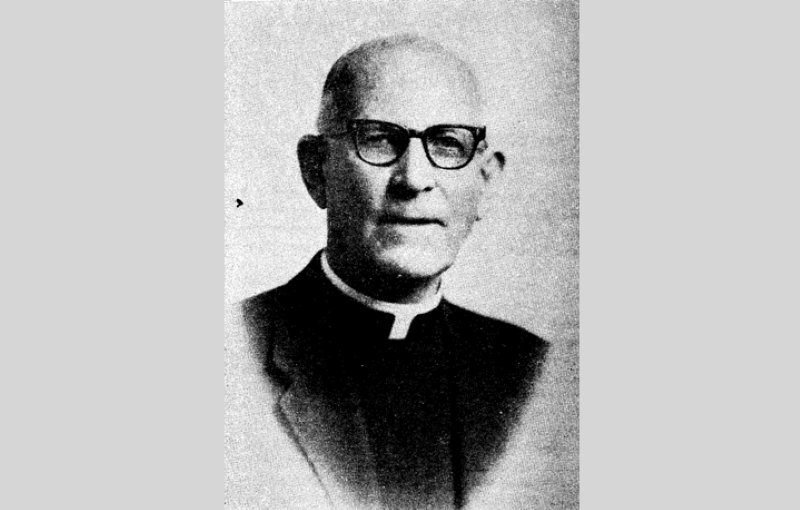
Rev. Arsen Kevorkian
(Van: 1889 – Providence: 1977)
The distinguished Arsen Kevorkian was born in Van in 1889, under the roof of his parents Aghajan and Shushan. His father, Aghajan, served as a preacher of the Evangelical community for some 40 years within the province of Vaspurakan.
For his primary and secondary education, Kevorkian attended the American School of Van, and then continued his studies at the well-known “Anatolia” College of Marsovan. In 1911 he returned to his parents, and at his father’s urging decided to pursue theology, leaving for Germany for higher studies to attend the Alliance Seminary in Berlin.
In 1913 he returned to his birthplace. As inspector, he was entrusted with the girls’ school of Van, and then he laid the foundation of the boys’ school.
In Van he joined the ranks of the Armenian Democratic Liberal Party, becoming a colleague of Artak Darbinyan.
During the First World War, he gave his unconditional participation to the cause of the transfer of Western Armenians to the Caucasus. After the heroic battle of Van, Kevorkian too finally came to Tiflis. At the end of 1915 he was sent to Baku as a teacher and preacher. Within the Armenian school of Baku, conscious of his calling, he taught the Armenian language to the orphans who had been relocated there, while also serving the Evangelical community.
In 1917 he was invited to Yerevan as an official of the Near East Relief, where he served within the American orphanage and refugee camp, organising the settlement and provisioning work of the refugees.
A year later he went to Persia and, as an instructor, served for a short time within the schools of Tabriz and Hamadan.
By the decision of the National Council of Tehran, as a representative he went to Baqubah (Iraq) to settle the orphans and refugees who were with the British. During that period, with the assistance of the British military authorities, he established refugee camps in Baqubah, where he settled and sheltered some 800 Armenian orphans. He then went to Baghdad, where as spiritual pastor he brought his assistance to the remnants of some 20,000 Armenian refugees driven into the desert.
In Baqubah his colleague was another distinguished figure of the ADL, the father of orphans, Ruben Herian.
Here it should be noted that the rescued remnants of the Armenian refugees, who would later form one of the flourishing colonies of the Middle East — the Armenian colony of Iraq — had come with their national structures mostly from Hajin, Sghert, Zeytun and Van.
In 1919 Kevorkian came to Yerevan to become the preacher of the Evangelical community in the capital city of Yerevan. At the same time he served within the Near East Relief and Lord Mayor’s Fund organisations.
During this period, the structure of the Ramgavar Party, transferred from Tiflis, had been established in Yerevan, whose official organ was edited by Kevorkian’s Van colleague, the ADL’s distinguished figure Artak Darbinyan. At that time, alongside Darbinyan, Kevorkian too edited the daily “Hayastani Tsayn” (Voice of Armenia) and became the secretary of the Ramgavar Party’s Armenia regional structure.
Here it is worth adding that during the passing five years, Kevorkian had become not only a community preacher, but also a supporter of the noble cause of assisting the heroic battle of Sardarapat and the refugees, and coming to independent Armenia, he served the eternal homeland of the Armenian people with his ideological conviction. However, for various political currents he had become a suspect element, and weeks before the Sovietisation of Armenia, the then Dashnak authorities of Armenia arrested and exiled Darbinyan and Kevorkian from Armenia.
Artak Darbinyan was destined to reach Constantinople, where an active and stable circle of the Ramgavar Party existed, while Kevorkian assumed a post in Persia, serving as pastor to the community of Tabriz.
In 1923 the distinguished figure was ordained as Reverend and was invited to the United States.
After arriving in the United States, he followed the courses of the Theological Seminary of Princeton University.
Within the eastern region of America, Kevorkian became the executive secretary of the ADL’s American chapter and, as a travelling activist, toured the Armenian colonies of the eastern states — Boston, Providence, Chicago, Philadelphia, New York and New Jersey. During this period he was a permanent contributor to the daily “Baykar” (Struggle).
In 1925 he was appointed pastor of the Armenian Evangelical community, serving first the West New York community and then within the Patterson community. Here it is appropriate to note that both cities were considered centres of Armenian activity in New Jersey at the time.
Through Kevorkian’s efforts, in 1928 a new Armenian Evangelical church building was constructed in New Jersey as a community centre.
In 1934 the distinguished figure received the title of Bachelor of Arts from the Union Theological Seminary of New York.
In 1936 he received an invitation to come to Fresno, where an Armenian Evangelical community existed. Thanks to him, it must be said, national life experienced a new vitality.
The following year (1937) he went to Fowler, to serve the pastoral post of the Armenian Evangelical Church of this town near Fresno. The same year, Antranig Andreasian arrived in Fresno as editor of the tri-weekly “Nor Or” (New Day). Kevorkian worked closely with Andreasian, bringing his permanent contribution to the tri-weekly.
During the years of the Second World War, Fresno had gradually become an important Armenian-populated colony of the Western United States, expanding a rich social life. Alongside his spiritual office, the distinguished figure supported with his unconditional participation the revitalisation of the ADL’s Western chapter, as well as the organisation of the Knights of Vartan.
In 1943 he returned to Eastern America, where he served for some 10 years as pastor within the community of San Diego.
In 1955, when he decided to retire in Boston, the Armenian Evangelical community deemed his presence important in Providence, and he decided to settle there, where alongside his capacity as preacher he devoted himself to publishing work.
During the years of pursuing the theological branch, he had prepared for publication a study he had conducted, which saw the light under the title “The Paulician-Tondrakian Movement in the Armenian Apostolic Church from the Seventh to the Twelfth Century.”
The distinguished figure remained a permanent contributor to the ADL’s daily “Baykar” and the tri-weekly “Nor Or,” as well as to “Hayastani Gotsnag” (Bell of Armenia).
In 1965 his first publication of documentary materials appeared, “The Heroic Battle of Vaspurakan (1915: April 7 – May 7),” and in 1967 “Our National Struggle for Existence: During the Years of Persecution 1915-1922” saw the light. The latter volume, for its valuable content, was awarded the T.M.M. Haygashen Uzunian literary prize.
In 1968, after retiring from his post as preacher, Kevorkian closely followed the rise of the homeland and the national movements unfolding in the Diaspora.
In 1977, in Providence, at the age of 88, he would close his eyes, deserving a national funeral.
Ara Aharonian