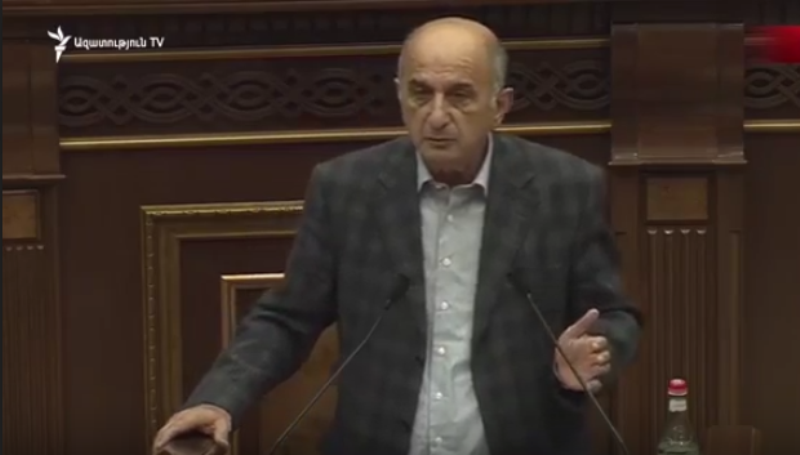
At the initiative of National Assembly President Ararat Mirzoyan, parliamentary hearings were held in the hall of the RA National Assembly sessions on the theme “The Constitutional Law on Parties, Existing Problems and the Scope of Changes.” Among the speakers was also political scientist Vigen Khachatryan, who proposed that once the draft is ready, those with proposals be given freedom, and that those making proposals be invited to the sessions of the commission or working group to try to defend their proposals. According to him, this would help the law become more useful and viable.
Vigen Khachatryan is the author of one of the versions of the RA first constitution, and recalling the discussions of the first constitution, he said: “There was a great debate when developing the constitutional norm on parties; nevertheless, our proposal passed there; we insisted that the constitutional norm be the following: the structure and functioning of parties must conform to democratic norms. Somehow, with great difficulty, we got that word ‘structure’ through. Later — during this constitution’s amendment — the word ‘structure’ was removed; go, look, compare. If we are speaking of the three fundamental legal principles of parties — namely freedom, equality, transparency — this must be restored in the constitution; this is what the constitution demanded, and if we go deeper, we see that the structure must conform to the norms of democracy, and this was spoken of here… Therefore, the law must develop this constitutional norm.”
According to Vigen Khachatryan, today it is very dangerous to erase everything and start anew: “Our past, with its experience and its trials, is important, and it must be valued — both the experience and the trials. And what do the experience and the trials tell us? From the very first day of our state’s creation, the struggle for spheres of influence began — of course, in the economy. After seizing the spheres of influence in the economy, a temptation would arise to seize the political field, and that is exactly what happened: in essence, power was turned into a currency ‘exchange point,’ a currency kiosk, where you bring rubles and exchange them for dollars, and dollars for rubles. In Armenia, power became that point where money was turned into power, and power into money, then into greater power, greater money, and the result was those 15 families.
…Now, thank God, the situation has changed, and we must give thanks to all those who did it. Yes, it has changed, and today we must not put the cart before the horse.
…Will a healthy economy emerge, will a healthy electoral system emerge, will healthy parties be formed — the opposite will not happen — but that does not mean we should not have a good law. In developing this good law, I think the more participation there is, the more proposals are voiced, and the more you hear the proposals from their authors, the more workable the law will be. I promise you I will bring several good proposals and defend them,” said Vigen Khachatryan, adding that the importance of state material support must also be emphasised, in such a way that this support does not extend to the three parties operating within parliament. He explained this as follows: “Because the parties operating in parliament are first of all tempted to present their own issues; this must be prohibited, and it must be a constitutional, legislative norm. In general, the sitting parliament must not set privileges or advantages for itself; those parties will lose nothing, because they will have an incomparably greater opportunity to present themselves to society by working in this hall; this principle must be maintained. Yes, tenfold more funding for today’s extra-parliamentary forces, and not a dram more for the sitting forces. I have no objection to your having good opportunities, but this must become a norm, a moral norm.”
Vigen Khachatryan also addressed the talk of weakening state intervention, considering it correct: “For parties to be free, they must be protected from state intrusion, but there is a second form of intrusion — extra-state intrusion, which is carried out in the person of wealthy individuals, groups pursuing material interests, and external states. In Armenia there are several so-called political forces whose activity is beginning to arouse suspicion in me — are these agents, or citizens of Armenia? How do we protect this small state from that agent network? It is a difficult problem, but this too guarantees the freedom of the party; we must think seriously about this.”
The political scientist also said: “In our law on parties, we must find a form — not for propriety’s sake or for the sake of appearances — but what do we have to say about the traditional parties in this law? Let us think; it is a difficult problem, because we had two Dashnaktsutyuns, I think in the 90s to 95s, it was a perversion; such a thing should not have happened. I think we had two Hunchakian parties, and now we also have a Ramgavar party that the parent party does not recognise, saying it has nothing to do with us. How do we solve these problems? They are difficult questions, but this must be solved. This is a reality — there is a Ramgavar party in Armenia, which, as such, is a group of people, unknown in the political field, with no political figures; the other party says, ‘Brother, that is not us, change that thing.’ That is, there is a Ramgavar party in Armenia that the traditional Ramgavar party says is not us, but they have been registered, because the traditional parties — forgive me — have no past as political parties; they are other organisations, the name is ‘party,’ but they are very important, and if we are speaking of diaspora-homeland ties, we must discuss the question of the traditional parties well and give correct solutions. I do not know what that solution is, but I know that what exists today is a perversion; we must think about it…”
Vigen Khachatryan also stressed the importance of such discussions, expressed thanks to all the participants and experts, adding again: “My only request is: rely on the existing experience, do not erase it; that experience exists; proceed from reality. As Nikol Pashinyan said, let us not write a law so that they say in Europe it is good, that Europeans like it, but it does not work for us; we do not need that. Write a law that will work here, and that is possible in one case: if you, using the capabilities of European experts and international experience, rely on the desires and goals of local political figures and structures.”