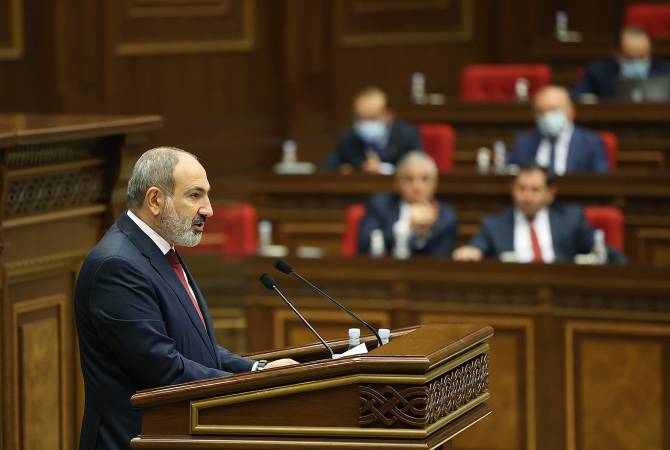
“The unblocking of the region should be one of the priorities of Armenia’s foreign policy,” Prime Minister Nikol Pashinyan declared today, August 24, while presenting the Government’s 2021-2026 programme of activities in the National Assembly, at the same time stressing that this process cannot take place at the expense of Armenia’s and Artsakh’s security and vital interests.
“This is a serious opportunity to break the blockade that has continued around the Republic of Armenia for 30 years. This is not a simple process, and it is being aggravated by the Azerbaijani side’s provocative statements about certain corridors,” said Pashinyan, again emphasising that neither in the November 9 nor the January 11 statements is there any expression, reference or formulation regarding the creation of a corridor through the territory of Armenia.
“The talk is about something else — just as Armenia is to receive a road through Azerbaijan’s territory for transport communication with Russia and Iran, so too is Azerbaijan to receive a road through Armenia’s territory for transport communication with its western regions and Nakhichevan,” said the Prime Minister.
Pashinyan did not deny that the issue of opening communications contains certain dangers for Armenia’s interests.
“That is why in the government’s programme we have noted that unblocking should be one of the priorities of Armenia’s foreign policy, while this process cannot take place at the expense of Armenia’s and Artsakh’s security and vital interests,” said Pashinyan, continuing: “If we want to form a favourable regional environment around Armenia, we must make Armenia a favourable environment for the region, moreover on the principle of reciprocity — no more, no less. This is our strategic security challenge.”
The head of the executive noted that the stability and peace of the region is their long-term strategy, and the deepening and regulation of relations with neighbouring countries should be among the important directions of foreign policy.
“The deepening of enmity is a threat to the stability and security of the region; overcoming enmity can become the axis of the regional foreign policy agenda,” Pashinyan said in particular.
Turning to foreign policy, Pashinyan first spoke about relations with Russia, stressing that Russian peacekeepers today are a guarantee of security in Nagorno-Karabakh, and Armenia should continue to strengthen and expand military, economic and political relations with Russia.
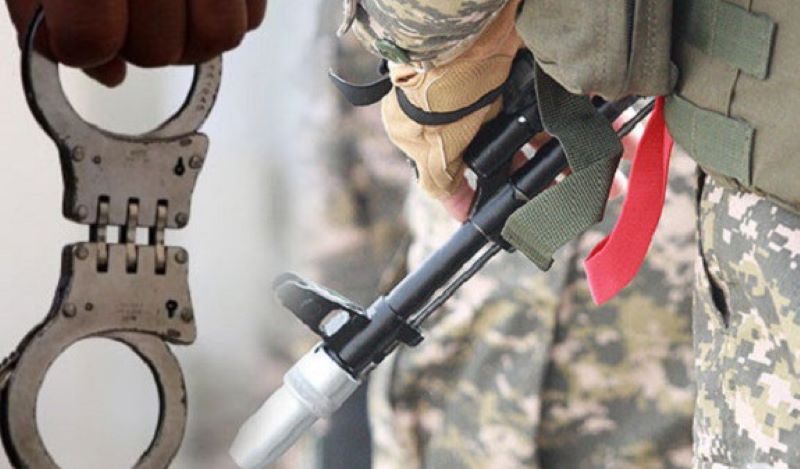
Notable was Pashinyan’s statement that a powerful counter-campaign is being waged in Azerbaijan against the Russian peacekeepers. He stressed that the Armenian servicemen captured after the November 9 trilateral statement and sentenced to imprisonment by Azerbaijani courts were captured when the territory was under the control of the Russian peacekeepers: “If we combine this fact with the reality that Azerbaijan has not signed the peacekeepers’ mandate to this day, it becomes obvious that this is a series of actions carried out against the peacekeepers, that is, against Nagorno-Karabakh and against stability and peace in Nagorno-Karabakh.”
Pashinyan also spoke about Armenia’s strong ties with the West. He cited examples of effective cooperation with the United States, the EU and France. He stressed that Armenia-United States relations have risen to the level of strategic dialogue.
In a speech lasting 3 hours, he touched upon the programmes expected in all spheres for Armenia’s development — education, culture, economy and sport.
The opposition deputies’ questions, however, concerned security issues. Most of them, however, were not about the future but about the losses of the past.
An uproar began over a question addressed to Pashinyan by Anna Mkrtchyan, a deputy of the opposition “I Have Honour” faction, laced with insults and irony. The President of the National Assembly, Alen Simonyan, decided to have Mkrtchyan removed from the session hall, and after security staff entered the hall, a scuffle broke out. Only after a 20-second break did the session continue in relatively peaceful conditions.