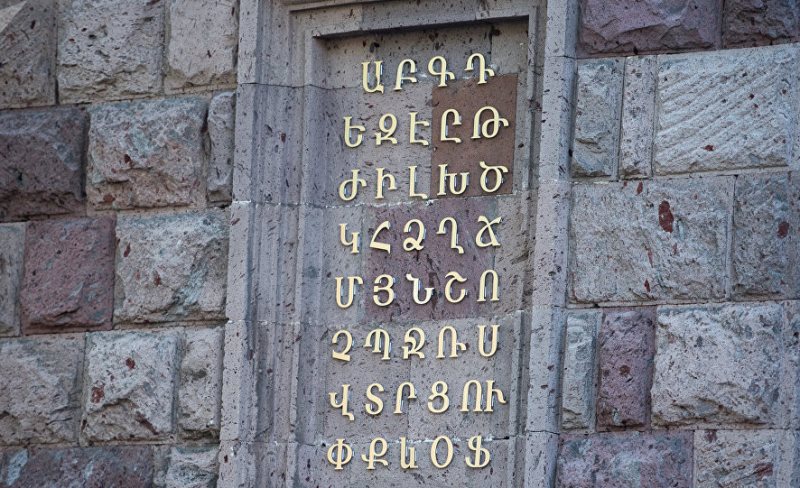
A people’s language is, without doubt, its greatest wealth. It is the symbol of a nation’s unity. The product of a collective, persistent effort. Moreover: language, with its structure and its vocal, phonetic possibilities, is the reflection of a people’s gifts and characteristics. It encloses within itself the genius and wisdom of the collectivity that created it. In its depths it holds the people’s creative fire, as well as the nature and quality of their craftsmanship, their tenderness and their way of thinking. Language carries within it the character, the expressive authenticity and the taste of the people who created it. It has gathered within itself the centuries-old spiritual patrimony of its speakers, and has preserved in its depths their entire history.
Without entering into details, let us say that, due to historical events, our modern language consists of two main parts, known by the names “Eastern Armenian” and “Western Armenian.” We do not attempt to favour one over the other. We are satisfied to note that they are the property of the two segments of the Armenian people, and that both, separately, have cultivated an authentic, pride-inspiring literature.
By a fortunate coincidence, Eastern Armenian is not only the language of the Armenians gathered in the Araratian plain and its surroundings, but also our state language. And as such, it is the living expression of the people. A faithful servant in the daily life of the Armenian legitimate authorities, and worthy of every care and encouragement.
Western Armenian, however, by the tragic arrangement of events, is scattered to the four corners of the world, with the souls who persist in using it. It is abandoned to the treacherous whims of hostile winds, and is perpetually subject to inevitable corruption. By a miracle, it still continues its existence. To the stubbornness and devotion, perhaps one should say the “madness,” of the exiled segment to live, we owe the survival of Western Armenian to this day. Yet, as is already evident, its essence is constantly being worn away. Its disappearance is already discernible on the horizon. It has truly reached a point where the terrifying alarm of an irreparable loss must be sounded.
And it must be remembered that Western Armenian, apart from all other data and considerations, is the living witness of our territorial and other claims, its constant and unyielding reminder.
It is in this sense, with this devastating anguish, that these lines are written.
According to appearances, the diaspora is not in a position to halt or even alter the sad course of relentless events. The reasons for this situation are many, and we do not wish to address them here.
In the face of the alluded realities, the authorities of Armenia, we believe, must take charge of our language in general. It is the unavoidable, non-deferrable duty of the Armenian state to also protect and preserve Western Armenian, as a national wealth, as a homeland tradition transmitted from century to century. Why not, also, as a treasure of global nature and capacity?
In our opinion, the competent bodies of Armenia, with the guiding assistance of specialists related to the subject at hand, must promptly develop a broad and comprehensive programme concerning Western Armenian, the implementation of which could be carried out step by step, according to available means and prevailing conditions. In connection with this imperative work, we take the liberty of presenting a number of quick and unorganised proposals or thoughts.
– As part of Yerevan State University or as a separate institution and, perhaps, under the supervision of the corresponding branch of the Academy of Sciences, a special department of Western Armenian must be established, with capacity and content privileged alongside the foreign languages currently taught.
– For the satisfaction of immediate needs, or otherwise, it is necessary to prepare –
a. – Teachers of Western Armenian:
b. – Lecturers teaching in Western Armenian, with specialisation in various subjects:
– Keeping especially the diaspora schools in mind, prepare textbooks in Western Armenian for the required subjects and specific grades, after conducting the necessary studies and consulting with the administrations of the schools in question.
– Western Armenian must be taught in all homeland schools, and at every necessary level, so that the new generation may know it and fully benefit from the literature cultivated in it. With corresponding concern, a worthy place must be given to the Western Armenian language and literature in school textbooks.
– Create conditions in Armenia where it becomes possible to establish a press in Western Armenian, and encourage such an initiative in every way.
– With special initiative and meticulous care, create particular conditions or facilities in the country whereby diaspora authors can, or are encouraged to, print and publish their worthy works in Western Armenian in Armenia. At the same time, every possible effort must be made so that these publications are accessible to the homeland reader.
– According to a planned programme, publish or republish the works of renowned Western Armenian writers, in the orthography of the originals, and strive to ensure they easily reach the public and especially the new generation.
It is understood that the competent or authorised bodies will feel free to resort also to various effective, productive measures. In any case, they must act immediately, at the first opportunity. Because the crisis began long ago. Because tomorrow may already be too late.
We are convinced that such undertakings will not only bring the two segments of the Armenian people closer together, cultivating mutual understanding and trust between them, but will also greatly contribute to their spiritual unity. Goods that the Armenian people have always needed.
The goal, in our view, is so sacred, so non-deferrable and historically fateful that, in the final analysis, it makes probable material and other concerns relatively unimportant.
Although we believe that, if the homeland adopts the idea under discussion, the Armenian diaspora, fully understanding its nature and capacity, will undoubtedly want to assume the corresponding financial and moral obligations.
Nicosia, Cyprus
Asadur Devletyan