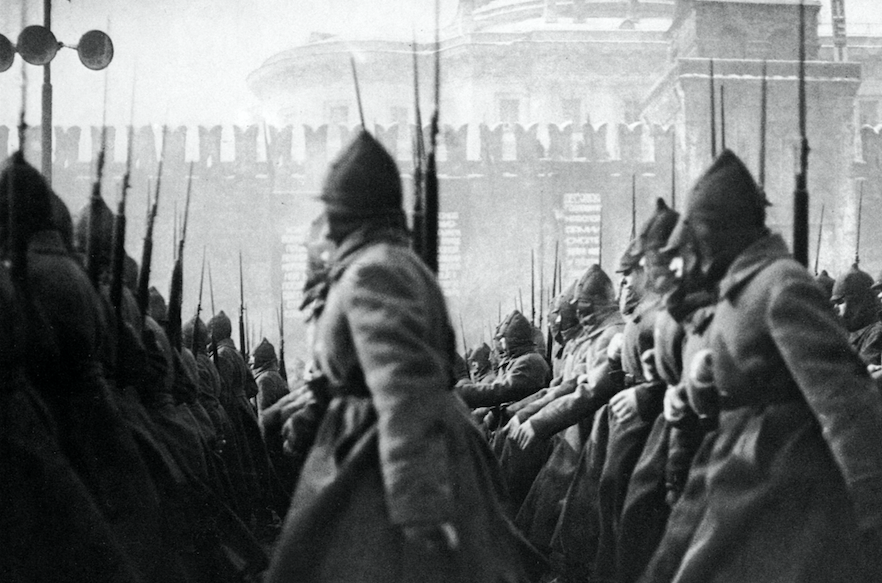
In 1920, two days after Mustafa Kemal’s April 26 letter to Lenin, on April 28, Azerbaijan peacefully declared its reality of becoming “Soviet” and, of course, as a first step, requested aid from Soviet Russia, despite the laughable and absurd Baku declaration that “the temporary military-revolutionary committee of the Azerbaijani Soviet independent republic has come to power by the will of the Baku revolutionaries and the working class of Azerbaijan, and that authority declares the former Musavat government a traitor to the people and an enemy of independence.” As if this were not enough, the declaration also noted that “the acting parliament will work with the same composition and local administrations will continue to work quietly in their places.” Thus, Mustafa Kemal’s plan to “see Azerbaijan within the group of Soviet states” became a reality.
Anastas Mikoyan says the following in his memoirs: “According to intelligence data, the Musavat government of Azerbaijan had an army of 30,000. 20,000 were stationed on the borders of Armenia, and 10,000 were stationed in military bases in a number of settlements. Shortly before the entry of the Soviet army, the Azerbaijani army had carried out the massacre of Armenians in Karabakh and Shushi. On the line of contact with the line occupied by our army, there were slightly more than 3,000 soldiers.” It was evident that the Sovietization of Azerbaijan had been agreed upon with Mustafa Kemal and the Musavat government, and that the Bolsheviks would not encounter resistance when they brought their troops into Baku.
And since there were still groups unaware of the aforementioned agreement who could incite unrest, it was necessary to send a small detachment aware of this matter, of which Mikoyan was also a part. Naturally, that Bolshevik detachment reached Baku without resistance, and on the night of April 28, the Musavatists released the “arrested” Bolsheviks from prisons and handed over power. And thus, the Musavatists became Bolsheviks in one day. Thus, the agreement was concluded between the Ottoman Turks, represented by Mustafa Kemal, and the Caucasian Turks, having Armenia as a common enemy country.
Thereafter, Russia effectively assumed the role of Mustafa Kemal’s executor regarding the Armenian question, which would lead to the “protection of the territorial claims” of the Caucasian and Ottoman Turks. To that end, on April 29, the Revolutionary Committee of Azerbaijan sent the following telegram to the government of Armenia: “The worker-peasant government of the Soviet Republic of Azerbaijan, represented by the Revolutionary Committee, demands:
A) Free Karabakh and Zangezur from your troops,
B) Put an end to inter-ethnic massacres, otherwise the Revolutionary Committee of the Soviet Republic of Azerbaijan will be forced to enter into war with the Republic of Armenia. The ultimatum’s deadline is 3 days.”
Following the aforementioned ultimatum, on May 20, the People’s Commissar of Internal Affairs of Soviet Azerbaijan, the authorized representative of Soviet power, Molla Yasin Mehmed Oglu, reports that in the Aresh region, massacres against the Armenian population continue; the representatives of authority are the same bloodthirsty officials who burn Armenian women and children alive, keep captives in slavery, and now continue their domination in the name of Soviet power.
So, in Sovietized Azerbaijan, it seems nothing had changed, and new ideological “concepts” had been introduced into the Armenian massacres, that Armenians are “imperialists,” “chauvinists,” and hinder the implementation of the Russian-Turkish “universal” plans to “Bolshevize the East.”
Consequently, to make the Mustafa Kemal-Lenin agreement a reality, on May 21 the Red Army approached Karabakh. And on May 24, Ordzhonikidze, in a telegram sent to the Deputy People’s Commissar of Foreign Affairs of Russia, Karakhan, Lenin, and Stalin, informed that Armenia does not agree to let their troops carrying military supplies to the Turks pass through Armenia, therefore he proposes to “immediately occupy Nakhichevan, Ordubad, and Julfa” from Armenia.
On May 25 of the same year, the Central Committee of the Bolshevik Politburo adopted a decision regarding Armenia: “to approve the People’s Commissariat of Foreign Affairs’ policy of assisting the liberation movement of the peoples of the East; Azerbaijan had been liberated from the peoples of the East, but according to the agreement, it was still necessary to hand over Karabakh, Zangezur, and Nakhichevan to it, as well as to liberate Turkey from the Entente, which, by Russian-Turkish logic, was hindered by the existence of the Republic of Armenia.” To safely deliver the weapons, ammunition, and gold promised by Lenin to the Turks, Russia needed an outlet and control over the southern parts of Armenia; therefore, an opportunity was needed for the Red Army to enter Armenia.
And so, that opportunity was created by the People’s Commissar of Foreign Affairs of Russia, Chicherin, with his following untruthful and inflammatory telegram: “According to reliable information, hundreds of communists have been arrested in Kars and other regions of Armenia. The government of Armenia is secretly executing communists, and in particular, Comrade Mikoyan has been executed. The Soviet government is deeply outraged.” As a result, by order of the Soviet government, the Red Army entered Zangezur and Nakhichevan. In Zangezur, the Red Army suffered a crushing defeat thanks to the exceptional resistance shown by the units of Garegin Nzhdeh, one of the theorists of modern military art, endowed with exceptional combat capabilities, a publicist, writer, and theorist of national ideology; however, the Red Army managed to occupy Nakhichevan. As for Karabakh, it had already been handed over to the Bolsheviks a month earlier, in May, by Dro.
However, during this period, Soviet Russia was trying to negotiate with the authorities of the Republic of Armenia to establish a temporary peace, so that the weapons and ammunition promised to Turkey would reach their destination uninterrupted through Armenian territory. Unfortunately, Mikoyan, dissatisfied with this course taken by Russia, made a decision harmful and treacherous to the nation when, on July 29, 1920, he sent another telegram to Ordzhonikidze, demanding from the central government that Karabakh and Zangezur be “immediately” annexed to Azerbaijan.
Unfortunately, the faith of Armenian Bolsheviks that “socialism would solve all contentious issues” proved futile, and all the newly Bolshevikized Turks of the Caucasus continued the killings, oppression, and discriminatory policies against the Armenian people.
It was already evident that the Ottoman and Caucasian Turks were hastening to accelerate events, because the Treaty of Sevres was in progress, which was to determine the borders of the three Caucasian republics, while the Russian-Turkish plan envisaged resolving the issue of Nakhichevan, Zangezur, and Karabakh, in order to present those working on the Treaty of Sevres and the allied states with a fait accompli, thus thwarting any pro-Armenian resolution or decision. The day of the signing of the Treaty of Sevres, August 10, 1920, is also marked by another historical treaty, when a “temporary armistice agreement” was signed between the Republic of Armenia and Soviet Russia, “by which Zangezur, Karabakh, and Nakhichevan were declared a neutral zone, and the security of its population was entrusted to Soviet Russia, until the question of their belonging to Armenia or Azerbaijan is decided.” However, Zangezur did not submit to this agreement, and under Nzhdeh’s leadership, the struggle continued against the Ottoman and Caucasian Turks and the Red Army, until Soviet Russia was forced to sign a ceasefire agreement with Nzhdeh and accept his main precondition, which was: “Zangezur is an inalienable part of Soviet Armenia.”
Kevork Haleblean