In his capacity as president of the Egyptian National Union, while Mihran Damadian was in Paris for the purpose of forming the Armenian Legion, he had the opportunity to meet with the president of the National Delegation, Boghos Nubar Pasha.
Previously, Damadian had been offered the opportunity to travel and visit various colonies as a representative of the National Delegation, in that capacity. But at this meeting, Boghos Nubar was to propose sending Damadian to Cilicia.
Mihran Damadian was known for his revolutionary activity in the territory of Cilicia, and on various occasions he had been in certain regions of Cilicia. Especially the Central Board of the Armenian Constitutional Ramgavar Party also had an important circle in Cilicia.
The proposal made by the president of the National Delegation in October 1918 was also to be adopted by the delegation of the Republic of Armenia, at the joint meetings of the delegation of United Armenia, and Mihran Damadian is proposed, as a representative of the delegation of United Armenia, to depart for Cilicia.
The plan to leave for Cilicia becomes acceptable to Damadian, and the delegation of United Armenia names him representative of the delegation to the Armenian communities of Syria and Cilicia, as well as to the French and English military and political structures.
United Armenian State
A year before the First World War, in 1913, the Armenian Committee of National Self-Defense, which was operating in Cilicia, composed of the Armenian units operating there, was to appeal to the consulates of the great powers existing in Cilicia, presenting a confidential memorandum.
The memorandum submitted concerned the program of autonomy in the name of the Armenians of Cilicia, which later in the course of the same year was published in a special booklet titled “The Armenian Question and Its Solutions.”
The program presented would certainly whet the appetite of a number of states, but the World War and then the Great Genocide would leave that question to England and France, with their secret agreement of May 1915, known as the Sykes-Picot Agreement, between the two states.
Stanley Sykes and Georges Picot had signed this secret agreement, which concerned the division of zones of influence between England and France — Cilicia, Syria, Lebanon and Palestine.
This program was certainly to be implemented only after the Allies’ clear victory, and with that intention Mr. Picot had planned to head toward Western Armenia, and had applied to Boghos Nubar Pasha, who was in Paris, to have a trustworthy and well-known Armenian figure accompany him, because in the capacity of France’s High Commissioner he was to undertake that mission.
Comrades of the Ramgavar Party’s Cilician Circle
By Boghos Nubar, Damadian’s name and circumstances were to be presented as representative of the delegation of United Armenia. With the declaration of the Republic of Armenia on May 28, 1918 and the aspiration for Cilicia’s autonomy, a glimmer of reconsideration of political interests was to be seen among the Allied powers, contrary to previous promises.
It is with this concern that the diplomatic president of the National Delegation, Boghos Nubar, was to be cautious in mentioning the name of the delegation of United Armenia in his letter of recommendation, when he was entrusting Damadian to depart for Cilicia.
Boghos Nubar’s approach was directed primarily at High Commissioner Georges Picot and the general commander of the English army in the Cilicia and Syria region, General Allenby.
In June 1919, Mihran Damadian’s plan to depart for Cilicia was to be realized, with an explanatory note transcribed by Boghos Nubar and Avetis Aharonian, of which at the time only Catholicos Sahak Khapayan of the Great House of Cilicia and the National Self-Defense Committee of Cilicia were kept informed, with reservation.
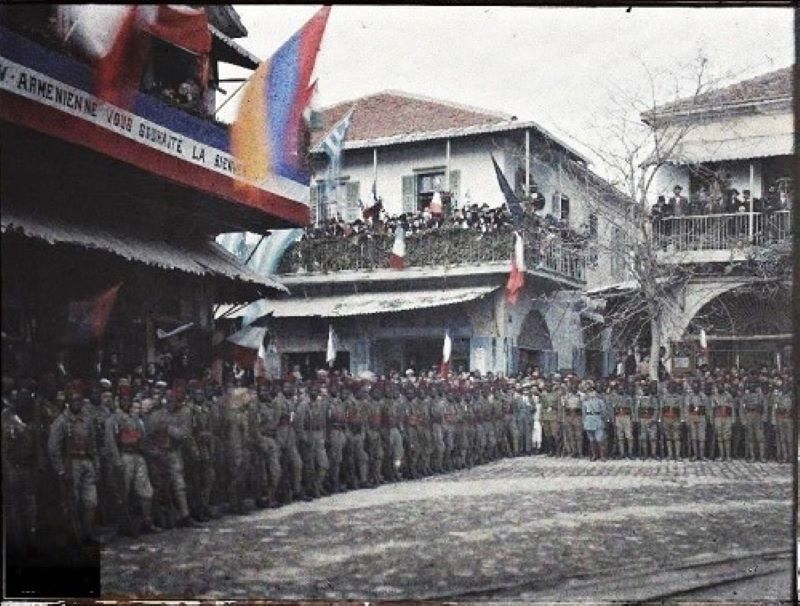
First Group of Armenian Legionnaires
Mihran Damadian’s first task was to establish contact with the refugee camps existing in Cilicia and to meet with the French army’s military officer in charge, Colonel Brémond.
Damadian was to choose Adana as his seat, and from there he was to begin his work with a more practical plan. At the beginning of the century, the diplomatic map of the Ottoman Empire’s territory had also named the Cilician region the Sanjak of Adana (Province), considering Adana’s urban position and population size. The territory of Cilicia considered by the United Armenian delegation, which was also a program ratified by Georges Picot, corresponded to the region of the Sanjak of Adana.
The Headquarters of Adana’s United Armenian Union
So, when Damadian undertook his mission, it was already clear that the program envisaged for Syria and Cilicia under France’s tutelage was to become acceptable to the Allied powers, especially after the “glorious victory of Arara” of September 19, 1918, where the Armenian Legion became conspicuous with its heroic dedication.
The volunteers participating in the Armenian Legion were mostly aware of the program of Cilicia’s independence, and with that intention they had spread and settled in regions adjacent to Cilicia, such as Cyprus, Syria and Lebanon, while many were already stationed within the territory of Cilicia.
Mihran Damadian, conscious of his office, after arriving in Adana and having thorough meetings, had kept informed the president of the delegation of the Republic of Armenia, Avetis Aharonian, as well as the president of the delegation of United Armenia, Boghos Nubar Pasha, who in turn frequently kept Damadian informed with bulletins about the developments in relations with the Allies.
For Damadian and the members of the Armenian Committee of National Self-Defense, the realization of the independence program with the approval of the French tutelage presupposed the formation of an organized army, for which it was deemed right to rally the volunteers of the Armenian Legion in Cilicia and entrust it to the experienced Colonel Jim (Bedros) Changalian, who had successfully led the Battle of Arara. Damadian, through his affiliated Ramgavar Party, had been able to establish contact with Changalian and obtained the latter’s consent, at the same time he had been able to appeal to Armenak Yekarian, the incomparable leader of the heroic battle of Van, who was in Egypt, from whom he had also received a positive response to plan with Changalian the creation of a volunteer army.
Colonel Brémond with His Guard
Around 275,000 Christian inhabitants had settled in the territory of Cilicia during that period, of whom 150,000 were Armenians, who were clinging to their ancestral centuries-old land.
For the plenipotentiary representative of the delegation of United Armenia, the task of forming an extraordinary Christian council in Cilicia became important, from whose program’s draft the government working for Cilicia’s autonomy was to emerge. Damadian was to enter into relations with representatives of the Greek, Assyrian, Chaldean and Syrian communities, explaining to them the preparations to be made for the independence program, as well as realizing the program of national unity, planning it with the regional leaderships of the Armenian parties operating in Cilicia.
And for the planning of the volunteer army, the supreme body of National Defense was to be brought to life.
This preliminary step in the preparation of Cilicia’s Independence program was communicated by Damadian to Colonel Brémond, who in turn had informed the French High Commissioner, General Gouraud.
Map of Cilicia
A week before the Act of the Declaration of Cilicia’s Independence, by a telegram dated July 30, 1920, Boghos Nubar Pasha had informed Damadian that for France, the program of Cilicia’s tutelage was still to remain dependent on the provisions of the treaty to be signed by Turkey in Sèvres in August.
But Damadian’s 14-month plan was to be realized on the morning of August 4, 1920, with the event of the declaration of independence inside the hall of Adana’s National Union, in the presence of representatives of the three Armenian denominations and the supreme body of National Defense.
Damadian, as plenipotentiary representative, explained to those present the purpose of the declaration, which was: to proclaim that day the independence of Cilicia from Turkey, endowed with autonomy under the patronage of the French state.
The same day, the Inter-Christian Extraordinary Council of Cilicia, under the chairmanship of Mihran Damadian, headed to Adana’s government house and there handed the envelope of the Declaration of Independence to Colonel Brémond, who asked for time to obtain ratification from France.
Proclamation of the Armenian State of Cilicia — August 4, 1920
During the following 24 hours, the Inter-Christian Extraordinary Council held meetings inside the hall of the National Union and unanimously agreed on the formation of a provisional government, which consisted of the following:
Mihran Damadian — Prime Minister
Dr. Mnatsakanyan — Minister of Foreign Affairs
Dr. Bezirjian — Minister of the Interior
Garabed Jamkochyan — Minister of War
Andranik Genjian — Minister of Commerce
Garabed Nalbantyan — Minister of Supply and Agriculture
Jean (Assyrian-Chaldean) — Minister of Education
Nikolaki Efendi (Greek) — Minister of Justice
And the ministerial posts of Communications and Public Works were reserved for a Turk and an Arab.
On the afternoon of August 5, the members of the provisional government headed to the government house to assume their office and to act under French tutelage. But the colonel, prepared to receive them, angrily warned Damadian and threatened to arrest the members of the government if they did not renounce the declaration of independence. All hopes dashed, on August 6 the National Union was informed that France had agreed to hand over the territory of Cilicia to Turkey, agreeing to sign the Treaty of Sèvres. The treaty was signed on behalf of the delegation of the Republic of Armenia by Avetis Aharonian.
Reserve Legionnaires
After the Treaty of Sèvres, the delegation of United Armenia was also to cease its existence, because the article in the treaty stipulating the attachment of the 4 provinces described therein to the Republic of Armenia was to have satisfied the territorial claims of the Western Armenians.
And after Cilicia’s one-and-a-half-day independence, by the hand of noble France, the Armenians of Cilicia were condemned to a new exile, without guarantee, being finally handed over to Turkey.
The Treaty of Peace of Sèvres remains to this day as a memorandum of the Armenian people’s right to reach a just solution to the Armenian Question.
ARA AHARONIAN