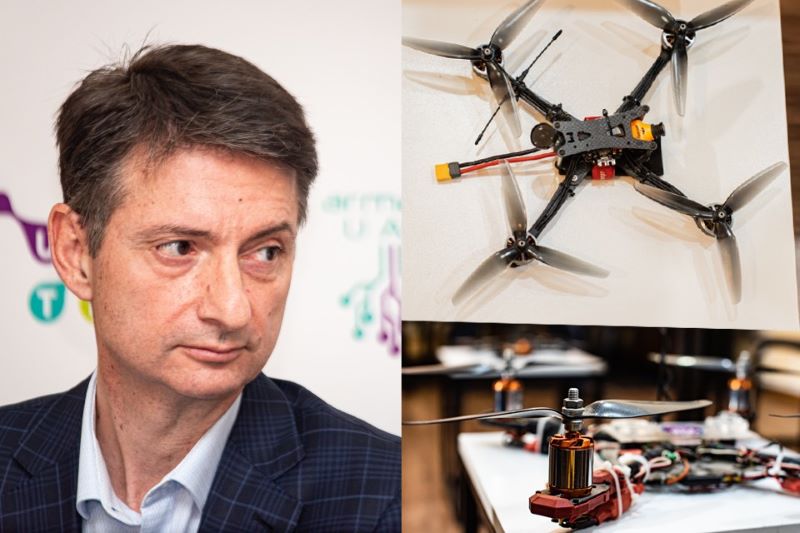
Within two years, it will become possible in Armenia to train 1,750 specialists annually in the design and manufacture of unmanned aerial vehicles (UAVs), as well as in the servicing and operation of such devices, the leaders of the Union of Advanced Technology Enterprises (UATE) announced on 19 January during a meeting with journalists, signalling the launch of the “Armat in the Air” programme.
The Union’s Executive Director, Raffi Kassarjian, noted that the need for such specialists became especially apparent during the 44-day Artsakh war. Such education in UAVs is also becoming increasingly in demand in civilian life year after year, as the UAV sector is one of the fastest-growing branches of the modern economy.
“We want to present our ‘Armat in the Air’ programme. It is a comprehensive educational programme for the preparation of unmanned aerial vehicles, which we are launching this spring. The goal is that, just as we trained 14,000 annual graduates in the ‘Armat’ workshops, we have a similar contribution,” said Kassarjian.
According to the “Armat in the Air” programme, it is planned to establish 25 UAV educational workshops in the Republic of Armenia and Artsakh this year, and a further 40 next year, where 15-18-year-olds will receive theoretical knowledge of the operation of unmanned aerial vehicles, and will master the specifics of their design and manufacture, software, servicing and control. Moreover, unlike other similar projects, the educational programme includes both rotary-wing and fixed-wing UAVs; the latter usually have a military purpose.
According to the head of the “Armat” programme, Sedrak Vardanyan, the implementation of the “Armat in the Air” programme costs 422 million drams, and the Union has already collected 52 million: “Already from the month of April we plan the introduction of 8 workshops. They will be in the cities of Gyumri, Vanadzor, the Monte Melkonian military academy in Dilijan, Talin, Gavar, Yerevan, Kapan and Stepanakert.”
According to Vardanyan, each workshop must operate three groups, the educational programme will last one year, and once 65 workshops are ready, the number of annual graduates can reach 1,750: “Of that number, a portion will go into conscript service, approximately 1,300-1,400 people, that is, at least within two years we give the army around 2,500 prepared young men who have turned 18. Those young men, as well as the girls and boys who do not go into conscript service, can also be included in the field of technology enterprises.”