From the Memoirs Series BEIRUT IN THE 1960s
By Vartan Tashjian
One of people’s natural, sometimes instinctive habits is to always pay a visit to their past, generally through albums, kept letters, souvenirs or diaries, and recall the years of adolescence and youth, when hair and beard were black, legs and gait were deer-like, and every conscious act was innocent, guileless, carefree and unpretentious.
This “nostalgic” return is always tinged with emotion and a shudder, when songs, melodies, films, classmates, faces, events, outings and gatherings of the past file through the mind’s pathways, and through the biological play of the Freudian psychology of brain cells, transport an imperfect experience into dreams, giving rise to wonder at how a person unseen for years suddenly comes to visit in the subconscious of the night-time pillow. And since those days will never come again, how sweet, how pleasant, how blissful they seem in the face of the inconsolable reality of regret.
Cities are the same and often seek their past, their days of glory, their golden age.
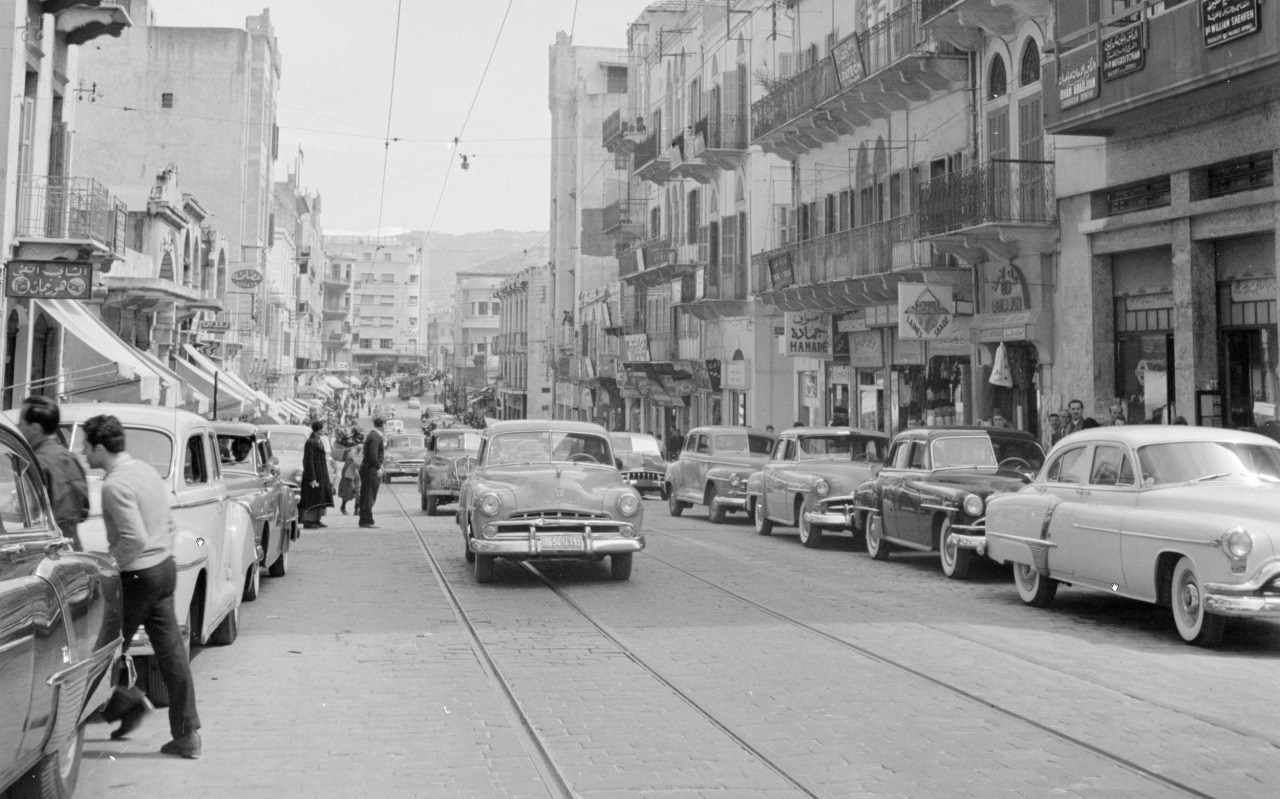
Beirut, the capital of Lebanon, is no exception to this truth, in the sixties—with its magnetic charm, beauty, way of life and vitality. This Middle Eastern city in European garb was a fusion of modernity and patriarchy, with a uniqueness bridging the new and the old, when there was as yet no talk of Dubai, Abu Dhabi or Qatar. From its skyscrapers to its historic buildings, from its bourgeois quarters to its pitiable corners, from the stone labyrinth to the marvel of nature observing it—the mountain slope—from the narrow, winding streets of ascent and descent to the cauldron of automobiles—the boulevards—from the ultra-modern shops of the famous Hamra to the goldsmiths and shopkeepers of the bustling Souk Sursock market, down to the foul-smelling stream of blood-mixed water from butchers washing meat and fish, under the feet of passers-by or customers holding their noses, with their hats and fezzes.
The main square, the Bourj, the heart of the city, was a cauldron of turmoil, a swarm of public buses, buses, taxis, service cars, people, shouting, and completing it all, frantic policemen in dark green uniforms, whose only weapon was the “unarmed” whistle in their mouths. The striking sight piercing the central Martyrs’ Monument and the expressive row of palm trees was the station of buses and taxis, for travellers heading to various villages and cities—Tripoli, Zahlé, Baalbek, Sidon, even Aleppo or Damascus, whose Arabic name, “ash-shem, ash-shem,” was heard as a herald’s call from very far away. The competition to win over customers, with lavish curses pouring from hot heads, created before the eyes of local residents a stage of shouting, commotion and often inevitable fisticuffs, to the point of terrifying the passengers.
The half-white, half-red painted public buses, with their incessant “ding-ding,” provided service from one end of the city to the other until late at night. One line, from the Bourj to Jemmayzeh, Bolikarpous, Dora, and on the other side westward, to Basta. Another line headed to the American University, so-called “culleh”; and to the southeast, to Badaro, the museum. In their haste, many, deeming the patience of waiting at the station a waste of time, would recklessly jump on or off the speeding bus, seriously endangering their lives. In our youthful years, we too did not lag behind in this adventure, on the way to and from university. Over there, the service cars, generally Mercedes, teemed, whose rough drivers with cigarettes never out of their mouths would employ endless gestures of head and hand, with the cunning peculiar to the craft of hunting customers, while their car radios loudly blared the long-winded songs of legendary Egyptian singers Umm Kulthum and Abdel Wahab.
On both sides of this square, apart from the Souk Sursock and the ill-reputed brothels, a striking presence were the city’s most popular cinemas—Roxy, Empire, Dunia, Metro, Rivoli, and a little further, the Grand Theatre and Capitol—always crowded with film lovers, enjoying everything from Hitchcockian productions to “cowboy” ones, from historical-war films to Dracula and musical comedies.
Large posters with drawings of the leading actors on the fronts of the halls were the attractive announcements of the film being shown. And who was the artist generally appearing under these pictures with a signature in capital letters? H. Torossian:
Hollywood was then an unreachable world for us, and the actors—unique idols, whose pictures were the permanent wall decoration of shoemakers’ walls. I could not imagine that years later fate would smile on me, allowing me to visit that capital of the silver screen many times, walk on its star-studded sidewalks, and with slight disappointment become acquainted with the deceptive appearances of filming inside the great studios, from the parting of the Red Sea to ET’s flying bicycle…
Inside the cinemas, during the intermission, it was a real pleasure to hear the songs of Dalida, Aznavour, Pepino di Capri and Los Paraguayos. Also Bob Azzam’s “Luna Capresse,” the splendid piece by the singer of Lebanese-Egyptian origin, also known for his “Mustafa” and “Ecrit dans le ciel.” And Les Ascarson’s “Gardez la derniere dance pour moi,” whose words—”Go, dance in his arms, Go, smile at his eyes, but don’t forget, to keep the last dance for me”… With what a thrill they plucked the psychological strings of our youth.
We would come out of the cinemas, insatiable, faces reddened from the stale air inside, sometimes with the urge to watch the same film again three hours later, if we had loved it very much. Along the sidewalks we would come face to face with all kinds of vendors. Thin, tall Sudanese black women with conical twists of paper holding warm pistachios, lottery ticket sellers shouting “Ya Nasib,” or “sherbetji” rattling their metal cups, never without a pinch of snuff. For rumbling stomachs, the felafel restaurants beyond would produce sandwiches like machines, in proportion to demand, before one’s eyes, with dozens of round thin breads lined up side by side. The well-known foods, however, bore a different stamp and address. Chicken was “Marroush,” sweets-biscuits “Ghantour,” ice cream “Semirannis.”
Beirut was the Paris of the East, in those days of glory, not only with its stamp of French architecture but also with the unique charm and fame of “La dolce vita” (the sweet life). As the center of the “Jet-set,” Alain Delon, Brigitte Bardot, Omar Sharif, Farid al-Atrash were there, along the Ain Mreisseh, at the Phoenicia and St. George hotels, or a little north of the city, on the red carpets of “Casino du Liban.” It was an unwritten law that the artistic and beautiful decoration of the shop windows of first-class streets such as Souk Tawileh, Hamra, Maarad, Verdun or Arlequin be changed every week, as an attractive invitation to the royal families and the wealthy of the Arab countries, rattling their large prayer beads, to empty their deep pockets. The Lebanese knew how to weave the praise of his goods, to enchant, to charm, to allure, to pour out words until the goods said “bye-bye” to the shop, according to accepted custom, at a bargained price, but securing a larger profit margin than expected for the cunning merchant…
Lebanon’s annual festivals were as much a magnet as the markets for art-loving tourists arriving from Europe, America and the Arab Gulf, with artistic events reviving the historic fortresses and palaces of Baalbek, Byblos and Beiteddine. And the local youth, apart from the campuses of the American, French and Lebanese universities, would choose as their gathering places Wimpy’s, Café de Paris, Horseshoe, Pigeon de Rock, or in the late hours, Kit Kat and Cave de Roi, blending the intoxicating scents of Guerlain and Christian Dior with the smoke of Gauloise, Kent and Lucky Strike, bestowing an intoxicating charm on both the surroundings and their friends, male and female.
Armenian life too did not lag behind these pleasant and rich days. Bourj Hammoud, with its purely Armenian character, was a little Armenia, with the broad activity of vibrant schools, churches, clubs and markets, though an American influence was also expressed in the endless honking of heavy automobiles filing through the narrow streets.
The city district also had its structures that strengthened and made the community proud. On the heights of the Serail, St. Nishan Cathedral, the citadels of Armenian education—the Hamazkayin Jemaran and the AGBU Hovagimian-Manougian School, the complex of the Alex Manoogian Center, the theatrical troupes of George Sarkissian’s “Gaspar Ipekgian,” Berj Fazlian’s and Krikor Satamian’s “Vahram Papazian,” the choirs of Barsegh Kanachyan’s “Kousan,” Kevork Gandaharian’s “Komitas” and Hambardzum Berberian’s “Nayiri”—these were the salt and bread of educational, athletic and artistic vitality. It was a shared experience to listen to Berberian’s “Anor” and Kanachyan’s “Oror” on concert programs, alongside their “Yegeghetsin Haygagan” oratorio and “Nanor” narrative choral work. The literary-social newspapers were the object of desire of an important segment of the people, and the name-day feasts of the churches were a renewal of old customs, with sheep laid at the feet of the Catholicos and his entourage, in preparation for the traditional madagh. Annual dance performances, commemorations, marches, national holidays brought the Armenian community together, paying tribute of respect and gratitude to our heroes, literary figures and devotees. The Homenetmen–Homenmen First Division football clashes also became activities that tensed the nerves of fanatical supporters, no different from the APOEL–Omonia rivalry in Cyprus, on free Sunday afternoons.
From time to time, groups arriving from Armenia injected marrow and blood into the people’s enthusiasm. The Armenian Song and Dance Ensemble, under the direction of Tatul Altunyan, would thunder in the “Unesco” hall for days on end, while “Spartak Yerevan,” the famous football team, champion and cup-holder of the Soviet Union that same year, held successive friendly matches on the vast “Camille Chamoun” stadium against local teams, turning the transport of thousands by bus from the Nahr Bridge into a kind of pilgrimage. Gohar Gasparyan would come to sound her incomparable voice in the vast hall of “Casino du Liban,” while Nishan Beshiktashlian, invited from Paris, enriched the literary-minded public with his witty satires in the “Assembly Hall” of the American University.
The Nahr Boulevard was a busy market for shoes, clothing and goldsmiths, with weekly displays of fashions, while from the Martirosian music store, the echo of beautiful songs, from Armenian to Argentine tangos, was a source of comfort for passers-by troubled by the day’s tensions.
With the good habit of the people, in the summer season they would leave the heat and humidity of Beirut, in their campaign to seek fresh air and rest in the villages—Aley, Bhamdoun, Chtaura, Anjar, Zahlé, or on the other line, Bikfaya, Dhour Choueir, Bolonia, Mrouj—satisfying their hunger and thirst with the delicious local pears, cherries, grapes and the pure waters of the Aakkar…
Behind all this beauty and naturalness, political life might not have been rosy, but Lebanon, the Lebanese and the Lebanese-Armenian, with Beirut at heart, lived and made live, without seriously entertaining the idea of emigrating to “dream lands”—America, Canada, France. Very few planned to leave this paradise and seek a destiny under other skies with the prospect of a more promising future.
But alas, people did not know the worth of their enviable ease, tranquility and wealth. In the crisis of religious, political, factional and personal rivalries, they did not at the same time see the danger of external intervention, influence or interests. The country’s volcano did not remain under the mountain, but heated up, stormed, and one accursed day suddenly exploded with terrible force, burying the Switzerland of the Middle East under dust, fragmentation and rubble for seventeen years. Thousands perished, thousands left, and our beautiful, prosperous, creative community was not spared either.
Now, years after this disaster, Lebanon seems to have regained its “normal” state and modernized, and more. A new airport, new skyscrapers, new squares, new markets give a new color and beauty to its face, while at the same time multiplying the intolerable congestion of the roads and the chaotic state. Here and there, however, the indelible scar of the civil war is evident, as a call to vigilance perhaps, so that future generations may, after this, at least lead the country with love, solidarity and wisdom toward lasting prosperity and peace, learning from the grave errors of the past and especially from the present painful situation of neighboring countries.
Beirut, yes, has acquired a new taste now, there is no doubt, but, whatever the case, different was the taste, different indeed, of the Beirut of the sixties.
22 January 2019
Nicosia