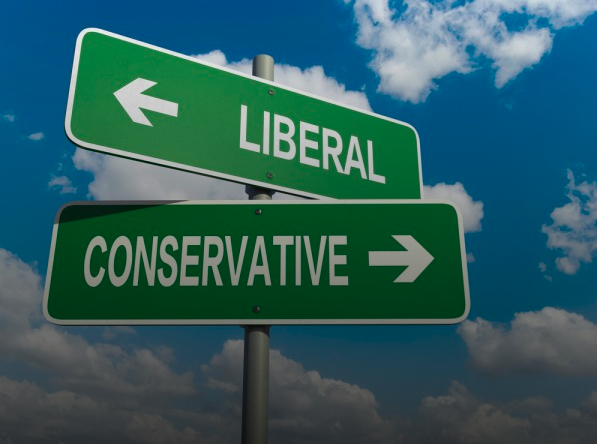
In political science, it is accepted that liberalism is opposed to conservatism. This was the case from the very beginning, when these ideologies emerged during the phase of socio-economic and political transformations, revolutions, and the inception of international theories.
It is well known that as ideological-political currents, liberals and conservatives hold a dominant status in the world today. Today, however, this has taken on a new character and manifestations.
In some countries, with one peculiarity or another, they have remained the same and constitute the main ideological axis of the given state and society. In Great Britain, the United States, and developed democratic countries alike, conservatives are in favour of a strong state and the preservation of public order, and they also attempt to ensure the state’s development and economic stability through strict tax administration. On the other hand, as a countervailing pole, liberals are in favour of the state’s liberalism, having an open society, and the freedoms, rights, and welfare of the human being, the individual.
Liberalism became a distinct political movement during the Age of Enlightenment, when it began to enjoy popularity among Western philosophers and economists. Liberalism rejected the notions widespread at the time of hereditary rights, state religion, absolute monarchy, and the divine right of kings.
Liberalism, as a distinct philosophical tradition, is attributed to the 17th-century philosopher John Locke. Locke believed that every person has a natural right to life, liberty, and property, and he particularly noted that governments must not violate these rights, on the basis of a social contract. Liberals were opposed to traditional conservatism and sought to replace the absolute power of government with representative democracy and the rule of law. The constant struggle between liberalism and conservatism was the logical opposition of society and the individual, because, according to liberals, if the individual is not strong, free, protected, and under proper attention from the state, the state cannot be self-sufficient, established, and powerful; while conservatives were confident that the state can be stable and developing if state structures function without interruption, the state’s apparatus of power, if the social and constitutional order stabilises, if national and traditional values are preserved, and so on.
Conservatism is a political-ideological current, a term first used by the French writer Chateaubriand, who in 1818 published the journal “Conservateur.” The father of classical conservatism is considered to be the English philosopher, publicist, and political figure Edmund Burke. In 1790, he published the work “Reflections on the Revolution in France,” containing conservative foundations. Thanks to conservative ideology and politics, Great Britain is today among the world’s leaders. All of Europe and the United States have adopted that path of development, and Russia has also taken that road.
As for liberal conservatism, it should be noted that it essentially has no pure form. Liberal conservatism, as an accepted distinct ideology, has not yet found its place in academic political science; however, on the other hand, the history of this tendency is all the more interesting, considering that the seeds of its origin go back to England, the bourgeois-democratic revolution, the Third Reich, and Spain of 1874-1931. Liberal conservatism, in essence, lies between socio-patriotism and Christian liberalism. It brings together the main tenets of conservative and liberal ideas, affirming that from the perspective of capitalism and free-market economic relations, liberalism is acceptable, while from the perspective of the modernisation of national identity, public and social matters, it adopts conservatism, which does not follow the already outdated left-right contradictions and divisions, effectively occupying the position of a traditionalist political centre.
Why is liberal conservatism interesting for traditionalist and transitional societies like ours? The Armenian people, in its genealogy, socio-cultural and cultural-civilisational sense, has in its collective historical memory elements of both LIBERAL and CONSERVATIVE thinking and coexistence. The long period of Armenian history has proven that conservatism, as a precondition for the development and security of the Armenian IDENTITY, has no alternative. Today, following the course of the rapidly changing world, the structural social and political behaviour of Armenian society, it becomes clear that we also need LIBERALISM. The development of the state’s economy, bilateral and multilateral inter-state relations, the trends of development and transformation of the commercial-economic world, regional and geopolitical rearrangements compel us to move quickly. We can, as a nation and state, remain firmly attached to conservatism for the preservation and modernisation of our identity, because that is the main axis of our national and traditional structure, but on the other hand, we cannot develop and prosper without liberalism, and also without moderate liberalism.
In political science literature, there are also publications stating that liberalism and conservatism are in reality not opposed; moreover, they are compatible. The global and local problems of the importance of state structures, national and public security, we can solve only by remaining on the strong positions of conservatism, but we cannot develop an economy based on purely statist national potential, because Armenia, being a small state, in reality does not have great opportunities to develop; therefore, we must LIBERALISE THE ECONOMY, but leave strategically important infrastructures under state control. In our understanding, they must be national, and it is here that the concept of MODERATE liberalism comes in. The liberal-conservative current can encompass left-wing socialist and right-wing socio-liberal conservative individuals and groupings.
Kevork Haleblean
United States