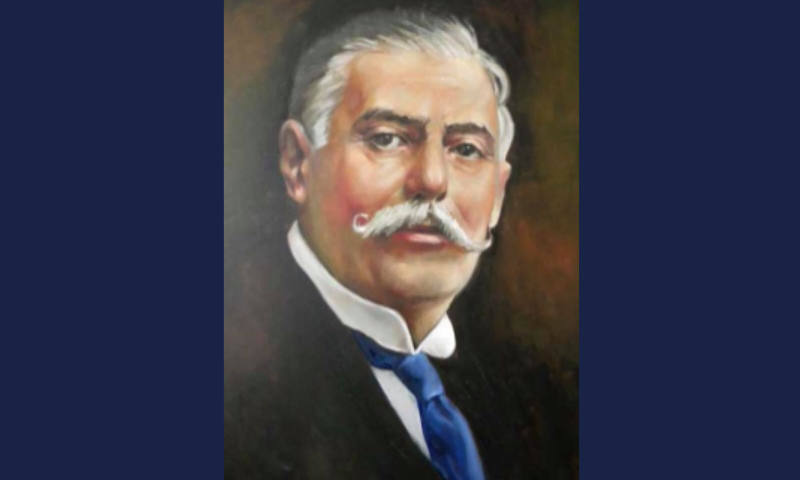
Mihran Damadyan was born in Constantinople in 1864. He was the fifth child of Serobe Damadyan.
For his primary education he attended the local S. Hagop and the Viennese Mkhitarist schools, and then his parents sent him to the Murad-Raphaelian school in Venice. The young Damadyan showed his abilities early on, signing literary articles in the school’s “Pazmaveb”. His first poems were published in 1878.
In Venice, while a student of Alishan, he first learned about the essence of the Armenian Question, and together with his classmates they began to take an interest in that question.
In 1880, when Damadyan graduated from the school, he returned to Constantinople. Having become aware of the sad developments that had taken place at the Congress of Berlin, the Armenian Question fermented within him all the more.
In Constantinople, Damadyan held teaching posts until 1883, also serving for a brief intervening period in Adana.
The Armenian United Society, whose founders were Mkrtich Portugalian and Arpiar Arpiarian, had already opened a number of schools in various provinces of Western Armenia. Their aim was to ensure the intellectual development of the Armenian youth, while at the same time tempering him with liberational aspirations.
One of the United Society’s important schools was the Nersisian school of Mush, to whose superintendency Damadyan was called in 1884. There, Damadyan had the opportunity to meet the first Vanetsi teacher, Hayrapet Janigian, who was later to become the founder of the Mush branch of the Armenakan Party.
Damadyan’s gradually developing liberational ideology took on new content in Mush, and a desire awoke in him to visit Van with Janigian, where the United’s leading school — the Van Varjabedanots — had, under Portugalian’s inspiration, become a furnace of liberational spirit for Vasbouragan.
Shortly afterwards, Damadyan, who constantly received information from his brother living in Constantinople about the important events agitating Turkish-Armenians, gained in Mush the reputation of a sought-after intellectual and, impelled by various incidents occurring in the region, adopted a revolutionary comportment. Thus, in 1886, together with Janigian and the local prelacy’s secretary, Kegham Der Garabedian, he laid the foundation of a secret organisation.
This Mush organisation had a pledge of secrecy. Its members, apart from those who enrolled them, were to be unknown to one another. Great enthusiasm had been created among the locals towards the organisation, and the number of those wishing to enrol was large. The initiators, bewildered by this reception and fearing that it would be difficult to keep a large organisation secret, temporarily suspended the admission of new members in order to organise internally.
Those envious of Damadyan’s rising fame resorted to betrayal. In 1888, Damadyan was forced to leave the Nersisian School and return to Constantinople to teach at the Ortakeuy Catholic school.
After rejoining his family, Damadyan observed that in the passing few years much had changed in Constantinople’s Armenian community, and the solution of the Armenian Question seemed to have receded from becoming a reality.
The Van and Daron incidents had begun to find a bad echo among Constantinople-Armenians. It seemed to Damadyan that the cause was the Patriarchate and the National Administration. He was convinced that the great revolutionary movement had to begin from Constantinople and radiate towards the Armenian provinces.
It was during that period that Damadyan met Hambardzum Boyajian (Medzn Murad), and together they formed a group of like-minded men, which was joined by revolutionary youths settled in Constantinople from Western Armenia, through whom it would be possible to establish contact with the provincial regions groping in the dark.
In 1889, Damadyan and his associates decided to join the branch of the newly formed Hunchakian Party, yielding mainly to Murad’s insistence.
In 1890, the Kum Kapu demonstration took place, as a consequence of which a large number of Armenakan and Hunchakian youths were arrested. Damadyan managed to take refuge in Athens, and there, with the Greeks, he continued his revolutionary activity.
Within less than a year, under the false name Melkon Khurshid, he set out for Western Armenia. He first passed through the cities of Cilicia, where he became acquainted with the local situation, and then reached Sassoun, where he found fertile ground for rebellion, especially since a significant number of revolutionaries had gathered there. Shortly afterwards, however, as a result of betrayal, Damadyan was arrested by the Turkish government in 1893.
As a dangerous revolutionary he was taken to Constantinople. During the transfer he was wounded in the leg. After spending a year in a Constantinople prison, he managed to escape, and in 1895 he organised the Bab Ali demonstration. But a day before the demonstration, by the decision of his associates, he was sent to Bulgaria and Romania to expand party work there. This time it was the Romanian government that arrested him and sent him on his way to Constantinople. Thanks to his resourcefulness, he managed to escape once again and take refuge in Athens, finally leaving his birthplace.
In 1896, Damadyan left for London, as an advisory member of the Hunchakian Centre, and a contributor to the “Hunchak” newspaper. By then, the split among the party’s leaders had already erupted, over the Nazarbekians’ course and over socialism.
Preferring to stay away from the socialist idea, Damadyan joined Arpiarian and Mihran Svazlian, and with them and several other like-minded men formed the Reformed Hunchakian Party in London, becoming a member of its centre.
In 1898, we find Damadyan in Alexandria, where he tried to give impetus to the spread of the Reformed.
In 1900, having married, he decided to settle in Egypt and began working in the customs house as an accountant.
Disagreements that had erupted among the Reformed caused him to withdraw from party activity for a period, bringing his share of national service through writing articles.
In 1904, Damadyan took up the post of accountant in Alexandria for the Mantashef petroleum company, which he was to hold until 1917. In 1908, after the proclamation of the Turkish sham Constitution, on October 31, together with a group of like-minded men, Damadyan founded the Armenian Constitutional Ramgavar Party, around which had gathered members of the moderate wing of the Armenakan Party and the Reformed Hunchakian Party. The radical Reformed were to adopt the name Azadagan (Liberal). Among the founders of the Constitutionalists were also Vahan Tekeyan, Vahan Malezian and other distinguished intellectuals.
Mastering seven languages, Damadyan frequently travelled to the cities of the Middle East on business, among them Aleppo and Beirut. As much as possible he always gave of his time to national questions. He also visited various regions of Cilicia, laying the foundation of Ramgavar clubs.
In 1915, Damadyan became one of the founders of the Ramgavar official organ “Arev”, which is published to this day. In 1916, in Egypt, the foundation of the Armenian National Union was laid with Damadyan’s participation. The Union’s aim was to organise an Armenian volunteer movement. In this connection he left for Paris and met with the president of the National Delegation, Boghos Nubar. Then, together with the Hunchakian Sabah Gulian and the Dashnaktsakan Hanemian, they headed to the United States, where he formed an Armenian National Union, always with the aim of furthering the volunteer movement.
In 1917, Damadyan was sent to Italy, as representative of the National Delegation to the Italian government.
In 1918, when the Delegation of United Armenia was called to life, Damadyan was appointed plenipotentiary representative of Cilicia, as a person well acquainted with that region. In that capacity he went to Cilicia, with the mission of organising a general uprising, which the Allied powers were also to support. Damadyan succeeded in bringing together Armenians, Greeks, Assyrians and Arabs, and on August 4, 1920, thanks to his efforts, Cilicia was declared independent, with Damadyan as prime minister. But that dream and enthusiasm were not to have even a day’s life, because the French government’s machinations had halted the entry into Cilicia of General Andranik and Armenak Yegarian and paralysed the Armenian volunteers.
Damadyan remained blockaded for a year and in 1921 returned to Egypt. On October 1 of the same year, the founding assembly of the Armenian Democratic Liberal Party was convened in Constantinople. Damadyan was elected a member of the party’s centre and then its president.
In 1922, the Mantashef company sent him to Beirut to hold the post of director of the company. He remained there about eight years. During his stay in Lebanon he established a tobacco production factory in Beirut and became a force giving impetus to national life. It was there that he participated in the AGBU’s Armenian Youth Association and conceived the plan for the founding of the first Ramgavar Azadagan daily newspaper, which was later to be realised in 1937 with the coming into being of the “Zartonk” daily.
In 1936, Damadyan’s state of health worsened, and because of an operation he lost his right leg, wounded 43 years earlier.
Damadyan returned to Cairo, where he spent the last years of his life. His last national accomplishment was his participation in the creation of the Armenian National Foundation.
In 1945, in Cairo, this incomparable leader passed away — one of the most brilliant representatives of the intellectual and revolutionary figures devoted to our national liberational movement.