These days marking the anniversary of the Armenian Genocide once again stir extraordinary emotions within the inner world of every Armenian. On the other hand, for some time now, certain misguided currents of thought have been put into circulation, seeking to trip up and/or sap our national unity.
Presumably as the expression of an overall strategic plan, particularly in Turkey, newly emerged fermentations of “reflecting on the mistakes of the past” have begun to appear. A tangible number of persons influential over public opinion (university professors, journalists, writers, political figures) — to a greater or lesser degree — have for some time now,
been alluding to the importance of no longer denying the sad events of the past, of expressing sorrow over them, and of keeping the future free of rancour and hostile feelings. Perhaps some of these may be considered positive developments. There are, however, clear classifications of tendency, the main ones being the following.
a) It was a time of war. The Armenians, incited and instigated by Tsarist Russia, the enemy of Turkey, were organising armed rebellion or even a blow against the state (referring, of course, to our self-defence battles), during which it is obvious that there would be and there were deaths on both sides. The work carried out by foreign Christian missionaries, directly or indirectly, also caused polarisations and extremist sentiments to develop between the Muslim majority and the Christian Armenian minority, especially considering that, for the most part, the inhabitants of particularly the eastern regions of the country were illiterate and ignorant (referring especially to the Kurds). Inevitably, sad clashes occurred, during which Turks also died. The authorities, for the safety of the Armenians, relocated them to less dangerous regions of the Ottoman Empire (namely, the desert of Der Zor). It was a state of war; famine and epidemics had reached their peak. Under these harsh conditions, many people died. The situation is regrettable, but we must not allow the sad pages of history to fill us inappropriately with prejudices or hatred.
b) Historically, it has still not become clear, and therefore has not been defined, exactly what happened during that sorrowful period (there exist mutually contradictory viewpoints on both sides). Therefore, let historians study in detail, particularly, the Turkish archives (which have now already become available, thanks to the commendable goodwill of the Turkish authorities). And, ultimately, let the historians decide what magnitude the “sad incidents of the past” had and with what qualifications they should be defined.
c) What was committed was a horrible crime, a dreadful massacre. It is necessary to acknowledge this very painful reality and never forget it, so that such sorrowful events never happen again. It is not absolutely necessary to call the tragedy of 1915 a “genocide” (perhaps, in general, one should avoid that qualification, so as not to frighten off the Turks entirely). The essential thing is to recognise and accept that this tragic act took place. When that desired (mere) recognition is achieved, and everyone expresses their grief and sorrow over the calamitous event, then it will be possible to close forever that black page of history — so that, henceforth, looking back may finally cease and a new future may begin to be built. (Perhaps, too, in Van, or elsewhere, a memorial will be erected in memory of all — and not only Armenian — martyrs).
Before any other reflection, it must be noted that it is, of course, extremely disturbing that some of our compatriots, even prominent personalities, “liberally” adhere to this third “school” of thought, completely ignoring the weighty consequences of that stance or else feigning indifference towards them. What or what might be the motive(s) of such an inept positioning is not difficult to guess or surmise.
The hypotheses put forward by the first grouping of opinions are so absurd that it is absolutely not worth making any further reference to them.
As for the second: there is nothing that has not been historically clarified, and 105 years later it still does not lack study. Beginning with the official diplomatic dispatches of the then American ambassador to Turkey, Henry Morgenthau, as well as of the British ambassador Viscount Bryce, after numerous more than exhaustive historical studies drawn from British, German, Austrian, Russian and other state archives, nothing remains any longer in need of elucidation. Particularly the altered and distorted Turkish archives cannot shed new light on the undeniable and horrifying historical realities.
What was perpetrated against the Armenians by the Turkish authorities, beginning from April 1915, was a premeditated genocide pursuing clear political objectives. The bestial slaughter and mass deportation of our people were carried out in a pre-planned manner, so that, through the depopulation of our ancestral lands, it might be possible to realise an extremely nationalist political programme — the embodiment of the insane dream of a Pan-Turanian empire to be formed through the fusion of Turkic-speaking tribes.
Therefore, when referring to the genocide committed against the Armenians, expressing sorrow over the “past”, “bloody”, “sad”, “reprehensible” events, saying “would that they had never happened”, qualifying the tragic events even with “shameful” or heavier adjectives and characterising them as “yeghern” or “massacre” absolutely represent no value whatsoever, if that is all there is to be.
Reconciliation is a noble aspiration, desirable by every conscious person. But an indispensable precondition for reconciliation is that the perpetrator fully realise the wrong he has committed, acknowledge it with repentance, and above all consent to assume commensurate responsibility, so that it is guaranteed that the given wrong shall never be repeated.
Moreover. Genocide is the greatest criminal offence committed against all humanity, which cannot remain unpunished and must not remain so.
Therefore, redressing the historically extremely weighty wrong of the genocide automatically means not only acknowledging, in its full magnitude, the recognition of the enormous crime committed, but above all the commitment, in that regard, to all obligations without exception, making logically satisfactory reparations for our immense human loss, for the cultural wealth seized from us as a nation and irreversibly destroyed, as well as for our people’s losses of property, goods, assets and other losses of astronomical value, but particularly by returning our confiscated territories.
It would, of course, be difficult to the point of impossibility to accurately assess all Armenian losses. However, the international community has created — more or less — logical precedents, according to which, after certain study, it is possible to arrive at conclusions and formulations by means of which acceptable solutions may be found. In this case we have no alternative but to rely on such conclusions.
The Turkish state has taken from us and confiscated land of MORE than two hundred thousand square kilometres in area; that is, almost seven times larger than the present territory of the Republic of Armenia. It would, of course, be just for that whole to be returned to us. But realism dictates that we limit our appetites, so that our demand may seem not only logical and feasible, especially to foreigners, but also have a clear legal basis. It would, of course, not be right, at this juncture, to create a debate about the territories demanded and their borders. On the other hand, however, it would be wrong to have absolutely no orientation in this regard. It is already time that the preparation of a comprehensive dossier studied in this connection be begun. To that end, the Wilsonian Borders, that is, a territory of approximately 68,500 square kilometres, can probably present a land claim with a more than clear legal basis and entirely logical. In other words, approximately one third of the lands confiscated from us by the Turks.
As is known, after the end of the First World War, for the establishment of conditions re-establishing peace, the Treaty of Sevres was signed between the Allied Powers and Turkey, on 10 August 1920. It is also known that, according to Articles 89, 90 and 91 of the said treaty, the determination of the common borders of Armenia and Turkey was entrusted to the arbitration of the President of the United States, Woodrow Wilson. In the following few months, after study by experts, the said border delimitation was carried out, and on 22 November of the same year, that is, 1920, the map of Armenia with the “Wilsonian Borders” was published.
We know, of course, that this decision was never implemented. With an unforgivable naivety, with the help of the Soviet authorities who encouraged it and with the acquiescence of the French and the British, Kemalist Turkey succeeded in tearing up the Treaty of Sevres. The Armenian Question, too, after being dragged on for three more years, was settled by the Treaty of Lausanne signed on 24 July 1923. It is true that there recognition was granted to all the arrangements forcibly imposed by Turkey, which were accepted as an accomplished fact. But neither by the Treaty of Lausanne nor on any other occasion was the justice of the Sevres decision denied, the legality of the Armenians’ land claim contradicted, or objection raised that the Wilsonian Borders were not based on historical right. In other words, by the Treaty of Lausanne, although, in fact, a number of the decisions and arrangements of Sevres were erased, in any case the legal basis of our land claim was never undermined.
In conclusion, for our people, particularly the Western Armenian segment, the full assertion of all our just national rights is not only absolutely non-negotiable, but also an unbreakable obsession that must, necessarily and permanently, form part of the agendas of all kinds of consultations and negotiations without exception concerning the genocide.
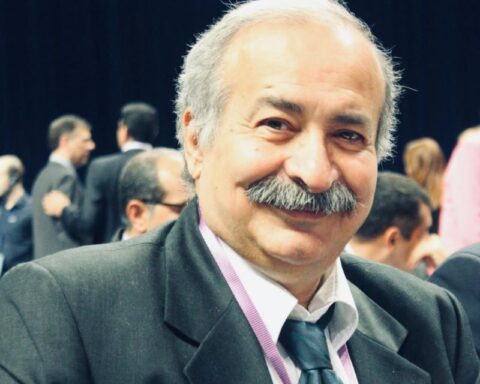
Asadur Devletyan
Nicosia, Cyprus