Turkey’s programmatic campaign to deny the veracity of the Armenian Genocide continues, erasing historical facts in the western expanse of the Armenian Highland, generally referred to as the region of Eastern and Central Turkey.
The destruction of Armenian historical monuments, which over the centuries have been pillars and sculptures.
Around 2,500 sites have been damaged by Turkey, while a great number of monasteries (200) and churches (1,600) have been demolished and reduced to ruins since the beginning of the 20th century.
-We include images of those monasteries and churches of historical importance, taken at the beginning of the 20th century, and their current state of ruin or rubble-
1 The Varagavank Monastery of Van, built in the 5th century AD; on the left, the monastery structure in 1900; on the right, the ruined remains in 2004:
2 The Lim-Anapat Monastery of Van, built in the 9th century; on the left, the monastery structure in 1900, and on the right, the ruined remains in 2004:
3 The Surb Karapet Monastery of Mush, with its walled structure, built in the 4th century AD; on the left, a photograph taken in 1900, and on the right, the remaining ruins photographed in 1970:
4 The Arakelots Monastery of Mush, built in the 5th century AD; in 1960 it was still standing, while a photograph taken in 2000 shows only a heap of stones at the monastery’s site:
5 The Monastery of Surb Krikor Lusavorich of Van, built in the 10th century AD; on the left, an image taken on the hillside in 1970, and on the right, the heap of stones remaining at the same site in 2004:
6 The Surb Hovhannes Monastery of Bagrevand, built in 631 AD; on the left, the monastery structure photographed in 1970, and on the right, in 2004, turned into steppe:
7 The monastery of Khtskonk (Ani region), built in the 10th century AD; on the left, the monastery structure photographed in 1970, and on the right, the 2004 photograph shows the ruin left of the structure on the rocks:
8 The monastery of Bagnayr (Kars region), built in the 11th century AD; on the left, the monastery structure photographed in 1960, and on the right, the 2004 photograph, the monastery in a state of ruin:
9 The Surb Bartoghimios Monastery of Vaspurakan, built in the 13th century; on the left, the monastery photographed in 1915, and on the right, its ruined state in 1960:
Ani, the city of 1001 churches (Khtsakh), which was the capital of the Bagratuni wealth, had become deserted and reduced to rubble after the successive invasions of the Seljuks and Mongols.
Below, the panorama shows the ruins remaining from the once beautiful city:
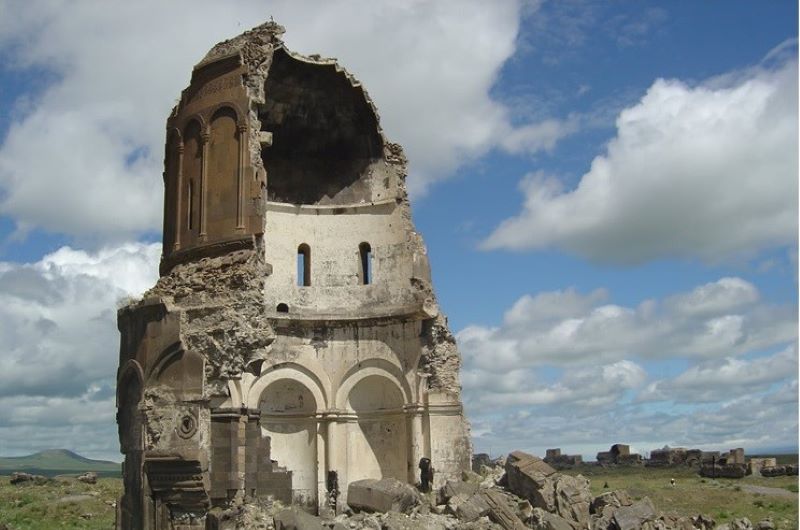
And the Surb Prkich (Holy Savior) Church, built in 1035, which stood as an architectural monument, lost the eastern side of its structure due to the fierce storm of 1955. And later, in the 1990s, the crosses and inscriptions on the walls of the remaining structure disappeared as a result of Turkish-style looting.
The important monasteries photographed in the territory of historical Armenia, placed above, which were standing at the beginning of the twentieth century, show in their current state of ruin and rubble the barbarism of the Turkish race, which continues to perpetrate cultural genocide against a civilized and creative people, annihilating its centuries-old history and the important architectural monuments built on its ancestral land, which had become the sturdy walls connected to the spiritual faith of the Armenian people.
It is beyond all doubt that only barbarism can aspire to planned annihilation, destroying the centuries-old spiritual and constructive culture of the Armenian people.
Prepared by: Ara Aharonian