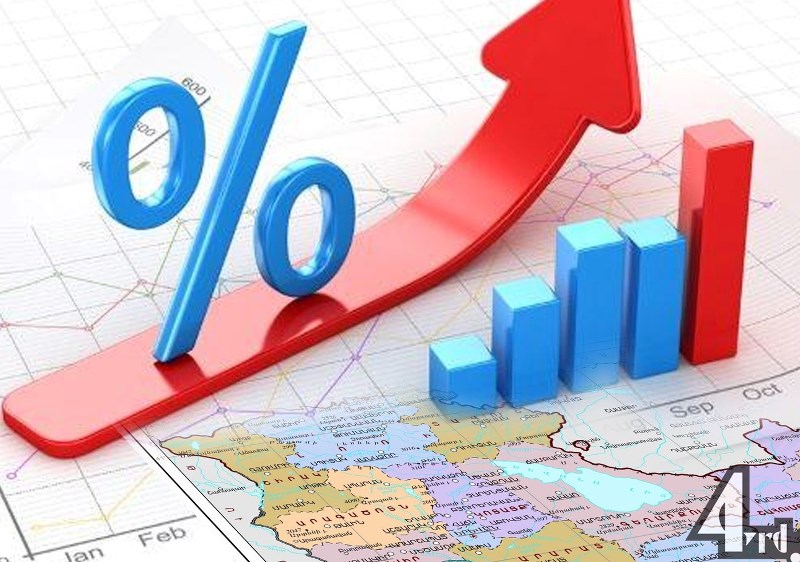
This year Armenia’s economic growth is expected to be higher than what is projected in the state budget, or what international financial institutions predicted at the beginning of the year.
According to Yulia Ustyugova, the Armenian representative of the International Monetary Fund, it is expected that Armenia will close the year with up to 7 percent economic growth, while in a conversation with “Azatutyun” today she recalled that as recently as April the Fund had predicted 4.6 percent annual economic growth.
“Our forecast for next year’s economic growth is largely identical to the Armenian government’s forecast. For this year we forecast 6.5-7 percent growth; for 2020 and the medium-term outlook we forecast growth in the range of 4.5 to 5 percent. I believe such a forecast is justified,” she said.
Ustyugova presented the reason that led to higher economic growth: “This year’s Armenian economic growth is more than we expected. Yes, over the past year we revised our forecasts because consumption, and especially private consumption, in Armenia was much more vigorous than we had predicted. Of course, it is positive that economic activity is growing, but it is not so good that the reason for such growth is consumption rather than investments, because it is investments that create the foundation for future growth. Therefore, the challenges remain: how to create stable, long-lasting economic growth, growth whose foundation is investments and exports, not consumption,” the IMF’s Armenian representative declared.
In response to “Azatutyun’s” question about how she explains the shortage of investors, she answered: “I think you will agree that last year Armenia was in a transitional phase. It was in a phase when the authorities were still working on strategies and priorities that would move the economy forward in the future. That is why investors have a wait-and-see approach. Some investors are rethinking their investments within the regional context.”
As for the state of the Armenian economy in the period following last year’s velvet revolution, Yulia Ustyugova noted that over the past two years the macroeconomic situation in Armenia has been stable, GDP has grown, inflation has been contained, the balance of payments has shown resilience, credit growth has contributed to economic activity, and tax revenues have increased.
According to Ustyugova, the tax reforms initiated by the Armenian government are capable of generating activity in small and medium-sized businesses. She noted that starting next year the tax burden in Armenia will be redistributed.