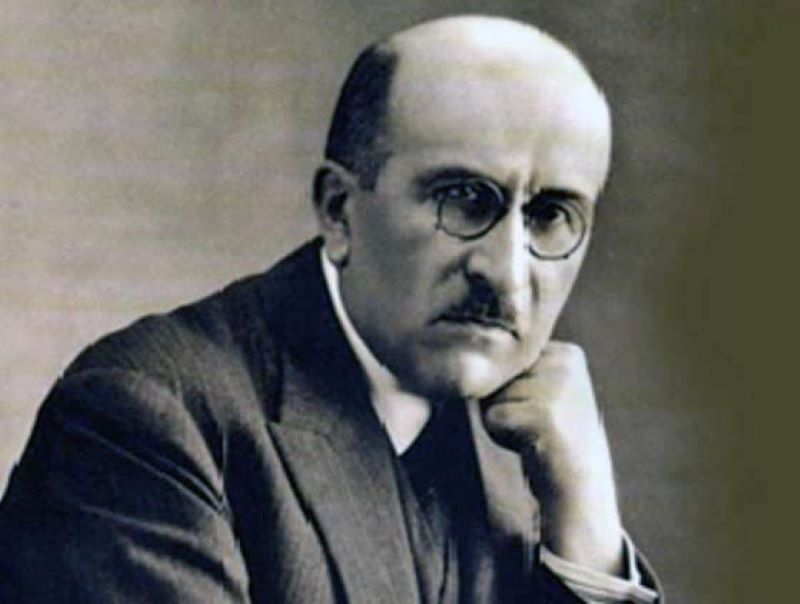
Today is the birthday of the great writer Vahan Tekeyan, who holds a unique place and tone in the rich world of Armenian literature. Born in Istanbul in 1878, Tekeyan died in Cairo, Egypt, on 4 April 1945, where the great intellectual’s ashes rest. His literary, pedagogical and journalistic life in Constantinople is well known, as is the fact that Tekeyan edited the combined daily newspaper «Zhoghovurti Tsayne-Zhamanak» in Constantinople for a period. Besides Constantinople, Tekeyan also lived in Europe and Cairo:
Regarding the last years of Tekeyan’s life in Cairo, the homeland literary scholar Artzrun Avagyan, one of the best interpreters of Tekeyan’s literature, published a noteworthy article, noting that in comparative terms, although Vahan Tekeyan lived longer than the other writers of our aesthetic generation of Western Armenian literature, a happy life was not allotted to him; moreover, every day he lived was full of many bitterness. The literary scholar Avagyan called Tekeyan’s life, especially its last years, tragic. He reminds that in a letter written to Mikayel Kurchyan in April 1940, Tekeyan noted with pain: «…My strength has waned, but I keep coming to the editorial office, because I must come and I must die in this bad weather, with bad assistants and in bad work…», and in a letter written in December of the following year, speaking of his «worse than bad» condition, he testified: «Yesterday evening when I left the editorial office, I stood for five minutes at the edge of the pavement, in the dark, not knowing where to go; how dark my thoughts were»:
Despite all that, Tekeyan continued to work, to create and, as the literary scholar Artzrun Avagyan reminds, despite his heavy condition, during that period he undertook to organise a fundraising drive to help Shahan Shahnur, who was in hospital, and to wage struggles in the national and party arenas.
«One of the expressions of the slight improvement in his condition was the opening in 1941 of the column titled “Amēnoṙay” (Daily) in the issues of “Arev”, which he called “the fruits of his second youth”. But no essential change was expected either in his economic or, especially, his health condition», writes Artzrun Avagyan in his article.
We present noteworthy excerpts from Artzrun Avagyan’s article titled «The Last Years of Vahan Tekeyan’s Life».
THE LAST YEARS OF HIS LIFE
In the spring of 1943, at the editorial office of «Arev», he had intestinal cramps and heart pains, and was taken to the French hospital, where he stayed for a few days. The writer already visits the editorial office frequently. He lives more «with the presence of yesterday against today», although he writes to one of his young correspondents (by the name of Fimi) that he still continues to «suffer alternately» with the past, the present and the future.
…Tekeyan’s days gradually became heavier and heavier, to which also contributed the difficult-to-bear hot and humid weather of Cairo, where he lived. In September 1943, Tekeyan went to Alexandria for a short time, whose seaside air had a restorative effect on his health, as a result of which he was not «very bad» — «while not being very good either», he expressed himself.
He participates in the organisational work of the «Armenian National Foundation», being created to support the preservation of Armenian identity among the Armenian diaspora. The writer is offered to take over the leadership of the educational council of the Armenian schools of Cairo, but he does not agree. The «atmosphere of Armenian life» in Egypt also does not make his days «breathable». Some of Tekeyan’s friends-companions also do not behave honourably. Soon he clashes with the management of «Arev» and some leaders of the party and ceases to contribute to the newspaper. He also withdraws from the Central Board of the Ramgavar Azadagan Party.
With the material support of Hrand Nasibyan, in 1943, Tekeyan’s collection of poems «Hayergutyun» (Armenian Songs) is published in Cairo. Because of the many difficulties life had raised, Tekeyan had not published a book for ten years. This 5th book of the writer aims to become a mirror of the path our people have traversed, to reflect its struggle for existence, its hope and faith, its losses and, especially, its human and national struggles…
…In the summer of 1944, Tekeyan visits Palestine. In Jerusalem, Jaffa and Haifa, meetings and gatherings are organised in his honour. The writer enjoys the company of H. Oshagan, Sh. Berberian and a group of his supporters; satisfied with those days he lived, he returns again to Cairo and leaves for Alexandria to be treated for asthma and hypertension. After an interruption of about a year, he resumes his heavy work at «Arev». Tekeyan was no longer like the former «newspaperman», nor did he «feel poetic surges under his chest» as before. Many thoughts and things to say were to remain «buried» in him forever. In a letter written at the end of October, he records: «Once upon a time there was an old man, whom they called a poet, and who, in the end, had come to love coming to the same conviction — but not without sadness, an old man, an old poet therefore, who shortly before reaching deep old age, perhaaps thanks to that conviction, would cast a reflection of the loves he had poured into his poems back upon himself, placing it in his gaze, his form and his voice — which, despite his being timid and fearful, were, more than reserved, almost hard and dry even during all his youth and adulthood»:
Thus, characterising himself and his poetry almost exhaustively from the distance of years, in the above lines Tekeyan repeatedly emphasises the boundless sadness that had accompanied him throughout his entire life.
The reasons for that sadness were various, among which Tekeyan’s surroundings and especially his allotted solitary life did not occupy a back seat: «It is difficult not to have a caretaker and a home, especially. Before, it was not like this at all. I lived in a family; whereas now I am only in a room, when I need rest and care more»:
Let us add that the «rooms» he always inhabited were «sepulchral», and the bread he ate was bitter, which is why, along with his tears, it was this condemnation that he swallowed and lived the remaining part of his allotted life «half in the state of a child and half in the state of an old man». Perhaps that is also why he often called himself «a cave», «a ruin», «a desert», a desert that, in his words, «became drier and more oppressive»:
Despite all this, Tekeyan always remained a devoted soul, believed that one must «cast aside thoughts and firmly… push forward the present small daily struggles, through whose victorious outcome tomorrow it will be possible… the great struggle…». During this period, Tekeyan prints in «Arev» several devastating unsigned editorials, one of which was «In response to the unnecessary clamour raised by the neighbours», referring to the organ of the opposing party of the Hunchakians, the newspaper «Yusaper», and frequently, as they also say, he soared in poetic worlds.
The only consolation becomes that, with the help of the patron of the previous book, the next collection, «Tagharan» (Book of Songs), comes into the world, whose preliminary titles — «Hogetun» (House of the Soul), «Verchin Luys» (Last Light), «Nor Ser» (New Love) — already suggested that in it the writer makes revelations of the diverse facets of human life and love.
1945 brought Tekeyan no poetic harvest, nor any restoration of health. In hot Egypt, where, in the words of H. Oshagan, «the mind slips», Tekeyan was «wasting away». He was wasting away in soul, in mind, but especially from the coldness emanating from his surroundings.
In the characterisation of Sh. Shahnur, that man, an «advocate of high morality», «always reserved», «hypersensitive», was forced to communicate daily with «marketplace people» who had no honesty or the soul of an intellectual. That noble man, who was also above his party comrades, as unhappy as he was in his personal life, was just as alone in his social environment.
At the beginning of 1945, Tekeyan has a pulmonary haemorrhage, begins to walk with difficulty, write with even greater difficulty, and even feels a weakness in reading. In March, Tekeyan is admitted to the French hospital in Cairo. The wounds on his hands and especially his lungs had reached an extremely bad state, the cough — now unbearable: «Am I to die suffering like this? If only there were an illness with such grace, that takes you away in a few days… but this!… ugh…»:
Soon the patient’s condition becomes so serious that the doctors advise speaking little, and more precisely demand «not speaking at all». Tekeyan was now a man confined to his bed, more alone than ever, and if we do not count his «accompanying» illnesses, he had no relatives beside him, no caring hands, and not even the pen that had so faithfully served his mind and hands for so many years. All that existed were a few supporters who visited for short times. The Lord was also absent. Tekeyan was now on his deathbed, to which he had been moved from the bed of his life’s pain. He was a helpless man, with his only one, which would soon no longer open. One of the last!… «Is your heart wasting away?» Armenian poet…:
Only one month before his death, Tekeyan cherished the thought that in the summer he would visit Jerusalem. He did not visit:
…With the poem «The Two Deaths» printed in his collection «Hrashali Harutyun» (Miraculous Resurrection) published in 1914, Tekeyan yearned for two kinds of his death: «to fade one evening» in a village hut, where «love prevails», or «to be carried to the fields of battle, vengeance-ablaze, fiery». But the accursed fate did not allow him to choose such an outcome, although his entire life differed little from a battlefield.
On 1 April 1945, which was the feast of Easter, the feast of salvation, peace and hopes, after examining the patient, wrapped in those same hopes but also filled with despair, the doctors conclude that «There is no hope». Already the first signs of death were appearing — the pallor of the face, irregular speech. The patient often asks for a moistened piece of cotton to be brought to his lips and whispers in a barely audible voice «shu…ush…», he even recited poetry: «It was my soul, you want my little soul… But my soul I will not give soon…». On 2 April, to provide more or less care, Tekeyan’s close friend, Doctor Shahen Sevyonkyan, moves the patient to his home, but a day later Tekeyan asks to be taken to his room in Heliopolis (Mikayel Kurchyan lived on the first floor), where a hired foreign (Austrian) nurse would care for him. Which dwelling place in the poet’s wandering life was that half-empty and comfortless room, no one can say, but it was the last one.
In one of his written poems, «Geghtskagan» (Rustic), Tekeyan dreamed of «…walking towards death little by little», but he did not make it wait too long. In the early morning of 4 April 1945, before dawn (at 4:30), in his small room, death, so «awaited» by the writer but never loved, visited him and… the light went out. That light, which throughout his life had always been a half-light and had opened for him very rarely.
Before his death, Tekeyan had asked for a «simple burial», «I do not want a ceremony, I do not want flowers. Oh… especially I do not want speeches». Not taking into account the writer’s wish, his remains were transferred the next day to the St. Gregory the Illuminator Church in Cairo. Among the mourners, close friends were few. The majority were those who had been indifferent and unconcerned towards Tekeyan when he was alive; there were even people whom the writer had never tolerated.
The funeral ceremony was restrained and simple; the prevailing element was pervasive silence. Tekeyan’s body was laid to rest in the Mar Mina cemetery in Cairo, near the graves of his unfortunate fellow writers Arp. Arpiaryan and Yer. Odyan. The new abode differed in nothing from his previous dwellings. It was just as dark and just as alone. Later, Tekeyan’s remains were transferred to the cemetery of Heliopolis, a suburb of Cairo, next to the grave of his friend-colleague Mihran Damadyan, where to this day they rest side by side…
One of the greats of Armenian literature departed from life — the helpless and abandoned Armenian writer. He who lived and expressed with his pen the glories and collapses of the Armenian man, who was a participant and one of the creators of the best creations of Western Armenian and Diaspora Armenian literatures, who devoted himself unreservedly to the golden visions of his people and recorded its «illuminated» struggles, one expression of which was his poem «Suetia».
Little villages, you have grown,
Immensely you have grown —
When you had no inhabitants…
And your Mountain grew,
The unknown misty Mountain
Became bright, became Armenian!…
Throughout his entire life, Tekeyan had no home; he was his own home. He had no family; he was his own family. He had no child; he was his own child — with the three poems titled «My Child» placed in his three books — and always remained the «old boy», that child who, as he wrote in his article about his mother printed in the «Arev» newspaper of 18 January 1927, became «a youth» at once, a youth with strange emotions, who was to be as strange a boy as he was also a prematurely aged man.
He lost his birthplace and his homeland and remained an intellectual yearning for consolation and comfort, a man yearning to be loved, who sometimes loved but was loved by no one, and it is those great losses of his that he sang in his works and proved with his entire life through the first line of a poem written in 1925.
«From the day I was born until now, my Homeland is with me
Everywhere, every year…»:
His lost and «losing» homeland.
My homeland, ah, how it betrayed me, deceived me…
Sometimes I demand from it the account of my boundless love,
Of my wasted vigour, of my shattered dream,
And sometimes, with my hands covering my face, I weep with a hopeless cry,
Begging it to live, no matter that it has killed me… («Mut Zhamer» — Dark Hours).
Tekeyan also bore on his shoulders the weight of the half-finished work of the martyred Armenian fellow writers and, with his entire life, became the eternal symbol of all times of those who became homeless in the diaspora:
On boards, dry, under roofs, in the cold
Now freezing side by side, the orphan hands of Armenian orphans… («The Hands of the Orphans»)
He — the man with a troubled soul and an always sad face — the eternally present Vahan Tekeyan of Armenian literature, whose life and work can perhaps be characterised in two words: struggle and decline. Neither life, nor love, nor happiness — this was said precisely for him. Nevertheless, Tekeyan was happy. Happy that he was a poet; more precisely, Tekeyan was a poet and precisely for that reason he was happy. A way out, a way out at any cost: this was the supreme task of Tekeyan the thinker and the artist and became the meaning of his life, which aimed to help the Armenian man, so that he would not remain alone with his pains.
«He was a night-travelling wayfarer, on an uncertain path. He was a golden-lettered passport, albeit torn», wrote Sh. Shahnur about him and added: «…Tekeyan had placed a stone on his heart and with it measured the bottomless tragedy of the Armenian». And indeed, Tekeyan carried within himself all the suffering of his nation, and whatever he wrote about himself, it equally concerned his suffering people.
A nation fallen into the abyss, drowning in the abyss.
The poet of harmonies, in the words of K. Zaryan, «one of the most precious faces of Armenian literature», in the characterisation of Levon Zaven Surmelyan, «the prince of Armenian poetry», in the words of A. Chobanyan, «the profound-thinking poet», embodied in himself the tragic fate of the Western Armenian and Diaspora Armenian intellectual and, through that fate, affirmed the Armenian man’s determination to survive.
Poet, prose writer (novel, stories, chronicles, memoirs), playwright (he had planned to write a verse drama), satirist, editor, literary critic, publicist, party and public figure, teacher, translator, letter-writer (most of which have cognitive, historical and literary value), deputy and benefactor Vahan Tekeyan managed to print six books. Several of his works were published posthumously — the diary-travelogue «Kesaria», «Yergu Draghtnere» (The Two Paradises), which contains part of his articles, some works published in the six-volume set of the «Tekeyan Fund Committee» of Cairo (15 volumes were planned), including the novel «Yete Dere Gamenay» (If the Lord Wills), «Hovhar Hokvoy» (Fan of the Soul) (prose and verse satire) and others, but to this day works scattered in various press organs (fictional and non-fictional) await separate publication.
There is and always will be the recognisable Tekeyan — the writer, the man and the figure, for whom the most precise characterisation was given by himself — «My Only One», whose poetic height, unfortunately, was not surpassed by any Diaspora Armenian poet.
Considering the entire course of the life allotted to him, in one of his poems («April te voch, yerazel» — To Live or Not, to Dream) he wrote: «We took no dream from life, and from the dream we took no life…»:
In that crucible of the unattainable dream and the longed-for life, the great poet lived and created, and from his distance-nearness, with the literature he created, addressed his contemporaries and all the newcomers, saying: «This story, which is mine and which is yours at the same time»:
Anush Truants
«Zhamanak»/Constantinople
January 21, 2021